
Fitness coaching success: 2026’s top industry trends
TL;DR:
- The fitness coaching industry is growing rapidly with over 728,000 businesses globally and $12 billion in revenue.
- Hybrid models, niche specialization, and technology integration are key drivers of success in 2026.
- Balancing automation with personal coaching maintains client trust and sustains competitive advantage.
The fitness coaching industry is not standing still, and neither should you. While some coaches are waiting for things to settle, the most successful ones are already adopting the strategies and tools that will define the next few years. The personal training market now spans over 728,000 businesses globally, generates more than $12 billion in revenue, and supports full-time coaches earning anywhere from $50,000 to $150,000 or more annually. What’s driving this growth? Hybrid models, emerging client niches, and smarter use of technology. This article breaks down exactly what’s changing in 2026 and how you can use these shifts to grow your client base and income.
Table of Contents
- Market overview: The state of fitness coaching in 2026
- Technology’s impact: AI, digital tools, and the evolving coach-client experience
- Business models on the rise: Hybrid, semi-private, and specialized niches
- Action steps: How to capitalize on 2026 trends for business growth
- Perspective: Why success in 2026 means blending tech and personal touch
- Boost your coaching business with the latest tools
- Frequently asked questions
Key Takeaways
Market overview: The state of fitness coaching in 2026
If you’ve ever wondered whether personal training is a safe career bet, the numbers answer that question clearly. According to the Personal Training Industry Report, the industry has shown remarkable resilience even during economic downturns. Fitness remains a consistent priority for a large portion of the population, which gives coaches a stable foundation to build on.
Here’s a quick snapshot of where the industry stands right now:
This isn’t just growth for growth’s sake. Coaches who understand personal training health benefits and communicate them effectively are converting more leads because clients increasingly see training as preventive healthcare rather than a luxury.
“The fitness industry’s recession-resistant nature stems from a simple truth: people prioritize health when times get tough, not just when times are good.”
So what are the main drivers pulling this industry forward? Three stand out:
- Hybrid service models that serve both in-person and remote clients
- Semi-private training that increases revenue per session without adding hours
- Niche specialization in high-demand populations like active aging adults and GLP-1 medication users
The biggest challenge coaches face is not a lack of opportunity. It’s knowing how to position their services to capture that opportunity. Coaches who invest in trainer business growth strategies and stay current with market trends are turning these challenges into competitive advantages.
With the groundwork set, the next section explores how technology is transforming everyday coaching.
Technology’s impact: AI, digital tools, and the evolving coach-client experience
Technology is no longer optional for fitness coaches. It’s become the difference between a practice that runs you and one you actually control. AI-powered tools are now handling everything from program design to client check-ins, freeing up hours every week for the work that actually requires your expertise.
Here’s how three service delivery models stack up in 2026:
The hybrid training model is winning because it captures the best of both worlds: personal connection for clients who want it and scalable reach for coaches who need it.
Here’s how to integrate new technology into your coaching business without losing your mind:
The business tools for trainers that perform best are the ones that reduce repetition while keeping the coach clearly in the driver’s seat. Even personalized swim coaching demonstrates that individualized feedback always outperforms generic programming, regardless of the sport.
Pro Tip
Do not automate emotional check-ins, progress celebrations, or conversations around setbacks. These moments are where client loyalty is built. Let technology handle scheduling and reminders, but keep the human connection in your hands. See how technology in personal training can enhance rather than replace your coaching presence.
Now that we’ve covered technology’s role, let’s examine how fitness business models are adapting in 2026.
Business models on the rise: Hybrid, semi-private, and specialized niches
Not every business model works equally well for every coach. But in 2026, the most profitable structures share a common trait: they scale without demanding more hours.
Here’s how the three leading models break down:
- In-person training: High client satisfaction and relationship depth, but capped by the number of sessions you can physically deliver.
- Online coaching: Unlimited geographic reach, lower overhead, but requires strong digital communication skills and systems.
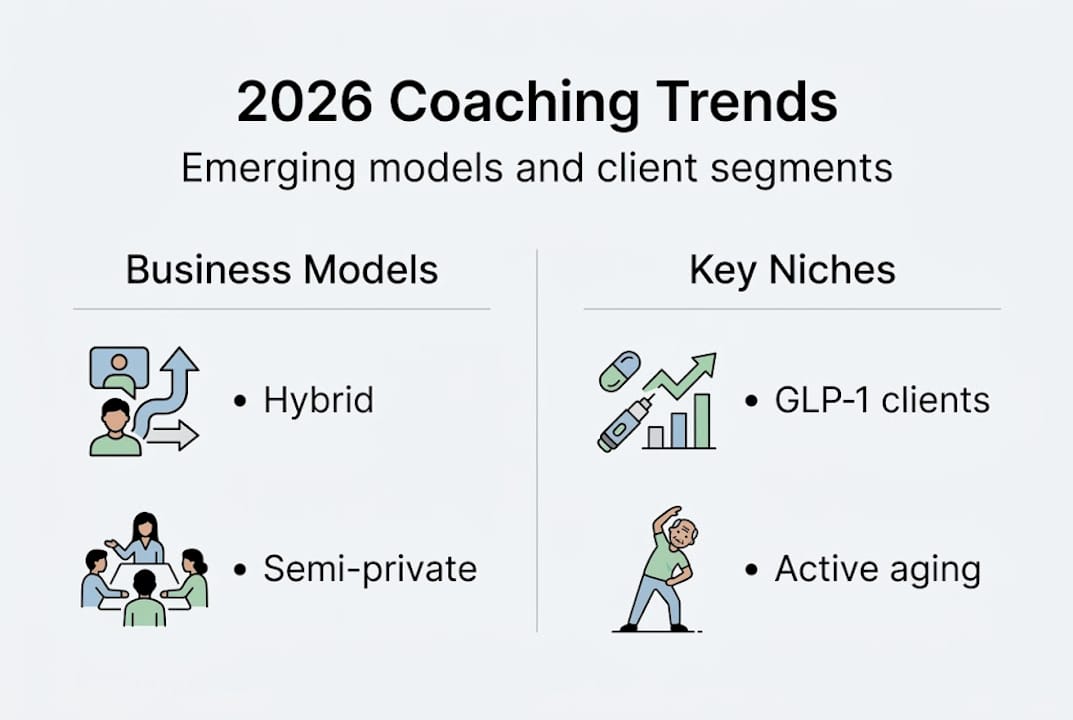
- Hybrid coaching: Combines both, giving clients flexibility and giving you a scalable revenue structure. This model requires solid top fitness business models thinking to price and package well.
Semi-private training is quickly becoming a standout. Instead of one coach to one client, you work with two to four clients simultaneously at a premium group rate. Your hourly revenue increases while clients benefit from a lower price point and some community accountability.

Statistic callout: Emerging niches like GLP-1 clients and active aging populations are among the fastest-growing segments in the industry right now.
GLP-1 clients (people using medications like Ozempic or Wegovy) need specialized programming to preserve muscle mass during weight loss. Active aging clients (typically 55 and older) prioritize mobility, balance, and functional strength. Both groups are underserved by general fitness offerings. Both are willing to invest in specialized expertise.
Optimizing your hybrid training model and pairing it with niche knowledge gives you a strong differentiator in a crowded market. Even workflow decisions matter here. Coaches who streamline their training workflow optimization serve more clients with less friction.
Pro Tip
Niching down does not mean turning clients away. It means marketing more precisely to the clients who are the best fit for your expertise. Your general clients can stay. Your niche just makes you easier to find and refer.
Having understood which models work, we now focus on actionable strategies for fitness coaches to leverage these trends.
Action steps: How to capitalize on 2026 trends for business growth
Knowing the trends is step one. Applying them to your business is where growth actually happens. Here’s a practical roadmap:
“The personal training market supports over 728,000 businesses globally and generates more than $12 billion in revenue, yet most individual coaches are only scratching the surface of their earning potential.” — Personal Training Industry Report
Solo coaches often feel like they need a large team to scale. They don’t. The right combination of a clear niche, a scalable model, and a few well-chosen automation tools can significantly change your revenue without burning you out. Focus your growth strategies for trainers on the levers that move the needle fastest: retention, referrals, and packaging.
Quick wins you can apply this week: update your intake form to include niche-specific questions, add a group option to your existing offerings, and set up one automated follow-up sequence for leads who haven’t converted yet.
To wrap up, here’s a candid perspective based on what works and what most trend articles completely overlook.
Perspective: Why success in 2026 means blending tech and personal touch
Here’s something most trend roundups won’t tell you: the coaches who are winning aren’t the ones with the most sophisticated tech stack. They’re the ones who use technology as a support structure, not a substitute for real coaching.
Automation is genuinely powerful. It saves time, reduces errors, and improves consistency. But when every client interaction gets filtered through an app, something important disappears. Clients stay with coaches they trust, and trust is built in the moments between the workouts. A birthday message you typed yourself hits differently than a scheduled automation.
The risk of over-investing in tools is that you start to sound like every other coach. Your unique perspective, your coaching style, your ability to read a client’s energy on a hard week, these things cannot be replicated by software. Learn more about balancing tech and coaching to keep your identity central as your systems grow.
The coaches who lead in 2026 will be the ones who let automation handle the repetitive and let themselves handle the irreplaceable.
Boost your coaching business with the latest tools
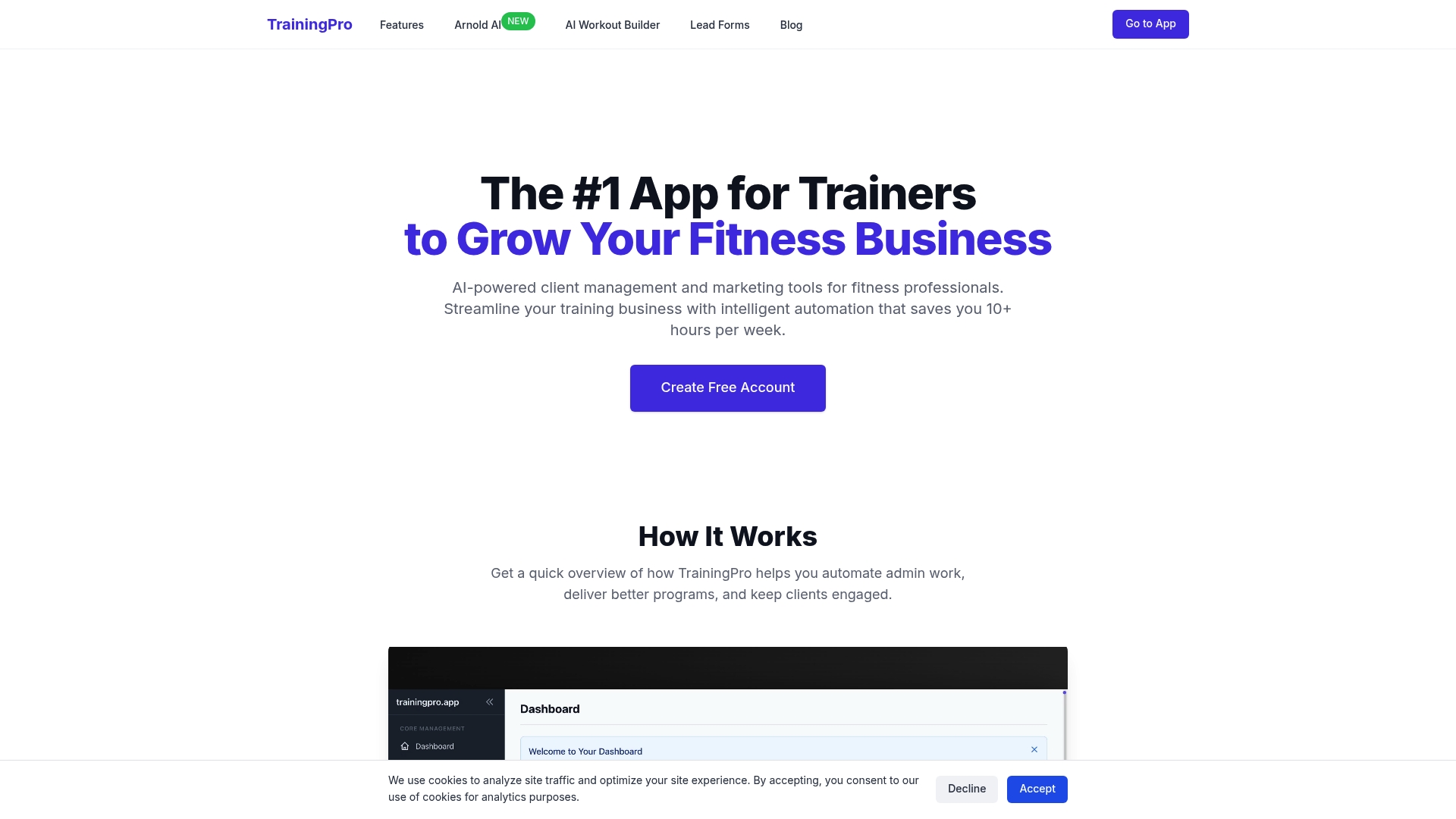
TrainingPro is built specifically for fitness professionals who want to grow without the operational chaos. From the AI workout builder that creates personalized programs in minutes, to the Arnold AI assistant that factors in injuries, training styles, and individual goals, the platform handles the heavy lifting so you can focus on coaching. Explore everything TrainingPro for trainers offers and see how it fits into your 2026 growth plan.
Ready to Transform Your Fitness Business?
Join thousands of trainers using TrainingPro to automate admin, grow their client base, and focus on what they love—coaching.
Start your 14-day free trial • Cancel anytime
Frequently asked questions
The leading trends include AI-driven coaching tools, hybrid service models, niche client segments like GLP-1 and active aging, and digital platforms that improve client engagement and retention.
Adopting hybrid or semi-private training structures, using automation to reduce admin time, and targeting high-demand niches are the most direct paths to increasing your income this year.
A hybrid coaching model combines in-person sessions with online programming and communication, giving coaches a broader client reach and more scheduling flexibility.
Emerging niches like serving GLP-1 medication users, active aging populations, and post-rehab clients are growing rapidly as demand for specialized coaching increases.
Absolutely. Full-time coaches are earning $50K to $150K+ annually, and the global market continues to grow across both in-person and digital channels.


