
Top workout tracking features for engaged clients in 2026
Choosing the right workout tracking features feels straightforward until you’re staring at a dozen apps, each promising to transform your client results. The reality is that most trainers spend more time comparing options than actually using them, and that delay costs you client engagement and program momentum. Whether you manage five clients or fifty, the features you prioritize directly shape how well you can personalize programs, catch plateaus early, and keep clients motivated. This guide breaks down the most valuable tracking features, compares leading apps side by side, and gives you a clear framework to match tools to your actual coaching workflow.
Key Takeaways
How to evaluate workout tracking features
Before you commit to any platform, you need a clear set of criteria. Not all tracking features deliver equal value, and the wrong priorities can slow down your sessions rather than support them.
Here’s what genuinely matters when evaluating workout tracking tools:
- Logging speed: Can a client log a set in under two taps mid-workout? Slow logging breaks session flow and reduces compliance.
- Progress analytics: Does the app show trends over weeks and months, not just today’s numbers? Depth matters for spotting plateaus.
- Recovery and fatigue data: Can you see when a client is accumulating too much volume before they break down?
- AI and automation: Does the platform suggest progressive overload adjustments based on actual logged data?
- Custom exercises and modifications: Can you add client-specific movements, substitutions, and injury notes without workarounds?
As fast logging and recovery tracking are expert-level priorities over just PR tracking, your evaluation should weight these above surface-level features like leaderboards or social sharing.
Pro Tip
Test any app’s set logging flow during a real workout before committing. If it takes more than two taps to log a set, your clients will stop using it within two weeks.
When you track fitness progress consistently, client retention improves because people can see their own momentum. That visibility is what keeps them engaged between sessions.
Hevy: Comprehensive workout logs and visual progress
Hevy is one of the most widely used tracking apps for a reason. Its feature set covers the full picture of client progress, not just raw strength numbers.
Hevy’s progress tracking features include monthly reports, muscle group charts, sets per muscle per week, body measurements, progress photos, workout consistency streaks, and year-in-review summaries. That’s a lot of data in one place, and it’s presented visually in a way clients actually understand.
Key features that stand out for trainers:
- Muscle group volume charts show weekly training distribution at a glance, making it easy to spot imbalances.
- Consistency streaks give clients a behavioral nudge to stay on track without you having to chase them.
- Progress photos paired with body stats create a holistic view that goes beyond the scale.
- Warm-up automation and RPE logging speed up session setup and add autoregulation data.
- PR notifications keep clients motivated with real-time wins.
12M+ users rely on Hevy’s tracking features, making it one of the most battle-tested platforms available for fitness professionals.
For trainers managing clients through mobile wellness apps, Hevy’s visual reporting makes it easy to share progress updates that feel meaningful, not just like spreadsheet exports.
Caliber: Analytics-driven gym tracking and performance tools
While Hevy excels in visual and holistic progress, Caliber’s deep-dive analytics can take client programming closer to peak performance. It’s built for trainers who want data precision, not just data volume.
Caliber provides advanced gym tracking with fast logging, exercise history view, automatic rest timers, detailed exercise instructions and videos, and progress analytics like strength score by muscle group, strength balance charts, 1RM estimates, and body stats tracking.
What makes Caliber particularly useful for professional trainers:
- Strength score by muscle group gives you a normalized view of where each client is strong and where they lag.
- Strength balance charts flag asymmetries before they become injuries.
- Exercise instruction videos improve remote client compliance without requiring constant check-ins.
- Automatic rest timers keep sessions structured and reduce dead time.
- 1RM estimates update automatically as clients log, giving you real-time programming data.
Pro Tip
Use Caliber’s 1RM and balance charts together when designing a new training block. If a client’s push-to-pull ratio is off, you’ll see it immediately and can adjust before it becomes a problem.
Caliber fits naturally into a workflow built around fitness software and AI tools because its analytics output is clean enough to act on without hours of interpretation.
Slate: Leading in muscle recovery intelligence and fast-tracking
If analytics and visuals aren’t enough, muscle strain and recovery data provide safeguards against costly plateaus or injuries. Slate is the standout here.
Slate excels in muscle strain and recovery tracking post-workout, fast set logging, advanced analytics like volume trends and 1RM progression, and benchmarks against strength standards.
Here’s what sets Slate apart for trainers managing high-volume or injury-prone clients:
- Per-muscle recovery logs show which muscle groups are still fatigued before the next session.
- Volume trend analytics make it easy to see when a client is approaching overreaching territory.
- Sub-2-tap set logging means clients can record data mid-set without losing focus.
- Strength benchmarks contextualize a client’s numbers against population standards, which is motivating and informative.
“Per-muscle recovery insight is a game-changer for client safety. Knowing a client’s hamstrings haven’t recovered before a heavy deadlift day prevents injuries that would set them back weeks.”
For trainers who need to make program adjustments for injuries, Slate’s recovery data gives you the evidence to justify those changes to clients rather than relying on gut feel alone.
AI-powered progressive overload: Alpha Progression, Jefit, and beyond
Technology takes recovery and analytics further. Here’s how AI automates gains while raising new questions for hands-on coaches.
Alpha Progression uses research-backed volume recommendations and AI for customized plans, while Jefit employs an AI-powered progressive overload system. Both aim to remove the guesswork from load progression.
What AI-driven overload engines actually do:
- Automated volume and load adjustments prevent stalling for intermediate clients who plateau on linear progression.
- Custom plan generation based on logged data, research models, and EMG-informed exercise selection.
- Adaptive deload suggestions when fatigue markers spike.
The honest caveat: some trainers find AI suggestions unpredictable, particularly for advanced clients with complex histories. The data models work best with consistent logging and relatively straightforward programming goals.
Pro Tip
Treat AI overload suggestions as a starting point, not a final answer. Review the recommendations weekly and override them when client feedback or recovery data tells a different story. Pair AI workout builder features with your own expertise for the best outcomes.
Advanced features for custom, flexible client programs
With the core and advanced features mapped, trainers need to know which edge-case capabilities separate good apps from great ones.
Edge cases handled by top apps include exercise substitutions, supersets, RPE and RIR autoregulation, injury modifications, and per-muscle recovery tracking. These aren’t extras. For experienced trainers, they’re essentials.
Here are the advanced features worth prioritizing:
- Exercise substitutions with client notes so you can document why a swap was made and reference it later.
- RPE and RIR logging integrated directly into set tracking for autoregulation without extra steps.
- Superset and circuit support with accurate rest timer management across paired exercises.
- Custom exercise templates that let you build movements not in the default library.
- Injury modification flows that flag affected muscle groups and suggest alternatives automatically.
“The difference between a good tracker and a great one is whether it handles your most complicated client as smoothly as your simplest one.”
For a broader look at what separates platforms, check out the best training software features available in 2026.
Comparison table: Which workout tracking features stand out?
To help you synthesize all of this, here’s a clear table to benchmark what’s best for your coaching style.
This table gives you a fast read on where each app leads and where it falls short. No single app wins every category, which is why matching features to your specific client mix matters more than chasing the “best” app overall. For a broader look at personal trainer app options, the landscape in 2026 offers more specialized tools than ever.
Which features are best for your clients? Practical recommendations
Armed with both details and summary, you can now align tracking features with client needs and your training workflow.
Manual overload trackers like Hevy and Strong suit experienced lifters who want control, while AI-automated platforms prevent stalls for intermediates through data-driven adjustments. That distinction should drive your choice.
Here’s a quick match guide:
- Hands-on, in-person trainers with experienced clients: Hevy or Strong for visual tracking and manual control.
- Remote or data-driven coaches managing compliance from a distance: Caliber or Slate for analytics, benchmarks, and recovery monitoring.
- Trainers focused on intermediate client growth: Alpha Progression or Jefit for AI-driven overload that prevents the most common plateau.
- High-volume practices with diverse client needs: Look for platforms that combine fast logging, custom exercises, and injury modification in one place.
When you prioritize tracking progress for engagement, the right feature set becomes a retention tool, not just a data collection exercise. Clients who see their progress stay. Clients who don’t, leave.
Ready to implement advanced workout tracking?
With your feature priorities defined, you’re one step away from integrating next-level tracking into your business. TrainingPro brings together the capabilities you’ve been comparing across multiple apps into a single platform built specifically for fitness professionals.
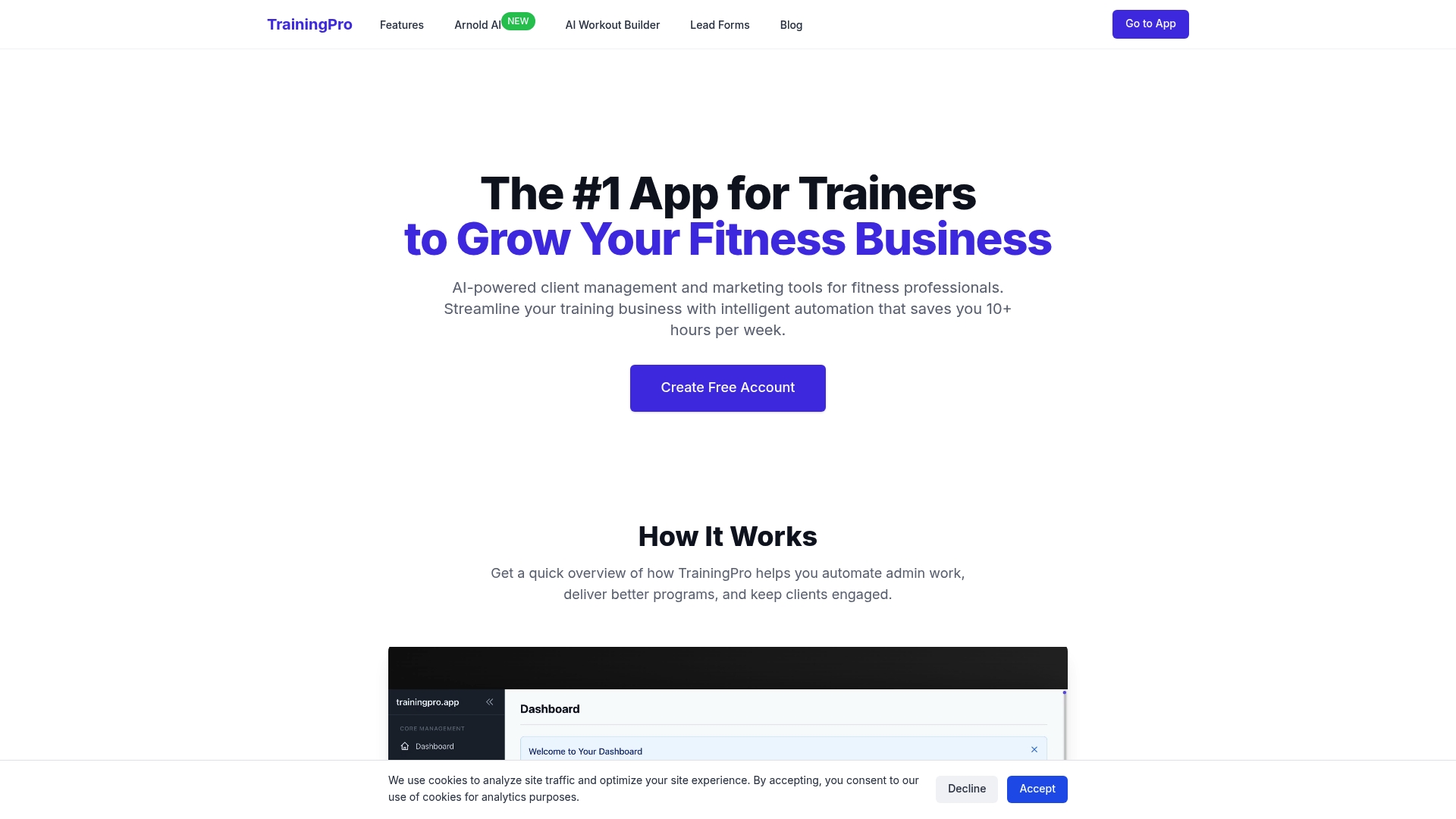
The custom AI workout builder generates personalized programs based on each client’s goals, injuries, and training history, so you spend less time building and more time coaching. The Arnold AI Assistant handles program modifications, client communication, and progressive overload suggestions automatically. And because TrainingPro runs as a Progressive Web App, your clients access everything without downloading a thing. If you’re ready to stop juggling tools and start running a more efficient practice, TrainingPro is built for exactly that.
Frequently asked questions
Fast logging and recovery tracking are expert-level priorities, along with progress analytics and flexible program adjustment tools that support effective client management without slowing down sessions.
AI-automated platforms adjust volume and load based on real logged data, preventing plateaus for intermediate clients and reducing the manual programming burden on trainers.
Yes. Top apps offer recovery monitoring and injury modifications through client notes and per-muscle fatigue tracking, giving trainers early warning signals before overtraining becomes a setback.
Caliber and Slate lead for remote and data-driven clients, offering robust analytics, compliance tools, and recovery intelligence that keep online coaching structured and accountable.
Recommended
- Why track fitness progress: boost client engagement | TrainingPro
- Boost client retention in personal training: 2026 strategies | TrainingPro
- Maximize client engagement with mobile wellness apps | TrainingPro
- How to create workout programs fast using AI in 2026 | TrainingPro
Ready to Transform Your Fitness Business?
Join thousands of trainers using TrainingPro to automate admin, grow their client base, and focus on what they love—coaching.
Start your 14-day free trial • Cancel anytime


