
Unlock the benefits of training program software for fitness pros

TL;DR
- Software streamlines operations but cannot replace the motivational and technical aspects of hands-on coaching.
- Combining software automation with human oversight enhances client adherence and business growth.
- Effective integration involves assessing needs, selecting relevant features, and maintaining personal client relationships.
Many fitness professionals assume that adopting the right software will automatically produce better client results. That belief is understandable, but it misses something critical. The trainers who get the most from technology aren’t the ones who automate everything. They’re the ones who know exactly where software helps and where it falls short. This article breaks down what training program software actually does, where it adds real value for your business, and how to blend it with hands-on coaching so you get the best of both worlds. Whether you’re just starting to explore digital tools or looking to refine your current setup, you’ll find a practical framework here.
Table of Contents
- What training program software actually does
- Key benefits for fitness professionals
- Limitations and expert nuances—why software isn't a silver bullet
- Best practices for integrating software into your coaching
- Why human connection still drives client results—even in a software-powered world
- Supercharge your fitness business with leading-edge training software
- Frequently asked questions
Key Takeaways
| Point | Details |
|---|---|
| Powerful automation | Training program software automates client management, scheduling, and marketing for boosted efficiency. |
| Hybrid models win | Combining software and human oversight yields the best results, driving higher client motivation and adherence. |
| Limits and pitfalls | Software can’t fully replace a trainer’s motivational role or handle complex, special-case clients alone. |
| Implementation matters | Strategic integration and ongoing refinement are key to getting the most value from your training software. |
| Human connection counts | Genuine client relationships, amplified by software, remain the foundation for long-term success. |
What training program software actually does
Now that we’ve dispelled some myths, let’s get specific about what training program software really offers and where it stops.
At its core, training program software handles the operational layer of your business. Think of it as the engine running in the background while you focus on coaching. The major functions include:
- Program design: Build, template, and assign workouts quickly, with options to customize by client goal, fitness level, or injury history.
- Client management: Store client profiles, track progress, and manage scheduling in one place.
- Communication: Send automated check-ins, reminders, and feedback prompts without lifting a finger.
- Progress tracking: Log metrics like body composition, strength benchmarks, and session attendance over time.
- Marketing automation: Capture leads, nurture prospects, and re-engage inactive clients through automated sequences.
When you look at software and AI tools side by side with manual methods, the difference in efficiency is hard to ignore. Research on software impact on training outcomes confirms that platforms reduce administrative load significantly, freeing trainers to spend more time on actual coaching.
| Task | Manual method | With software |
|---|---|---|
| Program creation | 30-60 min per client | 5-15 min with templates |
| Progress tracking | Spreadsheets, error-prone | Automated, real-time |
| Client communication | Ad hoc emails/texts | Scheduled, consistent |
| Lead follow-up | Manual outreach | Automated sequences |
| Scaling to 20+ clients | Overwhelming | Manageable |
That said, software excels in scalability but lacks motivational presence. A platform can send a check-in message, but it can’t read a client’s body language or notice that they’re struggling emotionally. The best personal training software options are built to support your judgment, not replace it.
Pro Tip
Use software for logistics, scheduling, and data. Keep hands-on coaching for technique cues, motivation, and real accountability. That’s where your irreplaceable value lives.
Key benefits for fitness professionals
Understanding the functions is useful, but how do those tools actually make a fitness pro’s life easier? Here’s where the impact gets real.
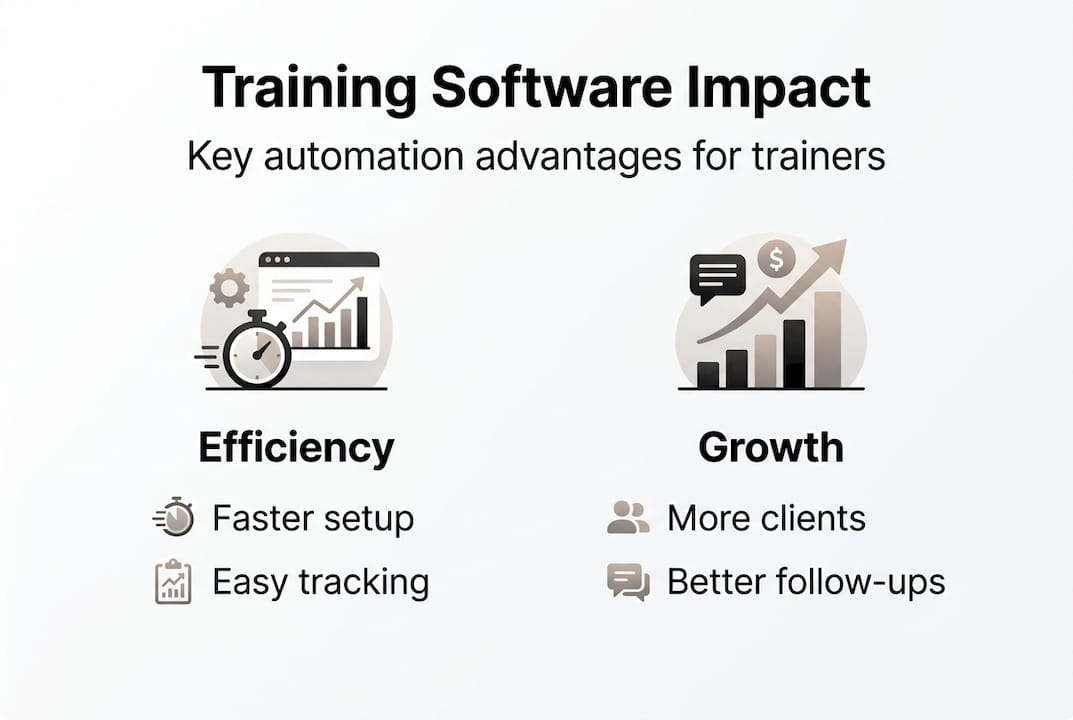
The most immediate benefit is time. When automation handles check-ins, program delivery, and lead follow-up, you reclaim hours every week for the work that actually moves the needle: refining programs, building relationships, and coaching in the moment. That’s not a small thing when you’re managing 15 or 20 clients.
Engagement numbers tell a compelling story. App-guided adherence reaches 81% compared to just 52% for self-guided approaches. And when you add a hybrid model combining software with regular in-person or live interaction, adherence climbs even higher, with some studies reporting 88% in hybrid setups. That’s a meaningful difference for client retention and results.
Here are some practical business wins trainers see when they implement the right platform:
- Faster client onboarding with digital intake forms and automated welcome sequences
- Consistent communication that keeps clients engaged between sessions
- Centralized data that makes program adjustments faster and more accurate
- Automated marketing pipelines that convert leads without constant manual effort
- Scalable systems that let you grow revenue without proportionally growing your hours
Scaling your business with automation becomes realistic when your operations aren’t dependent on you doing everything manually. And tools that help you maximize client engagement close the gap between sessions, keeping motivation high.

For solo trainers without these systems, the contrast is stark. Missed follow-ups, inconsistent communication, and manual scheduling errors quietly erode client satisfaction and referral rates. Software doesn’t just save time; it protects the client experience.
Limitations and expert nuances—why software isn't a silver bullet
Even with major upsides, there are crucial caveats every professional should know. Here’s what research and top trainers say about realistic limitations.
Software scales your reach, but it can’t replicate the micro-corrections you make in person. Watching a client’s squat form on a live video call is different from reviewing a logged rep count. The tactile, real-time coaching that happens in a gym session is genuinely hard to replicate digitally.
AI enhances coaching efficiency but can’t fully replace nuanced human judgment for injury management and complex client scenarios.
Motivation is another gap. A well-timed message from a coach who knows your history hits differently than an automated nudge. For clients who are already self-motivated and tech-comfortable, software works brilliantly. For low-engagement clients, rehab cases, or special populations, software alone underperforms and hybrid models are essential.
Exploring a hybrid model for training gives you the scalability of software with the human depth that keeps clients committed. And for complex cases, AI-powered program modification for injuries can support your decisions but should never replace your professional assessment.
Pro Tip
Use tech for what it does best: data, consistency, and scale. Never delegate the art of coaching. Your ability to read a client, adjust in the moment, and build genuine trust is what separates good trainers from great ones.
Best practices for integrating software into your coaching
With both the power and the pitfalls in mind, here’s a straightforward roadmap to integrate software into your coaching practice without losing your human edge.
- Assess your needs first. Before choosing a platform, list your biggest operational pain points. Is it client communication? Program creation time? Lead follow-up? Start with the problem, not the feature set.
- Select features that match your client base. A trainer working with rehab clients needs different tools than one running group fitness programs. Match the software to your niche.
- Onboard clients intentionally. Walk each client through the platform. Show them how to log workouts, message you, and track their progress. Adoption rates drop when clients feel lost in a new system.
- Monitor usage and engagement data. Most platforms show you who’s logging in, who’s completing workouts, and who’s going quiet. Use that data proactively to reach out before a client disengages.
- Iterate based on feedback. Ask clients regularly what’s working and what isn’t. The best software setups evolve over time, not overnight.
Hybrid use of software plus periodic human oversight consistently optimizes outcomes across client types. That means scheduling regular check-in calls or sessions even when clients are on a primarily digital program.
For personalized program creation, software accelerates the process but your expertise shapes the output. The same applies when adapting your clients’ programming across different training styles or competition formats.
Pro Tip
Block time each week to review client data in your platform. Fifteen minutes of intentional review can surface a struggling client before they quietly cancel.
Why human connection still drives client results—even in a software-powered world
So, what’s the real takeaway for professionals looking to thrive—not just survive—as our field gets more tech-heavy? Here’s our take.
Chasing full automation is a trap. The trainers who win long-term aren’t the ones with the most sophisticated tech stack. They’re the ones who use technology as a multiplier for their human impact. Hybrid use of software for efficiency paired with human oversight for motivation and form correction is what veteran trainers and the data both point to as optimal.
We’ve seen this play out consistently. Trainers who automate their logistics and then reinvest that time into deeper client relationships see better retention, stronger referrals, and higher satisfaction scores. The software creates space. What you fill that space with is what defines your business.
The professionals who treat technology as a crutch, expecting it to do the coaching for them, plateau quickly. Those who treat it as a tool that amplifies their expertise keep growing. Your insights on hybrid training should always start with the question: “How does this tool help me show up better for my clients?” Not “How does this tool replace me?”
That mindset shift is what separates trainers who thrive in a tech-heavy market from those who get left behind.
Supercharge your fitness business with leading-edge training software
Ready to put these insights and the right tools to work for your business? Explore these resources and experience the benefits first-hand.
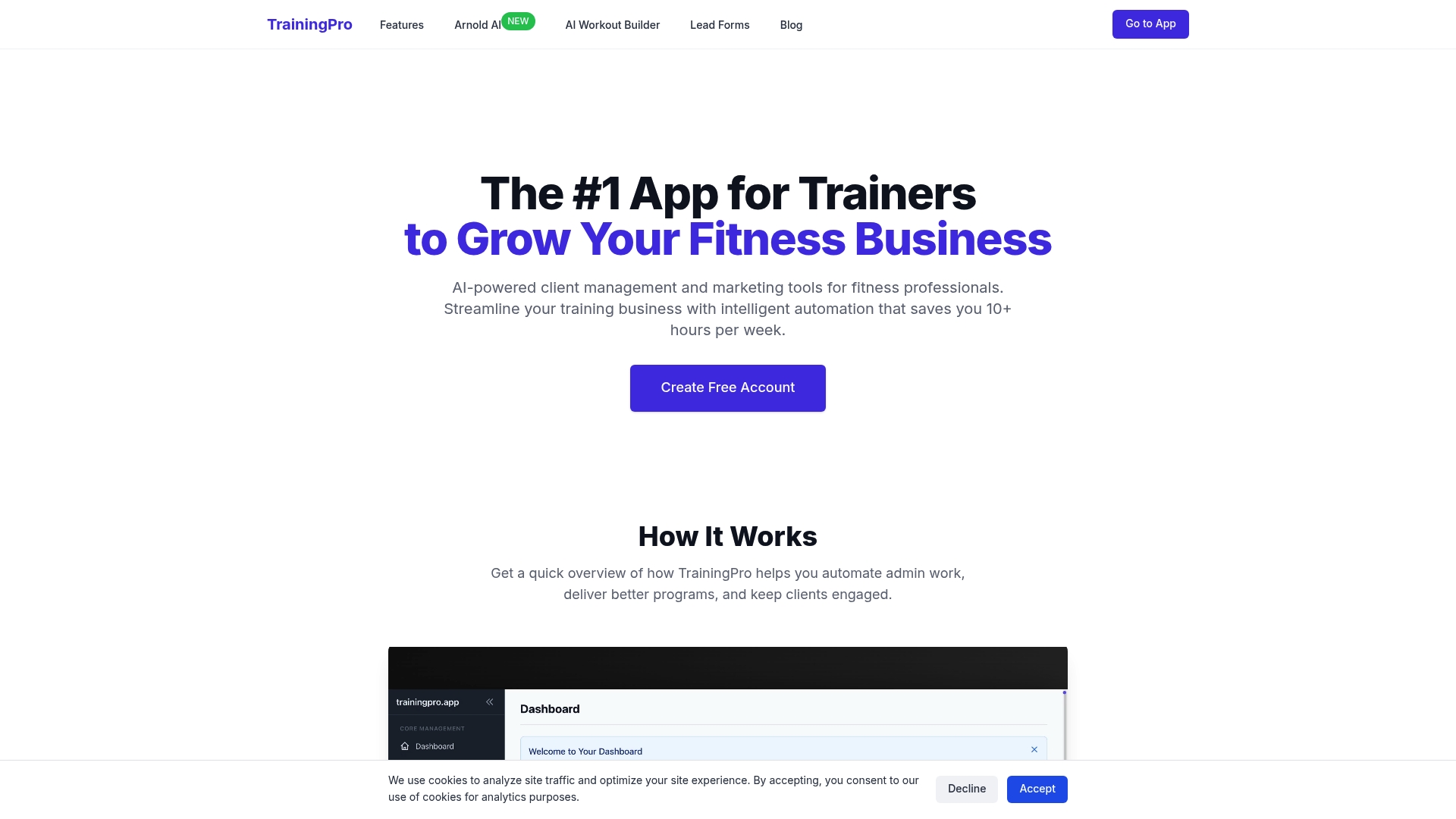
TrainingPro fitness software is built specifically for fitness professionals who want to run a smarter, more efficient business without losing the personal touch that keeps clients coming back. From automated marketing to AI-driven program design, every feature is designed to save you time and grow your impact.
Download the AI-powered workout builder eBook to see exactly how AI can accelerate your program creation. And if growing your client base is a priority, explore TrainingPro’s lead generation tools to build a frictionless pipeline that works even when you’re coaching. The right tools are ready when you are.
Ready to Transform Your Fitness Business?
Join thousands of trainers using TrainingPro to automate admin, grow their client base, and focus on what they love—coaching.
Start your 14-day free trial • Cancel anytime
Frequently asked questions
Training program software streamlines client management, program creation, and marketing, freeing trainers to focus on coaching. Software excels in scalability and automates the essential business tasks that otherwise consume hours each week.
No. Hybrid training outperforms software-only models for adherence and results, especially when clients need motivation, form correction, or personalized adjustments.
AI enables faster program adaptation and data-driven personalization, but expert review remains essential. AI can’t fully replace nuanced coaching for injury cases and complex client scenarios.
Prioritize program design, client management, automation, and strong integration with your existing business processes. These four areas deliver the clearest return on investment for most fitness professionals.
Not equally. Software works best for engaged, tech-comfortable clients. Software alone underperforms for low-engagement or special-needs clients, who benefit more from direct human coaching and regular personal contact.


