
Operational efficiency for trainers: next-level strategies
TL;DR:
- Operational efficiency means minimizing admin tasks to focus on coaching and client results.
- Automating scheduling, onboarding, payments, and check-ins saves trainers over 10 hours weekly.
- Tracking key metrics like utilization and retention helps trainers grow sustainably without burnout.
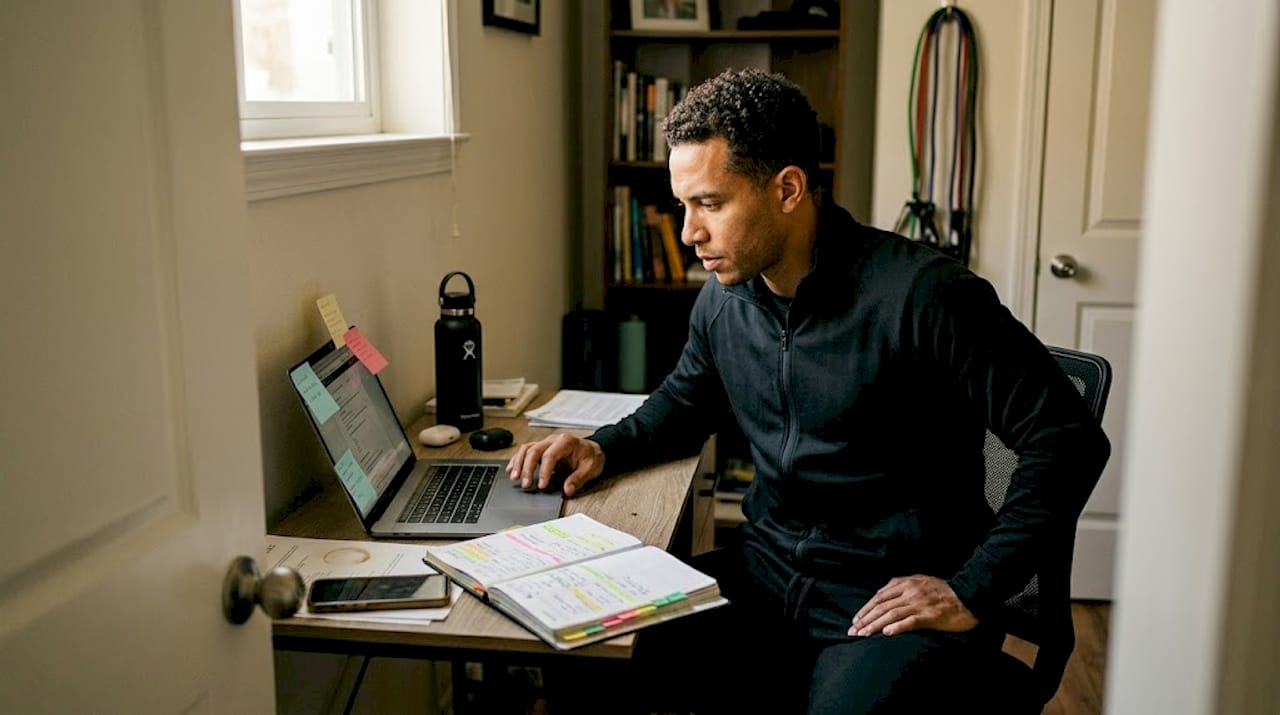
If you feel like you spend more time on admin than actual coaching, you are not alone. Scheduling headaches, chasing payments, repeating the same onboarding steps for every new client — these tasks quietly drain hours that should go toward delivering results. Operational efficiency for personal trainers is about maximizing client impact and revenue while using as few resources as possible, especially your time. The good news: smarter systems, not longer hours, are the real path forward. This article walks you through what efficiency actually looks like, how to measure it, and which steps to take next.
Key Takeaways
Defining operational efficiency for trainers
Now that we have set the scene for why time is your most precious resource, let us clarify exactly what operational efficiency looks like in the day-to-day life of a trainer.
As a personal trainer, you are running a business whether you think of it that way or not. Every hour you spend on a task that is not coaching is an hour you are not generating direct client value. Operational efficiency for trainers means structuring your work so that admin tasks take as little time as possible, leaving you free to focus on the sessions, programs, and relationships that actually grow your business.
Here is what inefficiency typically looks like in practice:
Every one of these tasks is a weak link in your service chain. Fix enough of them and you will notice two things happen almost immediately: you feel less burned out, and your clients get a better experience.
“Operational efficiency for personal trainers refers to maximizing client output and business revenue using minimal resources, particularly time, through automation of admin tasks like scheduling, onboarding, payments, workout delivery, and check-ins, allowing focus on high-value coaching.”
Automation is the single biggest lever available to trainers right now. But automation is not just about using apps. It is about building repeatable systems that work even when you are not watching. Think of it as your business running in the background while you focus on what you do best.
For example, setting up automated payment collection means you stop losing income to late or missed payments. Building a digital onboarding sequence means new clients always get consistent, professional information. Creating workout templates that can be quickly customized means you spend 10 minutes on program design instead of 45.
Efficiency is not about cutting corners or giving clients less attention. It is about removing the friction that slows you down so that when you are in front of your clients, you are fully present and prepared. Explore productivity hacks for trainers to start identifying where your hours are actually going. You can also study time management strategies used by high-performance coaches for additional frameworks.
The trainers who grow sustainably are not the ones who work the hardest. They are the ones who build smarter workflows and protect their energy for coaching.
Key metrics to measure operational efficiency
With a foundational understanding of operational efficiency, you can now measure it using specific performance indicators.
You cannot improve what you do not track. Most trainers have a rough sense of how busy they feel, but busyness is not the same as efficiency. These five key performance indicators (KPIs) give you an honest read on how well your business is operating:
According to personal training KPI benchmarks, a healthy trainer utilization rate sits between 65 and 75%, while anything below 55 to 60% signals real inefficiency that is likely costing you revenue.
Trainer Utilization Rate is simply the percentage of your available working time that is actually spent delivering paid sessions or billable services. If you are available 40 hours a week but only coaching for 20, that is a 50% utilization rate — below the benchmark. Low utilization often means too much time is going toward admin.

Client Retention Rate tells you how well you keep the clients you already have. Retaining a client costs far less than acquiring a new one, and client retention strategies consistently show that strong onboarding and regular check-ins are the biggest drivers of long-term loyalty. Aim for 65 to 80% retention across your client base.
Customer Acquisition Cost (CAC) vs. Customer Lifetime Value (CLV) is a ratio that tells you whether your marketing spend makes sense. CAC is what you spend to acquire each new client — ads, referral rewards, time spent on outreach. CLV is the total revenue a client generates over their full time with you. Your CAC should stay below one-third of your CLV. If you are spending too much to acquire clients who leave quickly, your numbers will never balance.
Average Revenue Per Client (ARPC) of $400 or more per month suggests your pricing reflects the value you deliver. If your ARPC is under $300, it may be time to reassess your package structure or add higher-value services.
No-show reduction is one area where automation pays off almost immediately. Automated reminders — sent 24 hours and 1 hour before a session — can reduce no-shows by 40 to 60%. That is recovered revenue with almost no extra effort on your part.
Take time to track client progress consistently, because it feeds directly into both your retention and ARPC numbers. When clients see results, they stay longer and spend more.
Pro Tip
Review these five KPIs once a month. A quick 20-minute check-in with your numbers will reveal patterns before they become problems, and it keeps your business decisions grounded in reality rather than gut feelings.
Smart automation: Tools and tasks to streamline your workflow
To make real improvements, it is crucial to move from just tracking the numbers to concrete actions — automation is the key.
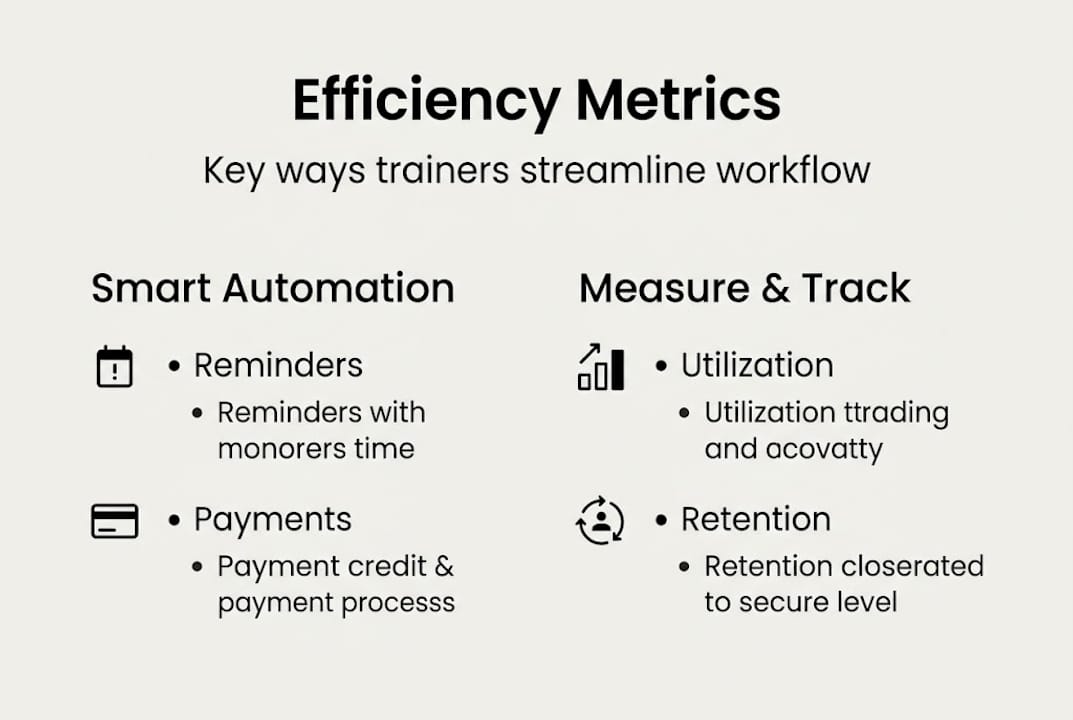
Most trainers know they need to automate. Fewer actually know where to start or what tools fit their workflow. The goal is not to automate everything at once. It is to identify the tasks that steal the most time and target those first.
Here is a side-by-side comparison of manual versus automated approaches for the most common trainer admin tasks:
As operational efficiency research confirms, automating scheduling, onboarding, payments, workout delivery, and check-ins is where trainers consistently reclaim the most time. Taken together, these five areas can save you more than 10 hours every single week.
Here is a simple four-step process to start automating your workflow:
- Audit your week. Write down every non-coaching task you completed in the last seven days and roughly how long each one took.
- Prioritize by time cost. Rank those tasks from most to least time-consuming. Your top three are your automation targets.
- Pick one tool to start. Choose software that handles at least two of your top tasks in one place. Adding five separate apps creates its own admin burden.
- Run it for 30 days. Measure whether the time savings are real before adding more tools. Adjust, then expand your automation from there.
Pro Tip
Automate your session reminders immediately. Sending reminders 24 hours and 1 hour before each appointment can cut your no-show rate by up to 60%, recovering real revenue with zero additional effort. Combine that with essential trainer tools that handle scheduling and payments in one place, and you have a solid foundation.
The point is not to remove the human element from your business. It is to make sure the human element — your time, your expertise, your energy — goes where it creates the most value.
Scaling your personal training business with operational efficiency
After automation provides extra hours in your week, the next step is leveraging that efficiency to scale your business.
Free time is not a luxury when you are a trainer. It is inventory. Every hour you reclaim from admin is an hour you can reinvest into growth, whether that means adding clients, building new revenue streams, or investing in your own skills.
Here is how efficient trainers typically use their reclaimed time to scale:
As your client base grows, it is critical to track the metrics from the previous section consistently. Utilization rate and retention are the two most important numbers to watch as you scale, because growth can hide inefficiencies that will eventually catch up with you.
For example, a trainer who grows from 15 to 25 clients but sees retention drop from 78% to 61% has not actually scaled successfully. The growth in new clients is masking a retention problem that will hurt income within 90 days. Learning how to retain personal training clients long-term is not just a service quality issue — it is a financial strategy.
Pro Tip
Set a simple rule for yourself — for every five new clients you add, review your utilization and retention numbers. This gives you an early warning system for bottlenecks before they become costly.
Scaling is not just about getting more clients. It is about building a business that can support more clients without falling apart at the seams.
A smarter path: What most trainers miss about operational efficiency
Having walked through practical steps, let us reflect on what most guides overlook when it comes to true operational efficiency.
Here is the uncomfortable truth: most trainers adopt tools before they understand their actual workflow. They sign up for software because a colleague recommended it, automate a bunch of tasks, and then wonder why their business still feels chaotic. The technology is not the problem. The lack of clarity about the client experience is.
Before you automate anything, ask yourself: what does an exceptional client journey look like in my business? Map that out first. Then build automation to support it, not to define it. Tools should serve your vision, not create one for you.
The other thing most guides miss is that efficiency is not a one-time project. It is a discipline. The trainers who sustain growth are the ones who regularly audit their systems, retire what is not working, and reinvest their time savings into the one thing no app can replace — genuine client relationships. Automation earns you time. What you do with that time determines whether your business grows or stagnates.
Work smarter, yes. But never lose sight of why clients chose you in the first place.
Take your training business further with the right tools
You now understand what operational efficiency means, how to measure it, and where automation makes the biggest difference. The next step is putting it all into practice with software built specifically for trainers.
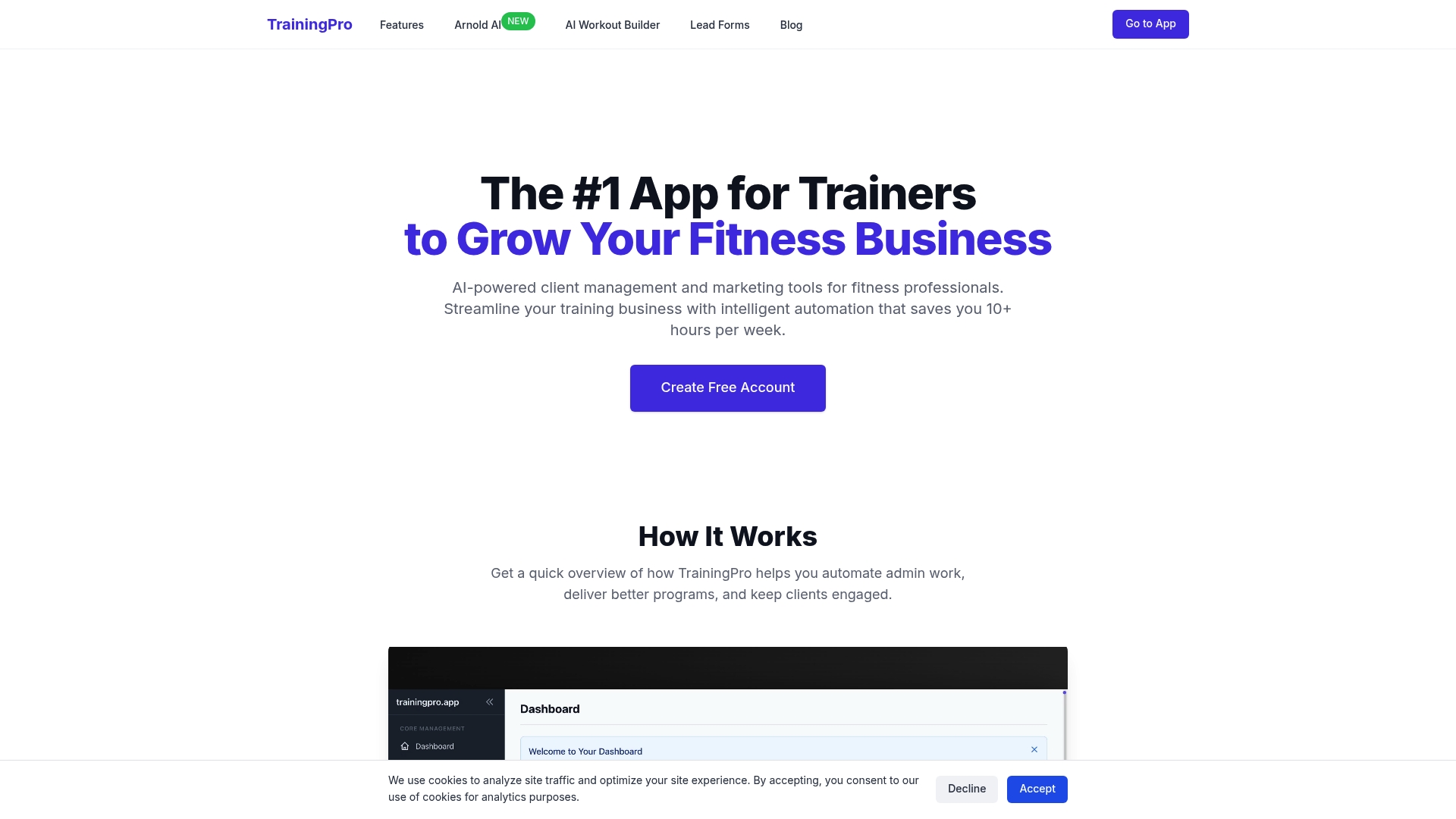
TrainingPro is designed from the ground up for fitness professionals. It brings client management, automated scheduling, payment collection, and workout delivery into a single platform — so you stop juggling apps and start coaching. Arnold AI, TrainingPro’s built-in AI assistant, helps you build personalized programs in minutes using the AI Workout Builder, accounting for each client’s goals, injuries, and preferences. Whether you want to save 10 hours a week or scale to 40 clients without burning out, TrainingPro gives you the infrastructure to make it happen. Explore the platform and see what a streamlined training business actually feels like.
Frequently asked questions
Operational efficiency lets trainers maximize revenue and client results while freeing up time for coaching by streamlining admin tasks like scheduling, onboarding, and payments.
Automate scheduling, onboarding, payments, workout delivery, and client check-ins first — these are the areas where automation of admin tasks delivers the biggest time savings.
A healthy utilization rate is 65 to 75%. Falling below 55 to 60% is a clear signal that too much of your available time is going toward non-coaching tasks.
Tracking your client retention rate shows whether clients are staying long enough to generate real lifetime value — strong retention leads to steady income and more referrals over time.
No. Efficiency comes from using the right tools that fit your specific workflow and client experience — adopting every new app on the market often creates more complexity, not less.
Recommended
- Business tools every trainer needs for growth in 2026 | TrainingPro
- Business growth strategies for trainers in 2026 | TrainingPro
- 10 productivity hacks for personal trainers: automate & engage | TrainingPro
- The Best Trainerize Alternative in 2026 Isn’t Just Cheaper, It’s Smarter | TrainingPro
Ready to Transform Your Fitness Business?
Join thousands of trainers using TrainingPro to automate admin, grow their client base, and focus on what they love—coaching.
Start your 14-day free trial • Cancel anytime


