
Branded fitness content drives growth: key strategies

TL;DR:
- Branded fitness content reflects your values, identity, and expertise to build trust and loyalty.
- Using a content pillar method ensures balanced, consistent messaging across education, social proof, lifestyle, and sales.
- Authentic, interactive content coupled with a full-system approach drives long-term client engagement and business growth.
Most trainers believe that posting more often equals more results. It doesn’t. What actually drives engagement, loyalty, and new client signups is a deliberate branded content strategy, not volume. Content pillar architecture reduces creative fatigue by 40% and ensures your messaging stays consistent across every touchpoint. This article breaks down exactly what branded fitness content is, why it outperforms generic posting, and how you can build a system that works year-round. If you’re ready to stop spinning your wheels and start building real authority, this is where it begins.
Table of Contents
- What is branded fitness content and why does it matter?
- The content pillar method: A proven framework for engagement
- Beyond posting: Why structure, interactivity, and authenticity win
- From content to growth: Measurable impact on clients and business
- Perspective: What most fitness pros miss about branded content
- How to amplify your brand with the right tools
- Frequently asked questions
Key Takeaways
| Point | Details |
|---|---|
| Strategic content wins | Planned, branded content beats random posting by boosting engagement and trust. |
| Use the four pillars | Rotating Education, Social Proof, Lifestyle, and Sales posts prevents burnout and maintains balance. |
| Metrics matter | Measuring engagement, retention, and conversion proves your content’s business value. |
| Authenticity drives growth | Interactive, authentic content fosters loyalty and stronger client relationships. |
What is branded fitness content and why does it matter?
Branded fitness content is any content you create that consistently reflects your values, visual identity, voice, and expertise. It’s not just a workout tip or a transformation photo. It’s a post, video, or story that a client could see without your name on it and still know it came from you.
Think about what separates a generic Instagram reel from a piece of content that actually builds trust. Generic content is interchangeable. Branded content is recognizable, specific, and purposeful. It carries your personality, your methodology, and your message.
Here’s what branded fitness content typically includes:
- Your visual identity: consistent colors, fonts, and logo placement
- Your voice: the way you explain concepts, your tone, your level of formality
- Your values: what you stand for, who you serve, and why you do it
- Your expertise: educational content that proves your knowledge
- Social proof: client results, testimonials, and transformation stories
This matters more than most trainers realize. Research shows that brand content traits including informativeness, entertainment, interactivity, and authenticity significantly boost purchase intention through brand attitude and loyalty. In plain terms, the way you show up in content directly shapes whether someone chooses to work with you and whether they stay.
“The goal of branded content isn’t to go viral. It’s to make the right people feel like you’re already their trainer before they even book a session.”
One of the biggest pitfalls trainers fall into is inconsistency. Posting three times a week with no consistent message or look creates confusion, not connection. Understanding professional fitness branding is the foundation. From there, every piece of content you create should work to boost client engagement in a measurable way.
Random posting doesn’t just underperform. It actively dilutes your brand equity over time.
The content pillar method: A proven framework for engagement
Knowing what branded content is, the next challenge is structuring it for lasting results. The content pillar method solves the “what do I post?” problem permanently by organizing your content into four clear categories.
The four pillars:
- Education: Tips, tutorials, explainer videos, myth-busting posts
- Social proof: Client testimonials, before and after results, case studies
- Lifestyle: Behind-the-scenes, personal stories, values-driven content
- Sales: Offers, program launches, calls to action
| Pillar | What it achieves | Example |
|---|---|---|
| Education | Builds authority and trust | “3 mistakes killing your squat form” |
| Social proof | Drives conversion and confidence | Client 12-week transformation post |
| Lifestyle | Creates relatability and community | Day-in-the-life training video |
| Sales | Generates leads and revenue | Limited spots open for coaching |
The data backs this up. Pillar architecture reduces creative fatigue by 40% and ensures balanced messaging that keeps clients engaged without overwhelming them with promotions.
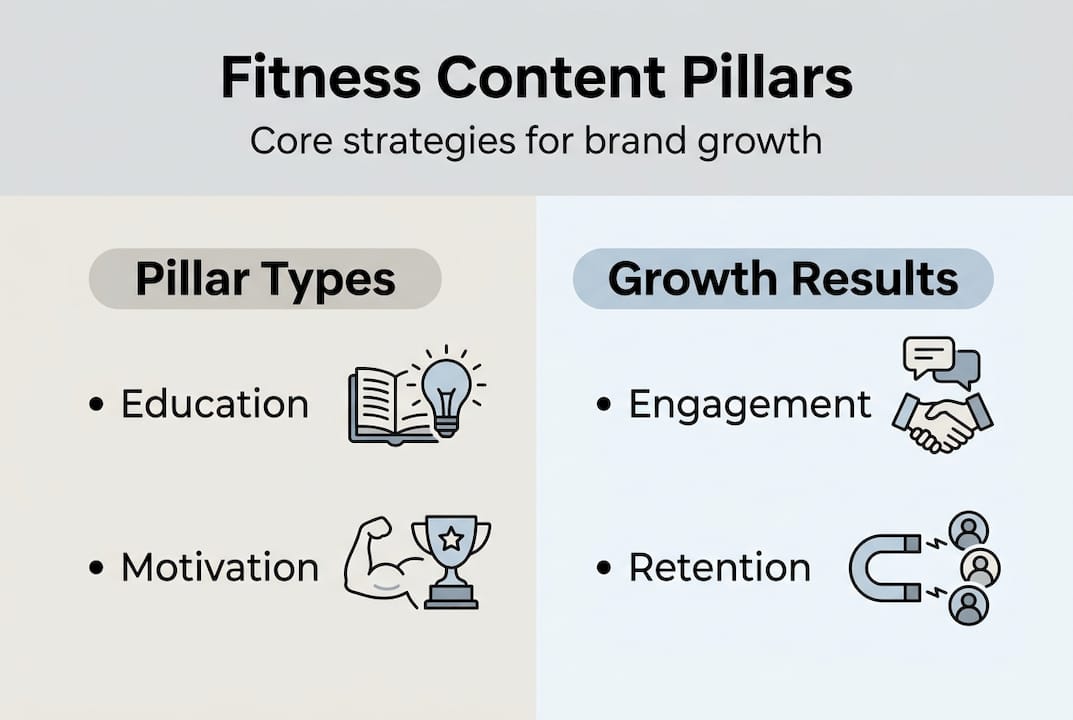
The 80/20 rule works well here. Aim for 80% value-driven content across education, social proof, and lifestyle. Use the remaining 20% for direct sales messaging. This ratio keeps your audience engaged without feeling like every post is a pitch.
How to plan a content week using this method:
- Choose 3 to 5 posts per week across your active platforms
- Assign each post to a pillar before you create it
- Rotate pillars so no two consecutive posts are the same category
- Batch produce content in 4-week blocks to save time
- Review what performed best and double down on that format next month
Pro Tip
Use your proven strategies for client retention data to guide which pillars to lean into. If your audience engages most with education, weight that pillar more heavily for a few weeks. Pair this with insights from mobile wellness app engagement data to refine further.
Beyond posting: Why structure, interactivity, and authenticity win
A strong framework needs fuel. The kind of content that actually builds genuine connections goes beyond scheduled posts. It invites participation and feels real.

Interactivity and authenticity consistently outperform polished but generic content. Sports brand content characteristics including informativeness, entertainment, interactivity, and authenticity significantly boost purchase intention. The path runs from content quality to brand attitude to loyalty to actual buying behavior.
What does that look like in practice?
- Fitness Q&A sessions: Go live weekly and answer the questions your audience is already asking. This builds authority in real time.
- Authentic trainer stories: Share a training setback you had, a client win that surprised you, or why you chose this career. Real stories create real connection.
- Interactive polls and challenges: Ask your audience to vote on their biggest fitness struggle. Then create content that speaks directly to the winner.
- Progress check-ins: Show your own training progress alongside your clients’. It normalizes the journey and builds community.
“The biggest mistake isn’t posting too little. It’s posting content that could have come from any trainer in the world.”
The common mistake here is prioritizing aesthetics over substance. A perfectly lit photo with no meaningful caption will always underperform a candid video where you solve a real problem. Your audience is smart. They can feel the difference between content made to impress and content made to help.
Pro Tip
Use tracking client progress data as content fuel. Share milestones (with permission), show the process, and make your clients the heroes of your content. This approach also strengthens your client management for engagement because clients who feel seen stay longer.
From content to growth: Measurable impact on clients and business
To make branded content worth your time, it must show results. The good news is that the data connecting content strategy to business growth is clear.
Audience-centric brandformance strategies using full-funnel video and storytelling outperform simply outspending competitors on ads. In fitness specifically, brands that build community and narrative around their services see stronger retention and conversion than those relying on paid acquisition alone.
Here’s what you should be tracking:
| Metric | What it tells you | Tracking method |
|---|---|---|
| Engagement rate | Content resonance | Platform analytics weekly |
| Client retention rate | Long-term loyalty | CRM or management software |
| Lead form completions | Content-to-inquiry conversion | Website or landing page data |
| Booking rate from content | Direct revenue attribution | UTM links or referral tracking |
| Social following growth | Brand authority building | Monthly platform review |
How to connect your content to growth objectives:
- Define your goal first. Retention, new leads, or upsells each need different content strategies.
- Tag each content piece by pillar and goal before publishing.
- Review metrics every 30 days. Look for patterns in what converts, not just what gets likes.
- Adjust your pillar ratio based on which content moves clients along your pipeline.
- Celebrate wins with your audience. Sharing milestones builds credibility and reinforces your brand story.
If you want to grow sustainably, explore trainer growth strategies and study fitness business model examples that align content with revenue from day one.
Perspective: What most fitness pros miss about branded content
Here’s the uncomfortable truth most content playbooks won’t tell you. Chasing likes is not a strategy. It’s a distraction.
The trainers who build lasting businesses aren’t the ones with the most followers. They’re the ones who build ecosystems. That means embedding their brand into the daily experience of their clients through apps, training plans, check-ins, and community, not just social media feeds.
Traditional sponsorships and isolated campaigns fail because they lack community and purpose. Brands that embed themselves into training plans and apps maintain relevance all year, not just on event day. The same principle applies to your content. A single viral post fades. A year-round branded experience compounds.
Most trainers focus on one channel, usually Instagram, and ignore how their content connects to their onboarding, their programming, and their client retention systems. That’s the weak link. Branded content isn’t about moments. It’s about building a memorable journey that keeps clients engaged at every stage.
The trainers who win are those who treat their content as part of a full system, where every post, every session, and every check-in reinforces the same brand promise. Consider how digital gym management tools can extend your brand presence beyond social media and into the daily touchpoints that actually drive retention.
How to amplify your brand with the right tools
Inspired to take your branded content to the next level? Here’s how to get started.
TrainingPro is built to help fitness professionals like you turn strategy into action without burning hours on manual work. From automating client communications to building branded programs, the platform supports every layer of your content ecosystem.
Use the AI workout builder to create personalized programming that reinforces your brand methodology with every client. Want to go deeper on content strategy? The AI-powered content guide gives you a ready-to-use framework for building authority and growing your business. Visit the TrainingPro app for trainers to see how automation, branding, and client engagement come together in one platform.
Frequently asked questions
Branded fitness content carries your values, visual identity, and messaging consistently, making your business recognizable and trusted. Brand content traits including authenticity and informativeness directly improve brand attitude and loyalty.
Plan your pillars and batch produce 4 to 8 weeks of content at a time, then supplement with authentic, in-the-moment updates. Batch production and pillar rotation prevent creative fatigue and keep your calendar consistent without gaps.
Track engagement, retention, signups, and conversion rates before and after implementing a content framework. Brandformance strategies consistently drive higher loyalty and conversion than ad spend alone.
Yes, using social proof as a content pillar builds trust and motivates prospective clients to take action. Social proof strengthens brand authority and directly supports conversion when used consistently.
Recommended
- Top 6 fitness business models to boost growth in 2026 | TrainingPro
- Business growth strategies for trainers in 2026 | TrainingPro
- What is professional fitness branding: guide for trainers | TrainingPro
- Why track fitness progress: boost client engagement | TrainingPro
- Branded content: drive engagement and conversions
Ready to Transform Your Fitness Business?
Join thousands of trainers using TrainingPro to automate admin, grow their client base, and focus on what they love—coaching.
Start your 14-day free trial • Cancel anytime


