
Why Use PWAs for Fitness? Boost Client Engagement

TL;DR
- PWAs increase client engagement and reduce bounce rates compared to traditional web and native apps.
- They offer offline access, instant updates, and lower development costs for fitness businesses.
- PWAs are ideal for content delivery, scheduling, and remote coaching, with limitations on iOS features.
Most fitness professionals spend serious money building native apps, then watch clients abandon them after the first update fails to install. There’s a better path. Progressive Web Apps (PWAs) deliver 3x higher engagement and 50% lower bounce rates compared to traditional mobile web, making them a powerful tool for client retention. This article breaks down exactly what PWAs are, why they matter for your fitness business, and how to use them to cut costs, reduce friction, and keep clients engaged whether they’re training in a signal-dead basement gym or working with you remotely.
Key Takeaways
What are PWAs and why do they matter for fitness?
With engagement at stake, it’s crucial to understand what makes PWAs different from both regular websites and traditional apps.
A Progressive Web App is a website that behaves like a native mobile app. Clients can add it to their home screen, receive push notifications, and use it offline, all without downloading anything from an app store. For fitness professionals, that distinction is huge.
Here’s what separates PWAs from a standard website:
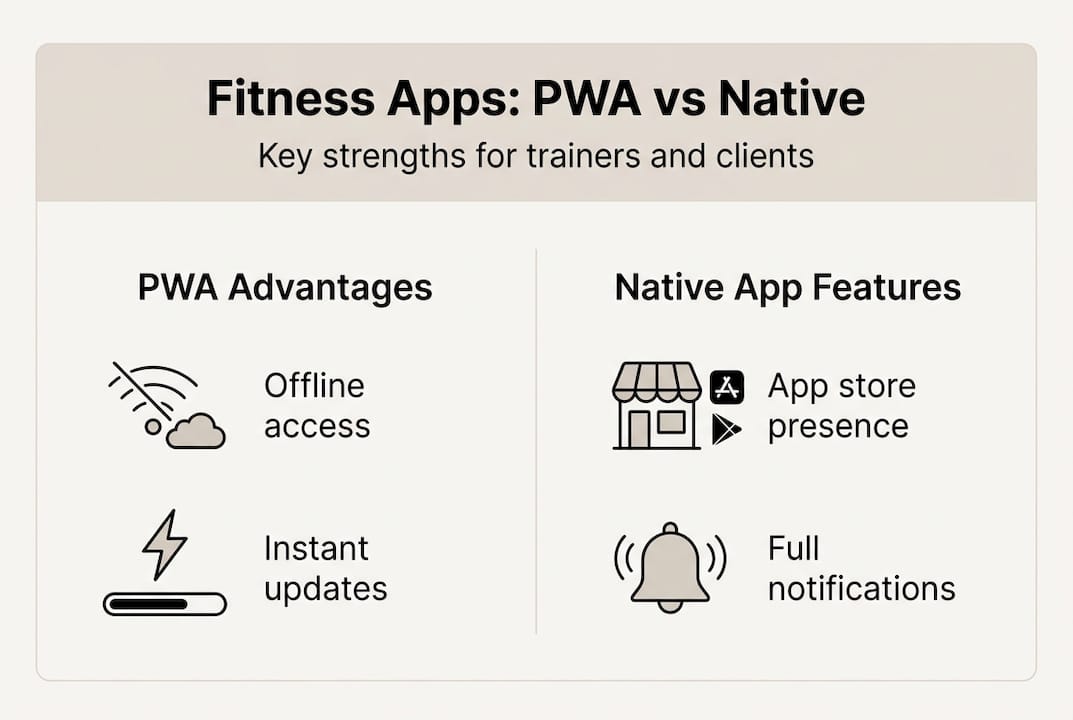
- Offline access: Clients can view workouts, videos, and schedules even without an internet connection
- Push notifications: Send reminders, program updates, or motivational messages directly to a client’s device
- Installability: Clients tap “Add to Home Screen” and the PWA icon sits right next to their other apps
- Responsive design: Works seamlessly across phones, tablets, and desktops without separate builds
- Fast load times: PWAs use caching to load almost instantly, even on slower connections
Think about the real problems these features solve. Your client is at a gym with spotty WiFi. They can’t load their program. They skip the workout or improvise badly. With a PWA, offline access to workout data and videos means that scenario simply doesn’t happen. The program loads from the device’s local cache, no signal needed.

For remote coaches, the installability factor matters just as much. Asking a new client to download an app from an app store creates friction. Some won’t bother. A PWA removes that barrier entirely. You share a link, they open it, they tap one button, and it’s on their home screen.
The fitness software benefits of moving to a PWA-based platform extend beyond client convenience. You get one system that works for everyone, regardless of device or operating system, without paying for separate iOS and Android development.
Pro Tip
Cache your exercise demonstration videos inside the PWA so clients can access them offline. This is especially valuable for clients training in basement gyms, hotel fitness centers, or outdoor locations where connectivity is unreliable.
Key benefits: Engagement, offline access, and cost savings
Understanding the technology, let’s look at the hard numbers and practical outcomes that set PWAs apart for the fitness industry.
The engagement numbers are hard to ignore. PWAs deliver 3x higher engagement and 50% lower bounce rates compared to traditional mobile web. That means clients who access your programs through a PWA are far more likely to stay on the platform, complete their sessions, and come back the next day.
36% boost in conversions has been reported by businesses switching from mobile web to PWA delivery. For fitness professionals, that translates directly to more clients completing onboarding, booking sessions, and staying subscribed.
Offline access is powered by two specific technologies worth knowing: Service Workers and IndexedDB. Service Workers act as a background layer that intercepts network requests and serves cached content when there’s no connection. IndexedDB is a browser-based database that stores workout data, client notes, and video files locally on the device. Together, they create an offline-first experience that feels completely seamless to your clients.
The cost picture is equally compelling. Development costs run 40 to 60% lower than native apps because you build one codebase that works across iOS, Android, and desktop. No separate teams, no duplicate testing, no app store fees eating into your margins.
Practical scenarios where this pays off for trainers:
- Client onboarding: New clients access your portal via a link, no download required
- Video delivery: Exercise demos load from cache during gym sessions with poor WiFi
- Self-service bookings: Clients book or reschedule sessions directly through the PWA interface
- Progress tracking: Clients log workouts offline, and data syncs when they reconnect
Improving client engagement with apps and consistently tracking fitness progress become much easier when the technology doesn’t get in the way.
Operational edge: Instant updates and reduced friction
Beyond technical and cost advantages, PWAs reshape daily operations for fitness professionals.
One of the most underrated benefits is update speed. With a native app, pushing a change to your program means submitting to the App Store or Google Play, waiting days for review, and hoping clients actually install the update. With a PWA, you make the change and clients see it the next time they open the app. No delays. No version conflicts.
Here’s how a real update cycle looks for a trainer using a PWA:
- Identify the change: A client’s knee injury means you need to swap out squats for leg press variations in their program
- Update the program: You edit the workout in your platform, swapping exercises and adding coaching notes
- Push the update: The change is live immediately, no submission process required
- Client sees it instantly: Next time your client opens the PWA, the updated program is there
- Send a notification: Use a push notification to alert the client that their program has been refreshed
This cycle applies to class schedules, pricing changes, new content drops, and anything else you manage through your platform. The operational speed advantage compounds over time.
“PWAs reduce onboarding friction, no downloads, fast updates, and clients are in your ecosystem within seconds of receiving a link.”
For updating workout programs on the fly or creating programs fast, the instant delivery model is a genuine competitive edge. Clients who receive shared workouts through a PWA link don’t need to troubleshoot downloads or deal with version mismatches.
Instant updates without app store approval improve operational efficiency significantly, especially for trainers who frequently adjust programming based on client feedback or progress.
Pro Tip
Push notifications are powerful, but use them strategically. Limit reminders to two or three per week per client. Overuse leads to notification fatigue, and clients will disable them. Keep messages short, specific, and action-oriented.
PWAs vs native apps: When to choose each for your fitness business
Every technology has its trade-offs, so smart trainers need to know when to use each tool.
PWAs are not the right answer for every situation. Understanding where each technology excels helps you make a confident decision rather than defaulting to the most expensive option.
The iOS limitations are real: push notifications and background sync are restricted on Apple devices for PWAs, while Android supports the full feature set. If your client base is heavily iOS and push notifications are central to your retention strategy, factor that in.
When native apps make more sense:
- Your platform requires deep hardware integration (heart rate sensors, GPS tracking, wearable sync)
- You’re building augmented reality coaching features
- You need high-performance real-time video processing
- Your brand equity justifies a premium App Store presence
When PWAs are the stronger choice:
- Content delivery: training videos, program libraries, educational resources
- Scheduling and booking systems
- Client portals for progress tracking and communication
- Basic workout logging and habit tracking
- Remote coaching where clients are spread across different devices
Gym environments with spotty WiFi actually favor PWAs over native apps in one specific scenario: once cached, a PWA loads reliably without needing the initial install conditions that native apps sometimes require.
For most fitness professionals running coaching businesses, content-driven platforms, or hybrid training models, a PWA covers the vast majority of client needs. The AI workout builder approach pairs naturally with PWA delivery, since program content is the core value and offline access makes it more reliable.
Our take: What most fitness pros miss with PWAs
After weighing the pros and cons, here’s why we believe PWAs can redefine what’s possible for ambitious trainers.
Most trainers treat PWAs as a “lite” version of a real app. That framing is costing them. The instant update cycle alone can reduce churn meaningfully. When a client’s program adapts to their feedback within hours rather than days, they feel seen. That responsiveness builds loyalty in a way that polished app store graphics never will.
The offline-first architecture is particularly underused in hybrid and remote coaching. Clients training in locations with poor connectivity often disengage quietly. They don’t complain. They just stop logging. A PWA that works without signal removes that silent dropout trigger entirely.
Our practical advice: don’t wait for a full platform overhaul before adopting PWA delivery. Start with a client portal. Get your programs, schedules, and progress tracking accessible through a PWA link. Measure engagement. Then expand.
One honest caveat: PWAs won’t win clients on their own. The technology is a delivery mechanism. What keeps clients engaged is the quality of your programming and the consistency of your communication. Explore TrainingPro’s approach to see how PWA delivery and strong coaching tools work together.
Explore TrainingPro’s PWA-powered solutions
TrainingPro is built specifically for fitness professionals who want to stop juggling tools and start delivering a seamless client experience. The platform is accessible via a Progressive Web App, meaning your clients get instant access to their programs, progress tracking, and communication without downloading anything.
If the benefits covered in this article resonate with you, TrainingPro puts them into practice. Use the AI workout builder to create personalized programs fast, explore the AI-powered training guide to sharpen your approach, or see all TrainingPro features to find the tools that fit your business. The platform is designed to save you over 10 hours weekly while keeping clients engaged and progressing.
Frequently asked questions
PWAs let clients access workouts and schedules offline with no app store download required, making them reliable in gyms or remote areas with poor connectivity.
Service Workers and IndexedDB enable offline-first data storage with modern web encryption, keeping client health and workout data secure when built to best practices.
iOS restricts push notifications and background sync for PWAs, while Android provides full support for both features.
PWAs use one codebase for all devices, reducing development costs by up to 60% and eliminating app store fees entirely.
Recommended
- Maximize client engagement with mobile wellness apps | TrainingPro
- Why track fitness progress: boost client engagement | TrainingPro
- AI-Powered Workout Builder Guide | Transform Your Fitness Business | TrainingPro
- Client management for fitness pros: boost retention & engagement | TrainingPro
Ready to Transform Your Fitness Business?
Join thousands of trainers using TrainingPro to automate admin, grow their client base, and focus on what they love—coaching.
Start your 14-day free trial • Cancel anytime


