
Effective workout program examples for trainers in 2026

Choosing the right workout program for each client can feel overwhelming when you’re balancing varied fitness levels, goals, and recovery capacities. With dozens of training methodologies available, from high-volume splits to low-frequency intensity protocols, the decision demands both evidence and experience. This article explores several proven workout program examples backed by research and expert insights, examining their structures, benefits, and ideal client profiles. You’ll discover actionable criteria for program selection, detailed breakdowns of popular training models, and practical guidance to enhance your client outcomes and engagement.
Table of Contents
- Key takeaways
- Criteria for selecting effective workout programs
- Push-pull-legs (PPL) split program
- CrossFit’s Mechanics-Consistency-Intensity (MCI) hierarchy
- Mike Mentzer’s High-Intensity Training (HIT) method
- Hybrid and metabolic resistance training programs
- Comparing workout program examples and making the right choice
- Enhance your training business with AI-powered tools
- FAQ
Key Takeaways
Criteria for selecting effective workout programs
Before diving into specific program examples, you need clear criteria to evaluate which approach fits each client’s unique situation. Biomechanics in program design is essential to optimize exercise selection and prevent injury, starting with joint mechanics and muscle engagement patterns. Your assessment should identify movement limitations, previous injuries, and muscular imbalances that could derail progress or create compensation patterns.
Program frequency and intensity must align with your client’s recovery capacity and training experience. A deconditioned client needs longer rest intervals between sessions, while an advanced lifter may thrive on higher frequencies. Consider how many days per week your client can realistically train, their sleep quality, nutrition habits, and stress levels outside the gym. These factors determine whether a 3-day, 4-day, or 6-day program makes sense.
Movement patterns and muscle group balance prevent overuse injuries and ensure comprehensive development. Your training program creation guide should include horizontal and vertical pushing, horizontal and vertical pulling, hip-dominant and knee-dominant lower body movements, and core stabilization. Neglecting any pattern creates imbalances that limit performance and increase injury risk over time.
Align program structure with specific client goals: hypertrophy requires moderate to high volume with progressive overload, fat loss benefits from metabolic stress and caloric expenditure, endurance demands sustained aerobic work, and maximal strength needs heavy loads with full recovery. Each goal requires different set, rep, and rest schemes. Finally, incorporate built-in progression and regression strategies so clients can adapt consistently without plateaus or setbacks.
Push-pull-legs (PPL) split program
The push-pull-legs split organizes training by dividing muscle groups into three distinct categories: pushing muscles (chest, shoulders, triceps), pulling muscles (back, biceps, rear delts), and legs (quads, hamstrings, glutes, calves). This structure allows you to hit each major muscle group twice per week when running a 6-day training schedule, providing optimal frequency for hypertrophy without excessive fatigue. PPL organizes training by muscle group with 2x frequency per week, ideal for hypertrophy with 10-20 weekly sets per muscle group.

A typical PPL schedule follows this pattern: push day 1, pull day 1, legs day 1, rest, push day 2, pull day 2, legs day 2, rest. Each session includes both compound movements and isolation exercises to create comprehensive muscle stimulation. Push days might start with barbell bench press or overhead press, followed by dumbbell variations and cable flies. Pull days typically begin with deadlifts or rows, then progress to lat pulldowns and bicep curls. Leg days combine squats or leg presses with Romanian deadlifts, leg extensions, and hamstring curls.
The beauty of PPL lies in its flexibility and scalability. You can adjust volume based on client recovery capacity, adding or removing sets and exercises as needed. For intermediate clients, 3-4 exercises per muscle group with 3-4 sets each provides sufficient stimulus. Advanced clients may benefit from 5-6 exercises with additional volume. Consider implementing group training program creation principles when scaling PPL for multiple clients simultaneously.
Sample PPL leg day structure:
Pro Tip
Monitor client recovery markers like sleep quality, resting heart rate, and subjective energy levels to adjust PPL volume weekly, preventing overtraining while maximizing hypertrophy stimulus.
CrossFit’s Mechanics-Consistency-Intensity (MCI) hierarchy
CrossFit’s MCI progression model provides a systematic framework for safely advancing clients through complex movements. CrossFit prioritizes mastering mechanics with 80% of intro session time before increasing intensity, particularly important for deconditioned clients. This approach recognizes that loading poor movement patterns accelerates injury risk and limits long-term progress.
The mechanics phase emphasizes movement quality through deliberate practice with light loads or bodyweight only. Clients spend weeks perfecting squat depth, hip hinge patterns, overhead positioning, and core bracing before adding significant external resistance. Slower tempos and frequent video feedback help ingrain proper technique. You might spend 4-6 weeks on mechanics alone for complex Olympic lifts, while simpler movements like air squats or push-ups progress faster.
Consistency represents the second tier, where clients demonstrate reliable attendance and technique maintenance across multiple sessions. This phase tests whether proper mechanics persist under mild fatigue and varying conditions. Only after proving consistent execution do clients advance to the intensity phase, where loads, speeds, and metabolic demands increase substantially. This progression suits diverse client capabilities by meeting each person at their current skill level.
The MCI model reduces injury rates compared to programs that prioritize intensity from day one. It also builds client confidence through mastery-based progression rather than arbitrary timelines. Your CrossFit programming adaptation strategy should include regular movement assessments to determine when clients genuinely ready for the next tier.
Pro Tip
Record short movement videos during warm-ups and review them with clients between sets, creating immediate feedback loops that accelerate mechanics refinement without extending session time.
Mike Mentzer’s High-Intensity Training (HIT) method
High-Intensity Training represents a radically different philosophy centered on maximal effort and minimal volume. HIT uses a single all-out set to failure after warm-ups, emphasizing extensive recovery between infrequent sessions. This approach challenges the conventional wisdom that more volume always produces better results, instead arguing that one properly executed set provides sufficient stimulus when taken to true muscular failure.
A typical HIT session includes 1-3 warm-up sets with progressively heavier loads, followed by one working set performed to complete concentric failure. Clients might perform 6-8 exercises per full-body session, training only 2-3 times per week with 48-96 hours between workouts. The extended recovery periods allow complete nervous system restoration and muscle repair. Sessions rarely exceed 45 minutes, making HIT attractive for time-constrained clients who can tolerate high discomfort levels.
The benefits include dramatically reduced time commitment, lower risk of overuse injuries from excessive volume, and strong focus on recovery optimization. However, HIT carries significant risks for certain populations. Clients with poor recovery capacity, inadequate sleep, high life stress, or limited training experience often struggle with the extreme intensity demands. Pushing to true failure requires exceptional mind-muscle connection and pain tolerance that beginners typically lack.
HIT works best for experienced clients who understand their bodies, recover well, and need efficient training protocols. It’s less suitable for hypertrophy-focused goals requiring higher weekly volume or for clients who enjoy frequent gym sessions. Your personalized training program guides should carefully assess client readiness before implementing HIT principles.
Hybrid and metabolic resistance training programs
Hybrid training programs strategically combine aerobic and resistance training modalities to develop comprehensive fitness across multiple domains. Hybrid 2-week microcycles yield modality-specific vascular and muscular adaptations; MRT rivals traditional cardio for sprint and VO2max improvements. These programs alternate focused blocks rather than mixing modalities randomly, allowing targeted adaptations while maintaining overall fitness.
A typical hybrid structure might include two weeks of resistance-focused training with 4 strength sessions and 2 low-intensity aerobic sessions, followed by two weeks emphasizing aerobic capacity with 4 cardiovascular sessions and 2 maintenance strength workouts. This microcycle approach prevents interference effects where excessive concurrent training blunts strength or endurance gains. Clients develop both muscular and cardiovascular systems without compromising either.
Metabolic resistance training (MRT) uses timed resistance circuits to create significant metabolic stress and cardiovascular demand simultaneously. Circuits might include 5-8 exercises performed for 30-45 seconds each with minimal rest, repeated for 3-5 rounds. Exercise selection emphasizes compound movements like thrusters, kettlebell swings, battle ropes, and sled pushes that elevate heart rate while maintaining resistance training benefits. MRT sessions typically last 20-30 minutes but produce substantial fatigue and caloric expenditure.
Research demonstrates that web-based HIIT bodyweight intervals improve fat mass and peak torque in obese adults, showing that properly designed high-intensity protocols deliver clinically significant body composition and strength improvements. This evidence supports MRT as a viable alternative to traditional steady-state cardio for clients prioritizing fat loss and athletic performance.
Hybrid vs. MRT vs. traditional cardio comparison:
Pro Tip
Customize hybrid programs by adjusting the ratio of resistance to aerobic microcycles based on client goals, using 3:1 for strength emphasis or 1:3 for endurance priorities, ensuring neither quality suffers from excessive interference.
Your hybrid personal training guide provides additional frameworks for balancing modalities effectively while preventing overtraining and maintaining client motivation across varied training stimuli.
Comparing workout program examples and making the right choice
Selecting the optimal program requires matching training variables to client profiles, goals, and practical constraints. Training history has evolved balancing intensity and volume; modern programs mix both for optimal client outcomes. Your decision framework should weigh frequency, volume, intensity, recovery demands, and client experience level simultaneously.
Program comparison matrix:
PPL suits clients seeking muscle growth who can commit to frequent training and recover adequately from moderate volumes. The structure provides clear progression pathways and allows specialization for lagging muscle groups. CrossFit MCI works best for clients needing movement fundamentals, especially those new to complex exercises or returning from injury. The emphasis on technique before intensity builds sustainable long-term training habits.
HIT targets experienced lifters wanting minimal time commitment while maintaining strength and muscle mass. The extreme intensity demands make it inappropriate for beginners or clients with recovery limitations. Hybrid programs and MRT serve clients pursuing comprehensive fitness improvements, particularly athletes requiring both strength and conditioning. These approaches prevent the specialization that comes from focusing solely on one training quality.
Use detailed client intake information including training history, injury background, schedule constraints, and personal preferences to guide your selection. Many clients benefit from program blending, such as combining PPL structure with MCI progression principles or incorporating MRT finishers into traditional strength programs. Leverage creating workout programs with AI tools to accelerate program design and modifications as client needs evolve.
Your ability to adapt programs for changing circumstances separates exceptional trainers from average ones. When injuries occur, AI program modification for injury capabilities allow you to quickly adjust exercises, volumes, and intensities while maintaining training momentum and client confidence.
Enhance your training business with AI-powered tools
Designing effective programs for multiple clients with varied goals, experience levels, and limitations demands significant time and expertise. TrainingPro’s AI-driven platform streamlines this process, allowing you to create personalized, progressive programs aligned with each client’s unique profile in minutes rather than hours. The system considers injury history, equipment access, training frequency, and goal priorities to generate evidence-based workout plans.
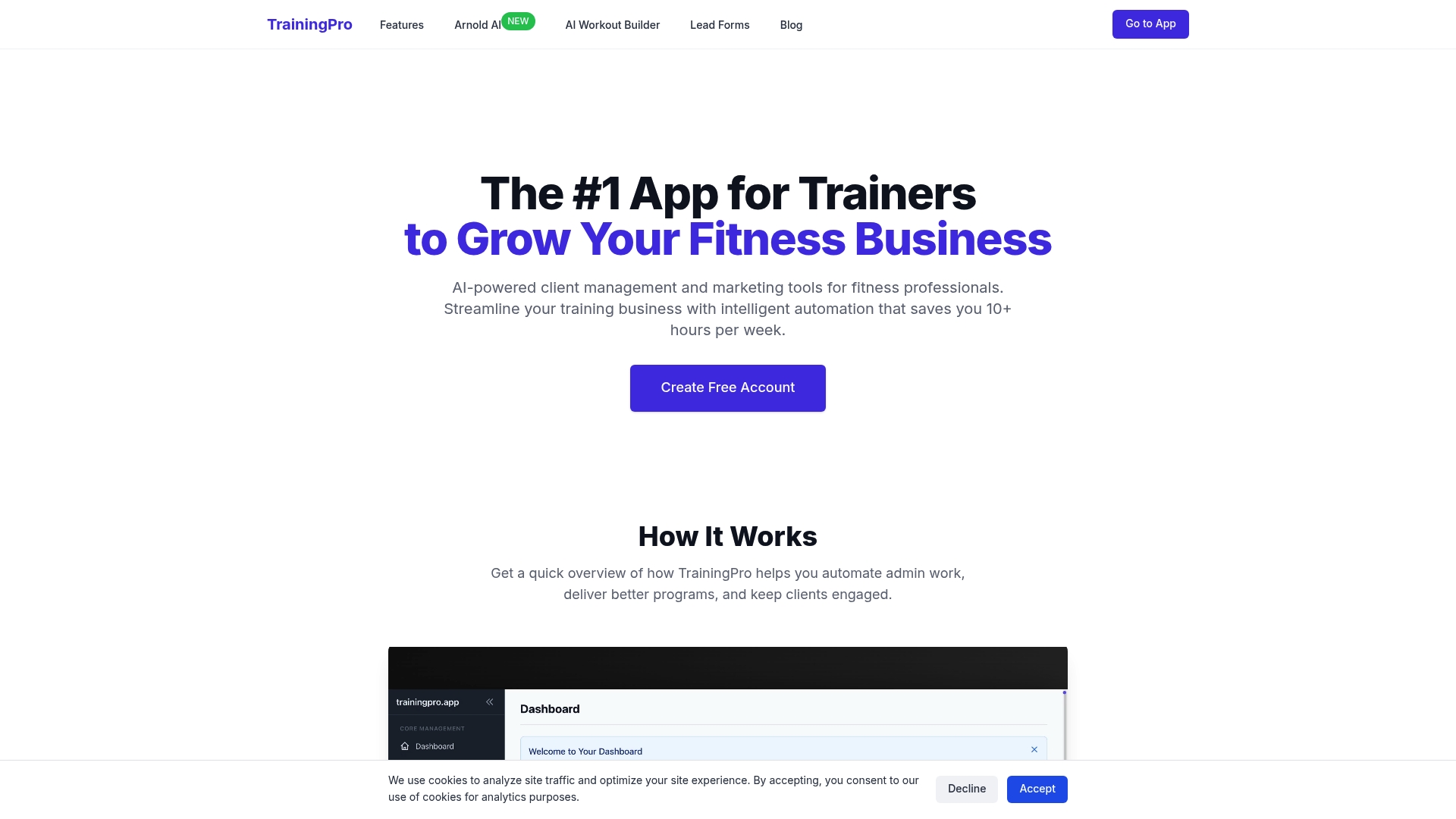
When client needs change due to injury, schedule shifts, or goal evolution, AI assistance enables rapid program modifications without starting from scratch. You maintain training continuity while adapting to new constraints. The platform’s AI workout builder handles the technical details of exercise selection, volume distribution, and progression schemes, freeing you to focus on coaching and client relationships.
Share completed programs seamlessly through the platform’s client portal, where individuals access workouts, log performance, and track progress over time. Group training features allow you to manage multiple clients efficiently, while lead generation forms help expand your client base through automated marketing funnels. Download our free AI-powered workout builder guide to discover how automation can save you hours weekly while improving client engagement and results.
Pro Tip
Use AI tools to create program templates for common client profiles, then customize individual variables quickly, building a scalable system that maintains personalization without excessive time investment per client.
FAQ
PPL offers balanced muscle group focus with twice-weekly frequency for each major area, optimizing hypertrophy stimulus while allowing adequate recovery between sessions. The structure is highly customizable for individual client goals, equipment access, and time constraints. You can easily adjust exercise selection, volume, and intensity without changing the fundamental split pattern, making it adaptable as clients progress.
The mechanics-consistency-intensity hierarchy prioritizes solid movement technique over intensity during early training phases, substantially decreasing injury risk from loading poor patterns. Clients advance to higher intensities only after demonstrating consistent proper form across multiple sessions. This progression model tailors advancement to individual readiness rather than arbitrary timelines, ensuring each client builds a strong technical foundation before facing significant training loads.
HIT works best for experienced clients who recover well from maximal effort training and possess strong mind-muscle connection to safely reach true muscular failure. These individuals typically have several years of consistent training history and understand their body’s recovery signals. The approach is less ideal for beginners lacking technique mastery, clients with poor recovery capacity due to sleep or stress issues, or those who enjoy frequent training sessions and social gym environments.
Hybrid programs enhance both cardiovascular and muscular fitness simultaneously through strategic microcycle organization that prevents interference effects. This approach allows you to tailor the balance between endurance and strength development based on specific client goals and competition demands. Athletes requiring multiple fitness qualities, such as CrossFit competitors or tactical professionals, benefit significantly from hybrid structures that maintain comprehensive physical readiness.
Yes, MRT matches or exceeds traditional steady-state cardio for improving sprint performance and VO2max, especially in trained clients seeking time-efficient conditioning. Research demonstrates that properly designed resistance circuits create sufficient cardiovascular stimulus while preserving muscle mass better than pure aerobic work. However, endurance athletes training for long-distance events still benefit from sport-specific aerobic volume that MRT cannot fully replicate due to different energy system demands and movement patterns.
Recommended
Ready to Transform Your Fitness Business?
Join thousands of trainers using TrainingPro to automate admin, grow their client base, and focus on what they love—coaching.
Start your 14-day free trial • Cancel anytime


