
Boost client outcomes with exercise data in 2026
TL;DR
Visual perception errors in velocity loss tracking can reach an average of 2.6 reps, impacting training precision. Combining systematic data collection with human coaching enhances client progress, engagement, and professional credibility. Effective coaching involves using technology as a tool to inform personalized programming while trusting your judgment and ongoing reflection.
You can watch a client’s squat form, count their reps, and sense their effort level. But here’s what surprises most trainers: coaches’ visual perception of velocity loss in resistance training carries an average absolute error of 2.6 reps. That gap between what you see and what’s actually happening matters. When you add systematic exercise data collection to your instincts, you stop guessing and start coaching with precision. This article breaks down exactly how to do that in ways that improve your clients’ results, deepen their engagement, and grow your fitness business.
Why exercise data matters for modern coaches
With the stakes set, let’s look at why exercise data is indispensable for the modern fitness coach.
Data is not about replacing your expertise. It’s about giving your expertise a sharper edge. When you track the right numbers consistently, you can spot plateaus before your client feels stuck, adjust load before fatigue becomes injury, and prove your methods are working.
ACSM guidelines emphasize reviewing client data to individualize exercise prescription using the FITT-VP framework: Frequency, Intensity, Time, Type, Volume, and Progression. This isn’t just academic advice. It’s the professional standard. Without data, you’re applying the same general logic to every client. With data, you’re building something uniquely theirs.
Consider what data actually does for your coaching practice:
- Reveals real progress that a client might not feel subjectively, giving them visible evidence that their hard work is paying off
- Identifies weak spots in programming, like a stalled strength metric or declining workout adherence, before they derail results
- Builds professional credibility because clients see you operating with intention, not guesswork
- Supports client conversations when you can reference specific numbers during check-ins instead of relying on memory
The custom training program benefits for clients go far beyond aesthetics. Personalization, backed by data, is what drives long-term retention and genuine transformation.
"Effective exercise prescription is not one-size-fits-all. Data-driven individualization, guided by frameworks like FITT-VP, is the foundation of evidence-based coaching practice." — ACSM Certified Personal Trainer Exam Content Outline
When you walk into a session knowing what your client’s last three weeks looked like in terms of volume, intensity, and attendance, you are operating at a fundamentally different level. That’s what data makes possible.
Human observation versus technology: What the evidence shows
Understanding why data matters, it’s vital to distinguish how human observation stacks up against digital tools.
Trainers are skilled observers. You read body language, catch form breakdowns, and pick up on energy shifts in real time. Those skills are irreplaceable. But the research is clear that the human eye has real limits when it comes to estimating physiological variables with precision.
Coaches’ visual perception of velocity loss carries an average absolute error of 2.6 reps. In velocity-based training, that kind of error changes the entire session. It means a client could be leaving more in the tank than you realize, or pushing harder than is productive.
At the same time, technology is not a perfect substitute. Research shows that technology-aided training improves squat speed but does not necessarily improve self-efficacy. In fact, clients with low sport involvement benefit more psychologically from traditional human coaching. This finding is important: the data tool does not replace the coach’s motivational role.
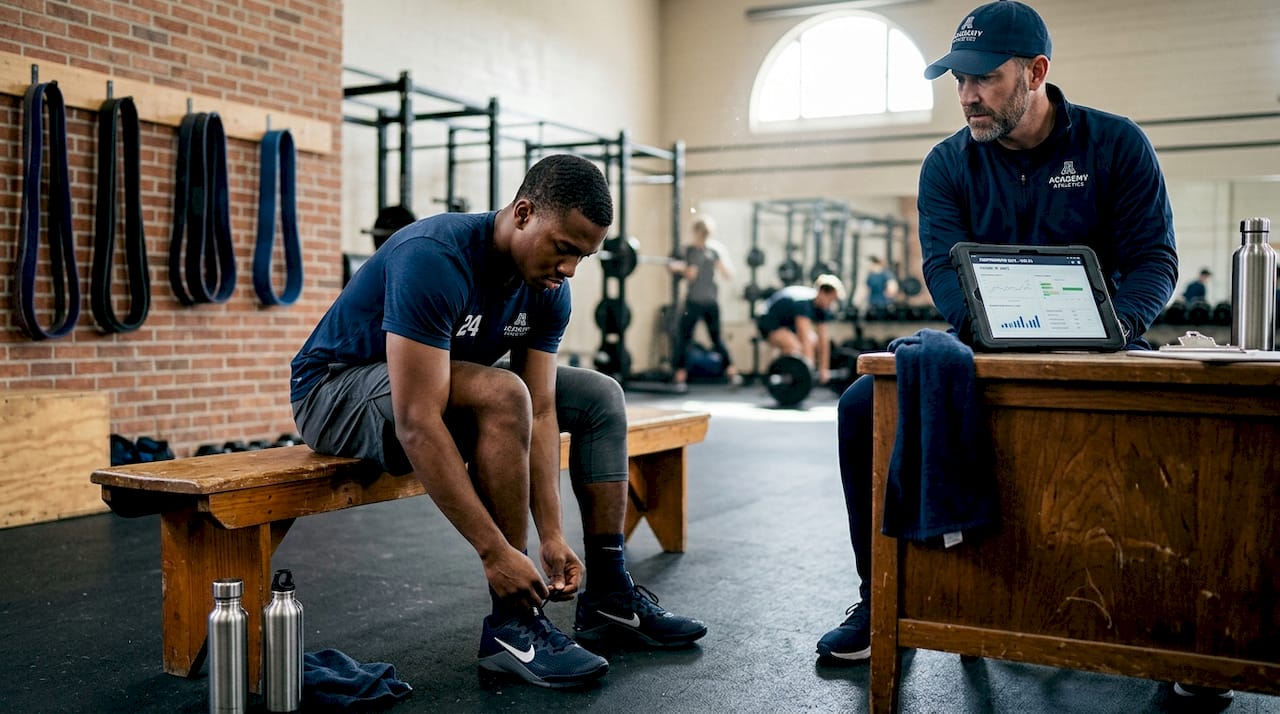
For those working with student athletes, student athlete tech training highlights how blending tech with human guidance produces stronger overall outcomes than either approach alone. The role of technology in coaching has never been about replacement. It’s always been about elevation.
Here’s a side-by-side comparison to put it in perspective:
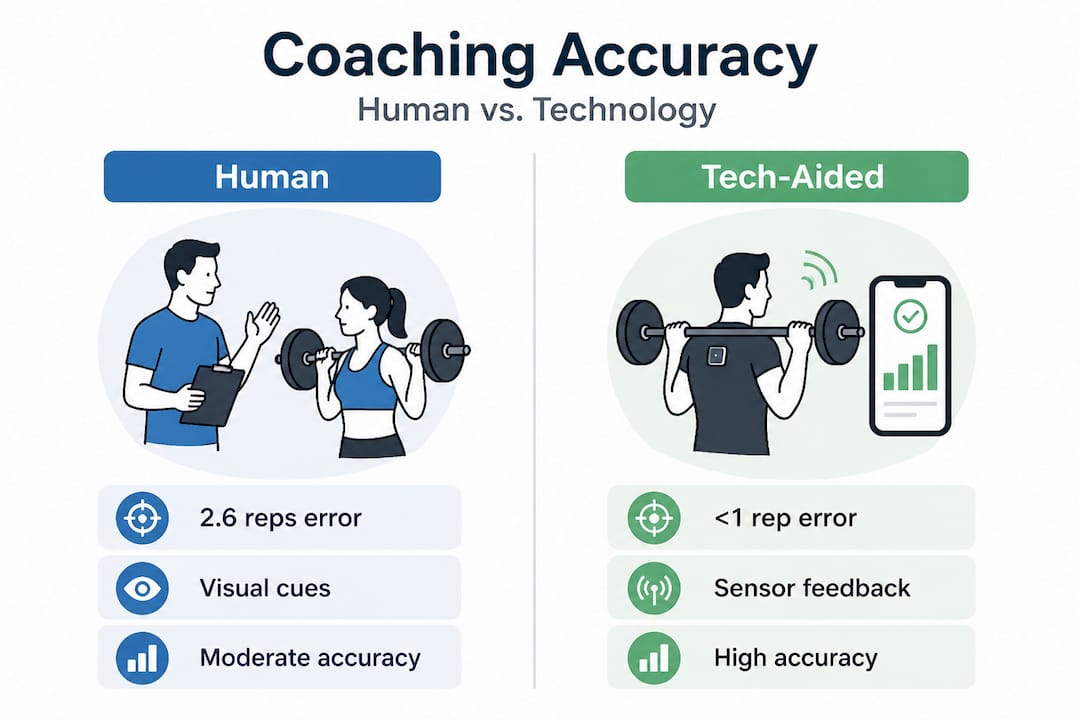
The takeaway here is not “use tech or use intuition.” It’s “use both, and know which tool serves which moment.”
Pro Tip
Never let a wearable or app replace the check-in conversation. Some of your best coaching insights come from asking “how did that feel?” and comparing the answer to what the data shows. When the two don’t match, that’s where the real coaching opportunity lives.
Decoding wearable and app data: What’s realistic and what’s not
After considering tech’s promise and pitfalls, it’s crucial to decode what wearable and app data actually means and where its limits lie.
Not all metrics are created equal. Fitness trackers and apps generate an impressive volume of numbers, but some of those numbers are far more reliable than others. As a trainer, your job is to know which data points to trust and which ones to treat with skepticism.
Here’s a practical breakdown of wearable accuracy across common metrics:
| Metric | Accuracy range | Notes |
|---|---|---|
| Heart rate (rest/moderate effort) | ±3 to 5 bpm | Reliable for steady-state work |
| Heart rate (>85% max effort) | Degrades significantly | Motion artifacts cause errors |
| Step count | 68 to 82% accurate | Better on treadmill than free movement |
| Energy expenditure | 56 to 71% accurate, errors >25% | Treat calorie counts as estimates only |
| Sleep wake detection | >90% accurate | Staging (REM, deep) only 60 to 75% accurate |
Motion artifacts reduce wrist-based heart rate accuracy significantly during HIIT and strength training. Composite metrics like “readiness scores” or “recovery scores” carry their own risks because most of them lack rigorous independent validation. They blend multiple imperfect signals into a single number, which can mislead you and your client.
Here’s a clear way to split what to trust versus what to question:
Data worth acting on:
- Heart rate trends over time (improving resting HR, faster recovery between sets)
- Session completion rates and adherence patterns
- Sleep duration trends across weeks
- Performance benchmarks like load lifted or pace per mile over time
Data to use with caution:
- Single-session calorie counts
- “Readiness” or “strain” composite scores without validation
- Sleep stage percentages
- Wrist HR data during high-intensity intervals
Understanding recovery tracking examples from experienced athletes reinforces the same principle: context and trend matter far more than isolated data points.
Your workout tracking features and fitness data analytics practices should reflect this. Focus on patterns across sessions, not outliers in a single workout.
Pro Tip
Always compare data within the same device over time. Cross-device comparisons (e.g., switching from one brand to another) invalidate trends. Consistency in the tool you use is as important as the data it generates.
Turning data into action: Personalization and progress tracking
Now that you know which numbers to trust, the next step is making exercise data meaningful through powerful, personalized coaching.
Raw numbers don’t coach anyone. You do. The goal is to translate what your data is telling you into specific programming decisions that move each client forward. Here’s a step-by-step process to do exactly that:
- Review the last two to four weeks of session data. Look at load, volume, and completion rates. Are they trending up, flat, or declining? A plateau in strength metrics across three or more sessions usually signals a need for deload or programming variation.
- Check readiness indicators before each session. This could mean asking how they slept, reviewing resting HR from their wearable, or looking at their subjective energy rating. High fatigue plus heavy load is a recipe for poor performance and increased injury risk.
- Adjust intensity based on what the data reveals, not just what’s written in the plan. ACSM guidelines support individualization over rigid adherence to a template. If a client’s performance metrics are dropping, that’s your cue to reduce volume or intensity, even if the plan says otherwise.
- Celebrate milestone data points with your client. When their average pace improves or they hit a new personal best on a compound lift, name it explicitly. Tie it back to their specific goal. This moment of recognition is powerful for motivation and retention.
- Log your programming changes and the reason for each adjustment. This creates a coaching record that informs every future decision and demonstrates your professional depth to clients.
Personalization goes deeper than just load and volume. Use data-driven cues to tailor programs around the whole person:
- Injury history: Adjust movement patterns and avoid loading patterns that spike discomfort scores
- Readiness scores and sleep trends: Lower-intensity active recovery sessions on poor-sleep days
- Goal-specific tracking: If the goal is hypertrophy, track volume load (sets x reps x weight) per muscle group each week
- Behavioral patterns: If a client consistently cancels Monday sessions, restructure their schedule around higher-adherence days
The connection between tracking and retention is real. When clients see their progress laid out in clear, objective terms, they feel the investment is working. Tracking progress keeps clients engaged and gives them a reason to stay.
If you want to build programs that actually respond to client data, the fitness program customization process starts with defining the right metrics for each goal. For a clear framework on structuring that work, the step-by-step program design process provides a reliable starting point that you can adapt with data as you go.
Expert perspective: The data-driven coach’s real leverage
Having broken down actionable tactics, let’s pause for a reality check: here’s an honest view on where trainers can go wrong and what actually works.
The fitness industry tends to swing between two extremes. Either trainers over-rely on instinct or they over-trust technology. Both extremes are weak links in the coaching chain.
Here’s the uncomfortable truth: most validation studies on wearable accuracy and VBT have a high bias risk. The research is promising but far from settled. That means even your best tech tools are working from imperfect foundations. And your own perception, however experienced, carries measurable error too.
So where does that leave you? It leaves you in the most important role there is: the integrator. The trainer who uses data as a prompt for better questions, not as a replacement for professional judgment. Technology excels at capturing physiological signals. You excel at understanding what those signals mean in the context of this client, this week, this goal.
The trainers who grow fastest in 2026 are not the ones with the most expensive wearables or the most complex tracking spreadsheets. They’re the ones who use data analytics perspectives to continually test, adjust, and improve their own programming assumptions.
"The human eye approximates velocity-based training thresholds but with error. Technology delivers stronger physiological gains; human coaching delivers stronger psychological and motivational outcomes. True coaching mastery is knowing which lens to apply and when."
Build a practice of reviewing your data not just to adjust client programs, but to challenge your own coaching assumptions. Ask yourself: “Was I right about this?” Let the numbers tell you. That habit of reflection is what separates good trainers from genuinely excellent ones.
Elevate your coaching with integrated exercise data tools
If you’re ready to apply these lessons at scale, powerful but easy-to-use tools can make all the difference for your clients and your business.
TrainingPro is built specifically for fitness professionals who want to turn data into results without spending hours buried in spreadsheets. The AI-powered workout builder helps you design programs that adapt to individual client data, goals, and training history in minutes. Every workout, every adjustment, and every milestone can be tracked inside one unified platform.

If you’re curious about where AI fits into your coaching model, the AI training business guide walks you through practical strategies for integrating automation without losing the personal touch your clients value. And if you want an AI assistant that actually understands fitness programming, Arnold AI generates tailored programs considering injuries, training style, and individual goals, giving you a true head start on every client plan. Your data deserves a platform built to use it well.
Frequently asked questions
Most wearables are reliable for heart rate at rest and moderate effort (±3 to 5 bpm) but can be off by 25% or more for calorie counts and intense-activity measures, so use them for trend tracking rather than exact values.
Focus on trends within the same device over time, including performance improvements, adherence rates, and client feedback, rather than placing too much weight on any single-session statistic.
No. While technology enhances performance tracking, low sport involvement clients benefit more psychologically from human coaching, making the trainer’s motivational and relational role essential regardless of the tools you use.
When clients can see objective proof of their progress over time, including improved performance metrics and consistency trends, they stay more engaged, feel more motivated, and are significantly more likely to continue their programs long-term.
Recommended
- Data analytics in fitness coaching: boost results in 2026 | TrainingPro
- Why track fitness progress: boost client engagement | TrainingPro
- Fitness coaching success: 2026’s top industry trends | TrainingPro
- How to create workout programs fast using AI in 2026 | TrainingPro
- Executive fitness: boost vitality and performance in 2026
Ready to Transform Your Fitness Business?
Join thousands of trainers using TrainingPro to automate admin, grow their client base, and focus on what they love—coaching.
Start your 14-day free trial • Cancel anytime


