
Fitness program customization: boost client results in 2026
Most trainers know that a program written for a 22-year-old college athlete will not work for a 45-year-old recovering from a knee surgery. Yet a surprising number of fitness professionals still rely on slightly tweaked templates and call it personalization. The gap between a generic plan and a truly customized one is not cosmetic. It directly determines whether your client hits their goals, stays engaged, or quietly cancels their membership. This guide breaks down what fitness program customization actually means, how to build it systematically, and why the evidence in 2026 makes a compelling case for going all in on individualized programming.
Table of Contents
- What is fitness program customization?
- Core mechanics of designing a customized fitness program
- Applying customization for diverse client needs: Cases and nuances
- Does customization deliver better results? Evidence and practical benchmarks
- Balancing technology, supervision, and evidence: What the research says for 2026
- Take your program customization to the next level with TrainingPro
- Frequently asked questions
Key Takeaways
| Point | Details |
|---|---|
| Customization drives results | Customized fitness programs lead to better engagement, safety, and progress than generic approaches. |
| Evidence-based process | Use structured assessments and FITT-VP principles to design tailored workouts for each client. |
| Adapt for unique client needs | Adjust programs for injuries, lifestyle, and changing goals to maximize effectiveness and retention. |
| Blend tech and supervision | Leverage digital tools for efficiency but prioritize personal feedback for optimal outcomes. |
What is fitness program customization?
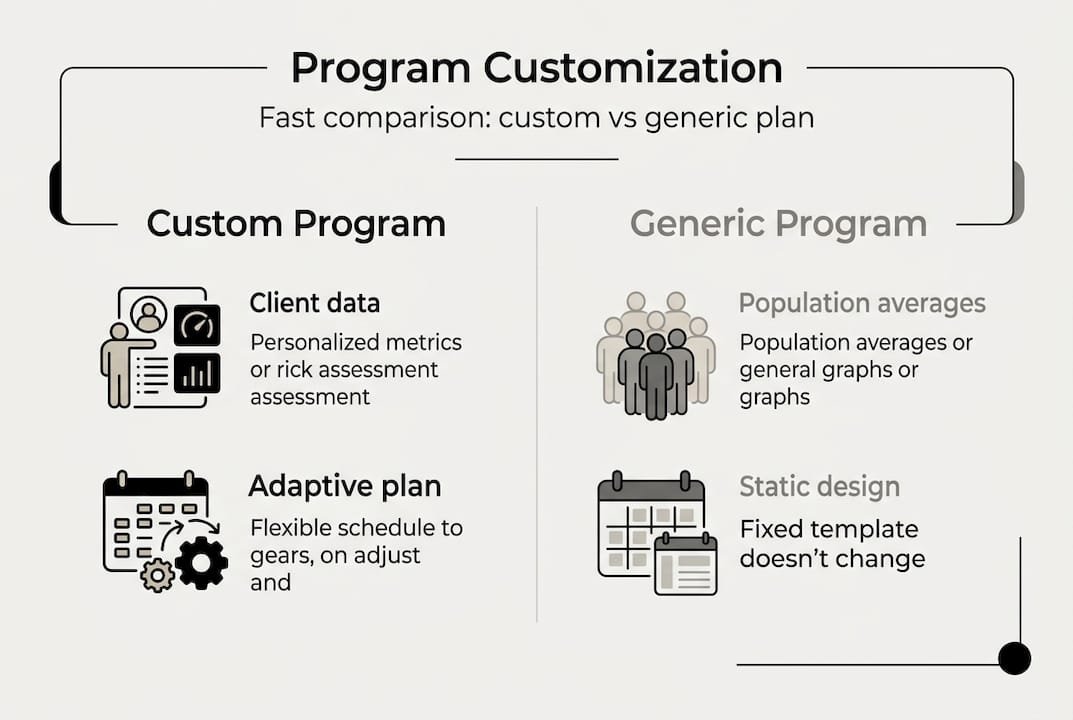
Fitness program customization is not just swapping out exercises. Customized program design is the process of building individualized workout plans based on a client’s unique fitness level, goals, medical history, lifestyle, injuries, and preferences. That is a fundamentally different starting point than pulling a 12-week template off a shelf and adjusting the weights.
Generic programs assume an average client. Custom programs assume your specific client. The distinction matters because no two clients walk in with the same combination of movement limitations, time constraints, motivational triggers, and performance targets. Trainers who understand this consistently produce better trainer success stories and retain clients longer.
“Fitness program customization means designing every variable of a client’s training around who they actually are, not who the average client is.”
The variables that shape a truly custom program include:
- Fitness goals (fat loss, muscle gain, sport performance, general health)
- Current fitness level and training history
- Medical history, injuries, and movement limitations
- Schedule availability and session frequency
- Lifestyle factors (stress, sleep, nutrition habits)
- Personal preferences (training style, equipment access, motivation type)
Meeting online coaching standards in 2026 means treating these variables as non-negotiable inputs, not optional add-ons. Clients who feel seen in their program are far more likely to show up consistently.
Core mechanics of designing a customized fitness program
Knowing what customization is and knowing how to build it are two different skills. The process follows a clear sequence, and skipping steps is where most trainers lose precision.
Here is the core workflow for building a custom program from scratch:
- Initial assessment: Movement screening, strength testing, cardiovascular baseline, and a thorough health history intake. This is where you catch contraindications early. Strong screening and evaluations at this stage prevent costly mistakes later.
- Goal setting: Establish specific, measurable short and long-term targets with the client. Vague goals produce vague programs.
- Program design using FITT-VP: Apply Frequency, Intensity, Time, Type, Volume, and Progression as your design framework. ACSM resistance training guidelines provide the evidence-based benchmarks for each variable.
- Periodization: Structure training phases (accumulation, intensification, deload) to prevent plateaus and manage fatigue over time.
- Monitoring and adjustment: Track performance data, subjective feedback, and adherence. Adjust the program based on what the data tells you, not just intuition.
The core mechanics of personalized design involve this full cycle of assessment, design, progressive overload, periodization, and ongoing adjustment. Cutting corners at any stage weakens the entire structure.
Using the right trainer software tools can dramatically speed up this process without sacrificing quality. Template libraries give you a starting structure, and customization layers on top.
Pro Tip
Build a library of 5-8 program templates organized by client archetype (beginner, intermediate, injury-modified, performance). Use them as scaffolding, then customize the key variables for each individual. You cut design time in half without losing personalization.
Applying customization for diverse client needs: Cases and nuances
The real test of your customization skills is not with your ideal client. It is with the edge cases: the postpartum mom returning to exercise, the 60-year-old with osteoporosis, the busy executive who can only train twice a week. These clients require more than adjusted weights.
| Client type | Key modifications |
|---|---|
| Beginner | Low volume, form-focused, simple movement patterns, longer rest periods |
| Injured client | Regressions, pain-free range of motion, medical clearance, compensatory work |
| Postpartum | Pelvic floor considerations, gradual load increase, fatigue management |
| Busy professional | High-efficiency formats (supersets, circuits), flexible scheduling, home options |
| Advanced athlete | Periodized blocks, sport-specific loading, advanced monitoring, tech integration |
Edge case programming requires that beginners focus on form and low volume, injured clients need regressions and modifications, and advanced clients benefit from tech-enabled feedback loops. Treating all three the same way is a fast path to poor results and lost clients.
Common challenges trainers face when customizing for these populations include:
- Incomplete intake information leading to missed contraindications
- Client resistance to lower intensity when they expect hard workouts from day one
- Overcomplicating programs for clients who need simplicity and consistency
- Underestimating lifestyle factors like sleep deprivation or high stress that affect recovery
- Failing to reassess as the client progresses and their needs shift
Wearables and fitness apps add a useful layer here. Heart rate variability data, sleep tracking, and step counts give you objective lifestyle context that clients often forget to mention. Pairing that data with strong customization strategies gives you a much clearer picture of what each client actually needs on any given week.

Pro Tip
Add a weekly check-in question to your client communication: "On a scale of 1-10, how recovered do you feel this week?" That single data point helps you make smarter real-time adjustments than any wearable alone. Pair it with your personal training checklist to keep every client touchpoint consistent.
Does customization deliver better results? Evidence and practical benchmarks
The question every trainer should be able to answer confidently: does all this extra work actually produce better outcomes for clients? The research in 2026 says yes, and the margin is not small.
“Personalized programs improve exercise attitudes, well-being, and health status more than generic plans, and supervised personalization yields superior strength and body composition gains.”
That finding holds across age groups, fitness levels, and training goals. Clients on customized plans report higher motivation, better adherence, and more consistent progress. For trainers, that translates directly into retention, referrals, and reputation.
Here are the evidence-based benchmarks every trainer should use to anchor their program design:
- Strength training: Work at 80% of 1RM for 2-3 sets per exercise for strength-focused goals.
- Hypertrophy: Target 10 or more sets per muscle group per week for meaningful size gains.
- Training frequency: Hit major muscle groups at least twice per week for optimal adaptation.
- Visible results timeline: Clients following a personalized plan consistently see visible changes in 6-8 weeks with proper adherence.
- Early wins: Strength and energy improvements typically appear within 2-4 weeks, which is critical for early client motivation.
These benchmarks are not arbitrary. They come from decades of controlled research and give you defensible standards to build your programs around. When a client asks why you programmed a specific volume or intensity, you have a clear, evidence-based answer.
Monitoring is what keeps these benchmarks relevant over time. A client who started at 60% of their 1RM six weeks ago may now be ready for 75%. Without tracking, you miss that window. Use your training checklist to build reassessment points into every program cycle.
Balancing technology, supervision, and evidence: What the research says for 2026
AI-powered apps, wearables, and digital platforms have changed what is possible in program customization. But the research draws a clear line between what technology can do and what it cannot replace.
Supervised personalization consistently outperforms AI and app-only approaches for both outcomes and safety. Technology helps with scale and engagement, but over-customization through algorithms can actually undermine the basics of consistent, progressive training.
Here is how the two approaches compare in practice:
Tech-enabled customization strengths:
- Scales to large client rosters without proportional time investment
- Provides real-time data from wearables and app check-ins
- Automates program delivery, reminders, and progress tracking
- Supports AI-based programming that adapts based on logged performance
Tech-enabled customization risks:
- Lacks the nuanced judgment of a trained coach observing movement quality
- Can generate overly complex programs that confuse or overwhelm clients
- Misses emotional and psychological cues that affect adherence
- Wellness app engagement drops sharply without human accountability built in
Supervised coaching strengths:
- Real-time form correction prevents injury and builds better movement patterns
- Relationship-driven accountability dramatically improves adherence
- Coach judgment adapts the session based on how the client presents that day
Supervised coaching risks:
- Does not scale easily beyond a set number of clients
- Relies heavily on the individual coach’s knowledge and consistency
Pro Tip
The most effective approach in 2026 is a hybrid model. Use technology to handle program delivery, tracking, and communication at scale. Reserve your direct coaching time for assessment, form coaching, and relationship building. Check out the AI builder guide to see how trainers are combining both without burning out.
Take your program customization to the next level with TrainingPro
Everything covered in this guide, from initial assessment to adaptive programming to evidence-based benchmarks, requires a system that keeps all the moving parts organized. That is exactly what TrainingPro is built for.

The AI Workout Builder lets you generate fully customized programs in minutes, not hours, using client-specific inputs like goals, injuries, and training history. Arnold AI, TrainingPro’s built-in AI assistant, factors in individual needs and training styles to produce programs that meet professional standards without starting from scratch every time. Trainers using TrainingPro report saving over 10 hours per week on program creation and client management, time that goes back into coaching, growing your client base, and delivering the kind of personalized experience that keeps clients coming back.
Frequently asked questions
Personalized programs measurably improve exercise attitudes, well-being, and physical outcomes compared to generic plans. Clients on custom programs also show higher adherence and longer retention with their trainer.
Every program should reflect individual goals, starting fitness level, and key lifestyle factors at minimum. ACSM guidelines support using evidence-based frameworks as a foundation, then tailoring the key variables rather than building everything from scratch.
AI-powered platforms, wearables, and digital assessment tools all support faster and more adaptive program creation. However, AI and app-only tools work best when combined with direct coaching rather than used as a standalone solution.
Most clients notice strength and energy improvements within 2-4 weeks. Visible physical changes typically appear in 6-8 weeks when the client follows a personalized plan consistently.
Recommended
- Why track fitness progress: boost client engagement | TrainingPro
- Boost client retention in personal training: 2026 strategies | TrainingPro
- Why use custom training programs: boost client results | TrainingPro
- Effective workout program examples for trainers in 2026 | TrainingPro
Ready to Transform Your Fitness Business?
Join thousands of trainers using TrainingPro to automate admin, grow their client base, and focus on what they love—coaching.
Start your 14-day free trial • Cancel anytime


