
Professional standards in online fitness coaching: 2026

Many fitness professionals assume online coaching demands less professionalism than in-person training. This misconception undermines client safety and business credibility. Professional standards in online fitness coaching encompass ethical guidelines, legal boundaries, personalized programming, and transparent communication. Understanding these standards protects clients, builds trust, and establishes sustainable coaching practices. This guide explores ethical responsibilities, technology use, client relationships, and practical strategies fitness professionals need to maintain high standards while scaling their online coaching business in 2026.
Table of Contents
- Understanding professional standards in online fitness coaching
- Navigating ethical guidelines and legal boundaries in online fitness
- Technology and personalized programming: handling challenges responsibly
- Building effective client relationships and maintaining professional boundaries online
- Explore TrainingPro tools to elevate your online coaching
- Frequently asked questions about professional standards in online fitness
Key takeaways
| Point | Details |
|---|---|
| Ethical and legal boundaries | Online fitness professionals must uphold clear ethical guidelines and distinguish coaching from clinical practice to protect clients and reduce legal risks. |
| Personalized programming standards | Tailored workout design considering individual client goals, limitations, and injuries is essential for effective and safe online coaching. |
| Technology and data privacy | Responsible use of fitness technology requires careful handling of client data privacy and awareness of algorithmic limitations. |
| Clear coaching agreements | Structured contracts defining roles, responsibilities, and service scope prevent misunderstandings and protect both coach and client. |
| Client relationships and accountability | Building trust through structured communication cycles and professional boundaries drives client success and retention. |
Understanding professional standards in online fitness coaching
Professional standards in online fitness coaching define the ethical, legal, and operational framework that separates qualified coaches from those operating without proper guidelines. These standards protect clients from harm, establish clear service boundaries, and create accountability structures that benefit both parties. Unlike in-person training where physical presence naturally creates some boundaries, online coaching requires explicit definition of what services you provide and what falls outside your scope.
The document provides insights and considerations for ethics in coaching, supporting members of the coaching profession in ethical decision-making. Ethical responsibilities include maintaining client confidentiality, obtaining informed consent before beginning any coaching relationship, and communicating clearly about what clients can expect. These aren't just nice-to-have practices. They form the foundation of trust that makes online coaching relationships work.
Legal considerations distinguish coaching from clinical practice. You cannot diagnose injuries, prescribe treatment for medical conditions, or provide nutrition plans that require licensed dietitian expertise. Crossing these boundaries exposes you to significant legal liability and puts clients at risk. Professional standards require you to recognize when a client needs referral to qualified medical professionals rather than attempting to address issues beyond your training.
Coaching agreements serve as your primary tool for defining these boundaries. A comprehensive agreement outlines your services, client responsibilities, payment terms, cancellation policies, and limitations of your role. This document protects you legally while setting clear expectations that prevent scope creep. When clients understand exactly what they're receiving, satisfaction increases and conflicts decrease.
These standards directly impact your business success. Clients choosing between coaches evaluate professionalism through your communication, contracts, and service delivery. Demonstrating high standards through structured processes and clear boundaries builds the trust necessary for client retention and referrals. Learning to build professional page for fitness business showcases these standards to potential clients.
Key elements of professional standards include:
- Maintaining strict client confidentiality across all communication channels
- Obtaining written informed consent before starting coaching relationships
- Clearly defining service scope and limitations in coaching agreements
- Establishing transparent pricing and payment structures
- Creating documented processes for client onboarding and offboarding
- Implementing regular review cycles to assess client progress and satisfaction
Navigating ethical guidelines and legal boundaries in online fitness
Ethical guidelines provide the moral compass for your coaching practice, while legal boundaries define what you can and cannot do under law. Standard 1.1 highlights the ICF Professional's responsibility to communicate and explain the nature of coaching to clients before the coaching engagement begins. This transparency requirement ensures clients understand what they're purchasing and what results they can reasonably expect.
Informed consent goes beyond having clients sign a waiver. It requires explaining your qualifications, the coaching process, potential risks, and what happens if clients experience pain or discomfort. You must verify clients have no medical conditions requiring physician clearance before beginning exercise programs. Documenting this process protects you legally and demonstrates professional responsibility.
Confidentiality obligations mean you cannot share client information, progress photos, or workout details without explicit written permission. This extends to social media testimonials, before-and-after transformations, and case studies. Even seemingly harmless posts can violate confidentiality if clients haven't specifically authorized that use of their information.

Legal boundaries become critical when distinguishing coaching from clinical services. Blurred boundaries between coaching and clinical services can lead to scope creep, where clients perceive coaching as treatment, increasing legal and regulatory risks. You cannot diagnose injuries, treat medical conditions, or provide therapeutic interventions requiring licensed healthcare provider credentials.
Establishing clear coaching agreements prevents these boundary violations. Your contract should explicitly state:
- Services you provide (program design, accountability, technique coaching)
- Services you do not provide (injury diagnosis, medical treatment, licensed nutrition counseling)
- Client responsibilities (medical clearance, honest communication, following programs as designed)
- Your responsibilities (timely communication, personalized programming, professional conduct)
- Termination conditions for either party
- Liability limitations and assumption of risk acknowledgments
Scope creep happens when clients ask for services outside your defined role and you accommodate without adjusting agreements. A client requesting meal plans when you're not a registered dietitian, or asking you to diagnose shoulder pain, puts you in legal jeopardy. Professional standards require you to recognize these requests and either refer clients to appropriate professionals or clearly decline.
Pro Tip
Create a written code of conduct outlining your ethical standards and review it with new clients during onboarding. This proactive approach demonstrates professionalism and sets clear expectations from day one.
Transparent communication serves as both ethical requirement and legal protection. Document all client interactions, program modifications, and concerns they raise. If a client reports pain, document your response and any referrals you provide. This paper trail demonstrates you acted professionally if questions arise later. Using a personal training checklist 2026 ensures you consistently follow professional protocols.
Technology and personalized programming: handling challenges responsibly
Technology enables online fitness coaching but introduces unique professional challenges. The use of technology in online fitness introduces new ethical considerations, particularly regarding data privacy and algorithmic bias. Client data including personal information, health history, progress photos, and workout performance requires secure storage and careful handling. Using platforms with proper encryption and data protection measures isn't optional. It's a professional standard.
Algorithmic bias in fitness apps can recommend inappropriate exercises for certain populations or fail to account for individual limitations. Relying solely on automated recommendations without applying professional judgment violates your responsibility to provide personalized service. Technology should enhance your coaching, not replace your expertise and critical thinking.
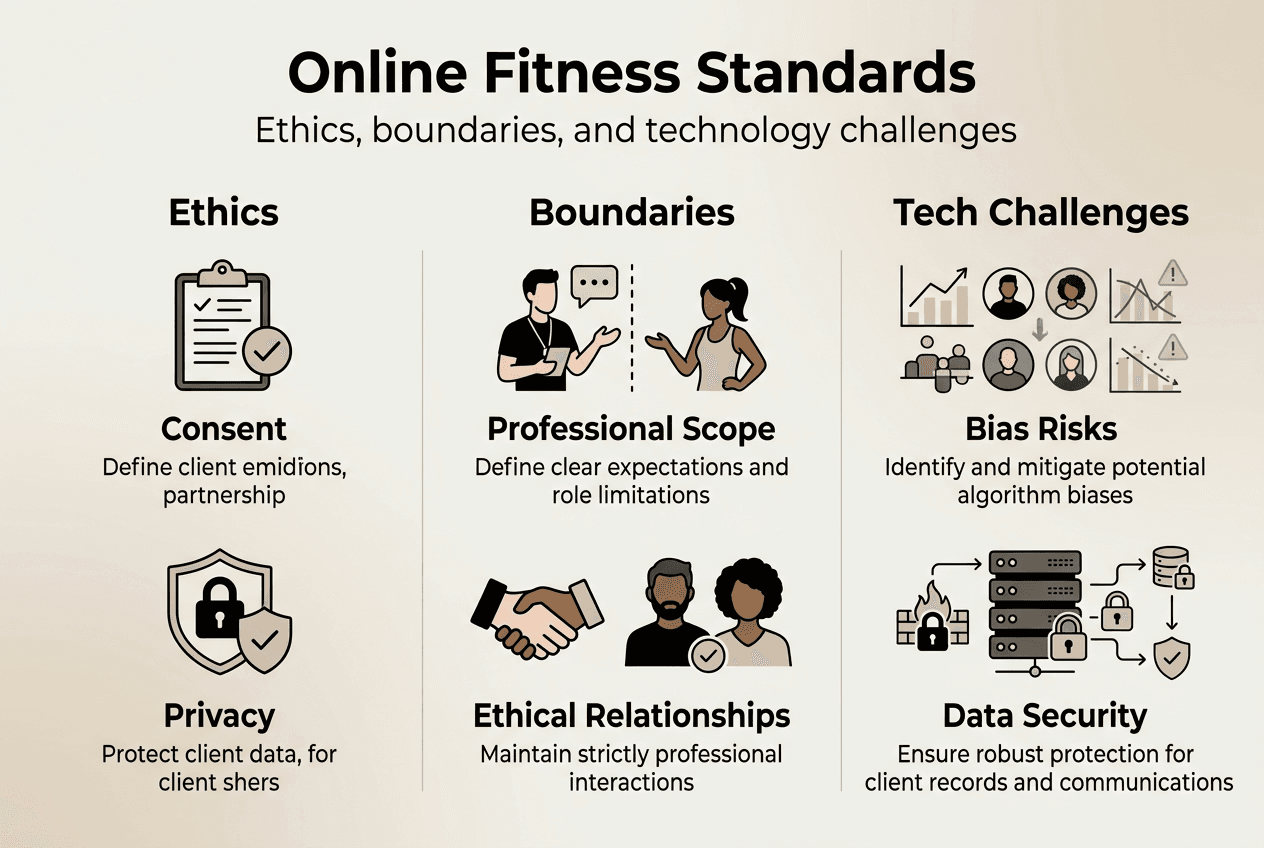
Comparing technology approaches reveals important considerations:
| Technology Type | Benefits | Risks | Professional Standard |
|---|---|---|---|
| Generic workout apps | Low cost, easy access | No personalization, injury risk from inappropriate exercises | Supplement only, never replace coaching |
| Custom programming software | Personalized design, progress tracking | Data privacy concerns, learning curve | Use platforms with encryption and clear data policies |
| Video communication tools | Real-time feedback, relationship building | Privacy violations if not HIPAA-compliant | Obtain consent, use secure platforms |
| AI workout generators | Time efficiency, variety | Lack context about injuries and limitations | Review and modify all AI suggestions before delivering to clients |
A common pitfall is the over-reliance on generic workout plans without considering individual client needs and limitations. Professional standards require you to assess each client's goals, experience level, injury history, equipment access, and schedule constraints before designing programs. Cookie-cutter PDFs sent to every client regardless of their situation demonstrate lack of professionalism and increase injury risk.
Best practices for personalized programming include:
- Conducting thorough intake assessments covering medical history, goals, and preferences
- Designing progressive programs that adapt as clients improve
- Tracking performance metrics to inform program adjustments
- Scheduling regular check-ins to gather feedback and address concerns
- Modifying exercises when clients report pain or difficulty
- Explaining the rationale behind exercise selection to educate clients
Progress tracking extends beyond recording weights and reps. Professional coaches monitor adherence patterns, energy levels, recovery quality, and subjective feedback. This comprehensive approach reveals when programs need adjustment before clients become frustrated or injured. Implementing structured communication schedules ensures you gather this information consistently.
Pro Tip
Structure your programming in defined cycles (4-6 weeks) with built-in assessment points rather than creating open-ended programs. This approach provides natural opportunities to evaluate progress, gather feedback, and demonstrate ongoing value to clients.
Accountability mechanisms separate effective online coaching from passive program delivery. Regular check-ins, progress reviews, and responsive communication keep clients engaged and motivated. Technology facilitates this through automated reminders, progress dashboards, and messaging systems, but your personal involvement remains essential. Learning how to create workout programs fast using AI while maintaining personalization standards demonstrates professional efficiency. Understanding personalized training program guide principles ensures technology enhances rather than replaces your coaching expertise.
Building effective client relationships and maintaining professional boundaries online
Client relationships drive retention and referrals in online fitness coaching. Successful online coaching involves a weekly cycle of assessment, programming, feedback, and accountability. This structured approach creates predictable touchpoints that build trust while maintaining professional boundaries. Clients know when to expect communication and what type of support they'll receive.
Building rapport remotely requires intentional effort. Without in-person interactions, you must create connection through responsive communication, genuine interest in client success, and consistent delivery of promised services. Video check-ins add personal dimension that text-based communication lacks. Seeing facial expressions and body language helps you gauge client motivation, confidence, and concerns more accurately.
Professional boundaries prevent relationships from becoming inappropriate or ineffective. Maintaining coach-client dynamics rather than friendship ensures you can provide honest feedback and hold clients accountable. Becoming too friendly makes difficult conversations about lack of adherence or unrealistic expectations harder to navigate. Clear boundaries also protect you from clients expecting 24/7 availability or services outside your agreed scope.
Weekly structured cycles provide framework for effective online coaching:
- Monday: Review previous week's performance data and client feedback
- Tuesday: Adjust current week's programming based on review
- Wednesday: Mid-week check-in to address questions or concerns
- Thursday: Send next week's program with explanation of changes
- Friday: Accountability message reinforcing weekend adherence
- Weekend: Available for urgent questions within defined response times
This structure creates consistency while setting boundaries around your availability. Clients learn when to expect communication rather than assuming you're always on call. Defining response time expectations in your coaching agreement (for example, within 24 hours on weekdays) prevents frustration when you don't immediately answer messages.
Motivational support distinguishes coaching from simple program delivery. Recognizing client achievements, addressing setbacks with empathy, and helping clients overcome obstacles builds the relationship that drives long-term success. This support must remain professional rather than becoming therapy or personal counseling, which requires different credentials and training.
Accountability techniques keep clients progressing toward goals:
- Regular progress photos and measurements at defined intervals
- Performance tracking showing strength and endurance improvements
- Habit tracking for nutrition, sleep, and recovery behaviors
- Weekly reflection questions prompting clients to assess their effort
- Celebration of milestones and non-scale victories
- Constructive feedback when adherence drops without judgment
Pro Tip
Experience coaching yourself by hiring a coach in an area where you want to improve. This firsthand perspective on what effective coaching feels like dramatically improves your ability to empathize with clients and structure your own coaching approach.
Scaling your business while maintaining relationship quality requires systems and boundaries. As your client roster grows, you cannot provide the same level of individualized attention to 50 clients as you did to 5. Professional standards require you to either limit client numbers to maintain quality or implement group coaching models with clearly defined service levels. Exploring business growth strategies for trainers and learning to scale fitness business automation helps you grow sustainably without compromising professional standards.
Explore TrainingPro tools to elevate your online coaching
Maintaining professional standards while scaling your online fitness business requires efficient systems that don't sacrifice personalization. TrainingPro's platform streamlines client management, program creation, and communication so you can focus on coaching rather than administrative tasks. The AI Workout Builder creates personalized programs considering individual client goals, limitations, and equipment access in minutes rather than hours.
Download the free AI-powered workout builder guide to discover how artificial intelligence can transform your fitness business while maintaining the professional standards your clients deserve. Arnold AI assistant handles routine client questions, tracks progress, and provides accountability support, saving you over 10 hours weekly while ensuring consistent client communication that builds trust and retention.
Frequently asked questions about professional standards in online fitness
Essential ethical standards include maintaining client confidentiality, obtaining informed consent before beginning coaching relationships, clearly communicating your qualifications and service limitations, and referring clients to appropriate medical professionals when issues exceed your scope. Transparent pricing, honest marketing, and delivering promised services consistently also form core ethical requirements.
Your coaching agreement should explicitly define services you provide and exclude, outline client and coach responsibilities, establish payment terms and cancellation policies, include liability waivers and assumption of risk language, and specify communication expectations and response times. Have clients sign this agreement before beginning any coaching services and review it during onboarding to ensure understanding.
Online fitness coaches cannot diagnose injuries, treat medical conditions, or provide nutrition counseling requiring registered dietitian credentials. You must distinguish coaching from clinical practice, obtain medical clearance for clients with health conditions, maintain appropriate liability insurance, and comply with data privacy regulations governing client information storage. Understanding your scope of practice prevents legal liability.
Ethical technology use requires selecting platforms with proper data encryption and privacy protections, obtaining client consent for data collection and storage, avoiding over-reliance on automated recommendations without professional review, and maintaining human oversight of AI-generated programming. Technology should enhance personalization and efficiency while you retain responsibility for all client recommendations. Following a personal training checklist 2026 ensures consistent professional technology practices.
Maintain professional boundaries by defining communication channels and response time expectations, keeping conversations focused on fitness and coaching rather than personal issues, avoiding social media friendships with current clients, and providing honest feedback even when uncomfortable. Build rapport through genuine interest in client success, consistent service delivery, and empathetic support while preserving the coach-client dynamic necessary for accountability.
When clients request services outside your scope, clearly explain why you cannot provide that service, refer them to qualified professionals who can help, and document the request and your response. Use these situations to educate clients about your role and reinforce the boundaries established in your coaching agreement. Never attempt services requiring credentials you lack, regardless of client pressure.
Recommended
- Business growth strategies for trainers in 2026 | TrainingPro
- Personal training checklist 2026: streamline success | TrainingPro
- How to Become a Personal Trainer in 2026: The Real Career Path | TrainingPro
- Best Link in Bio Platforms for Fitness Coaches: A 2026 Review | TrainingPro
- Understanding body composition: a 2026 fitness guide – Armageddon Sports


