
Unlock client engagement with fitness content libraries

TL;DR:
- A fitness content library is a structured, searchable system for delivering reusable coaching assets.
- It enhances client engagement, saves time, and scales personalized support effectively.
- Proper organization, tagging, and regular audits are key to maximizing usability and results.
If you're spending hours creating new content for every client, you're not alone. Most fitness professionals hit a wall where the volume of ad-hoc creation leads to burnout, inconsistency, and missed follow-ups. The fix isn't grinding out more material. It's building a smarter system. A well-organized fitness content library lets you store, search, and deliver your best resources repeatedly, so your coaching stays consistent and your clients stay engaged. This guide covers what a fitness content library actually is, why it outperforms random content creation, and how to build one that drives real results.
Table of Contents
- What is a fitness content library?
- How fitness content libraries transform client engagement
- Efficiency and scalability: Operational benefits for trainers and gyms
- What makes a content library usable and what most fitness pros miss
- Measure success: What outcomes should your fitness content library drive?
- Why most fitness pros miss the real value of content libraries
- Get started with your own fitness content library
- Frequently asked questions
Key Takeaways
What is a fitness content library?
A fitness content library is more than a folder of saved files. Think of it as your coaching command center: a structured, searchable system where every resource you've ever created is organized, labeled, and ready to deliver. As defined in practice, it's "an organized, on-demand collection of fitness-related assets that can be searched, reused, and delivered to clients."
This is a critical distinction: a fitness content library is not your Instagram feed or email newsletter. Social media drives awareness and engagement. A content library drives delivery and results. Reusable assets, not marketing content, are its core focus. One is built for broadcasting. The other is built for coaching.
So what belongs inside one? Here's a practical breakdown:
- Workout programs: Full training plans organized by goal, fitness level, or equipment available
- Exercise videos: Demonstration clips with coaching cues, linked to the NASM exercise library standards for form and safety
- Habit and lifestyle guides: Sleep, recovery, and daily movement resources that support training
- Nutrition resources: Meal templates, macro guides, and simple eating frameworks
- FAQs and coaching notes: Answers to the questions clients ask repeatedly
- Resource guides: Gear recommendations, warm-up sequences, and onboarding materials
Organization is what makes this useful. Without clear categories, tags, and searchable metadata, even the best content becomes a pile of files no one can find. The goal is to turn your existing assets into a living, functional coaching tool.
"A library's power isn't in how much it contains. It's in how fast you and your clients can find exactly what they need, right when they need it."
If you're working on building an exercise library from the ground up, start with your most-used assets and build from there. You don't need hundreds of files to launch something useful.
How fitness content libraries transform client engagement
Here's where the real payoff shows up. A fitness content library doesn't just save you time. It changes the quality of your client relationships. When a client can access exactly the right workout, video, or guide the moment they need it, your coaching feels personal and responsive, even at scale.

Delivering programming and accountability wherever the client is, not just in scheduled sessions, is what separates connected fitness businesses from transactional ones. A library makes that possible without adding hours to your week.
Here's how that plays out across key engagement outcomes:
You can also connect tracking client progress directly to your library, so as a client hits milestones, the system surfaces the right next resource. That kind of continuity is what client engagement strategies are built on. Clients feel supported. They stick around longer. They refer others.
The access and convenience factor also matters for ongoing client management. When clients can revisit a form video at 6am before the gym, they show up more prepared and more confident.
Pro Tip
Don't just use your library for new clients. Set up automated touchpoints using existing library content to re-engage clients who haven't logged a session in two weeks. It requires zero extra content creation and keeps your pipeline warm.
Efficiency and scalability: Operational benefits for trainers and gyms
Engagement gains matter. But so does your time. This is where a content library becomes a serious operational tool, especially if you're managing multiple clients or running a gym with staff.
Consider the difference between two workflows:
To get the most out of your library at scale, follow these steps:
- Tag every asset with goal, equipment, level, and format so filtering is fast
- Build templates for your most common client types so onboarding takes minutes, not hours
- Document your update cadence: decide how often content gets reviewed and refreshed
- Standardize naming conventions so anyone on your team can find what they need immediately
- Systematize your best practices into guides within the library itself so they don't live only in your head
The scale impact is measurable. Centralized resource hubs decrease time spent on creative production and increase brand consistency. Large fitness networks have reported 40% faster creative production after building centralized content frameworks. For individual trainers, that means more time coaching and less time building decks.
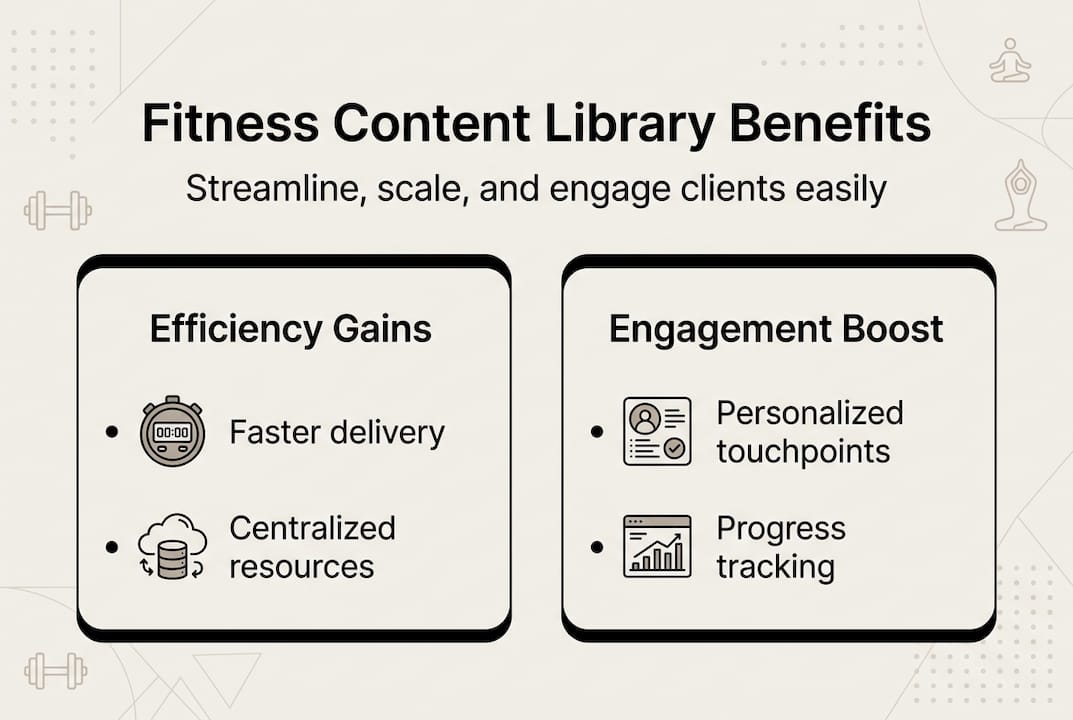
Paired with automation and scalability tools, your library becomes a system that grows your business without proportionally growing your workload. Combine that with strong retention practices and AI-powered library ideas, and you have a foundation built for long-term growth.
What makes a content library usable and what most fitness pros miss
Building a library is easy. Building a usable library takes intention. Most fitness professionals make the same mistake: they upload files without structure, skip tagging, and end up with a digital storage dump that no one actually uses.
A library's usability depends on organization: proper tagging, themes, and metadata so content is actually findable and actionable. Here's what that looks like in practice:
Strong usability features to build in:
- Tags by goal (fat loss, strength, mobility, sport-specific)
- Filters by equipment (bodyweight, dumbbells, full gym)
- Categories by client type (beginner, post-rehab, performance athlete)
- Clear naming with version numbers for updated content
- Separate sections for reference content versus delivery content
That last point is one most trainers overlook entirely. There are two distinct types of content in a library. A reference library covers form, mechanics, and educational content: things like technique breakdowns or anatomy explanations aligned with resources like the NASM exercise reference library. A delivery library contains programming, workout plans, and accountability tools pushed directly to clients.
Mixing the two without clear separation creates confusion. Your clients shouldn't have to scroll through your squat form breakdown to find their week four training block.
For more guidance on structure, the process of organizing your content library matters as much as the content itself.
Pro Tip
Schedule a quarterly library audit. Pull up your least-accessed content and decide: update it, archive it, or delete it. Outdated resources erode trust and create friction for clients who find conflicting information.
Measure success: What outcomes should your fitness content library drive?
Once your library is live, you need to know if it's working. And "working" doesn't mean you have 200 files stored. It means those files are driving real results for your clients and your business.
The key KPIs to track are:
- Client retention rate: Are clients staying longer since you started using the library?
- Program completion: Are clients finishing the programs you assign them?
- Repeat content access: Which resources do clients return to most often?
- Booking and session frequency: Does easy resource access increase session consistency?
- Re-engagement rate: Are lapsed clients responding to library-based outreach?
Retention, engagement, and program usage are the true benchmarks for content library success, not content quantity. A library with 20 excellent, well-organized resources beats one with 200 random uploads every time.
Stat to know
Fitness operators with strong content delivery infrastructure consistently report higher profit margins and lower churn compared to those relying on manual delivery and ad-hoc programming.
Gather feedback regularly. Ask clients directly which resources they found most helpful. Use that data to refine what you build next. The goal of tracking client engagement is to make your library smarter over time, not just bigger.
Your content library should ultimately drive business growth. If it isn't, it's a storage system. Treat it like a client engagement engine, and measure it accordingly.
Why most fitness pros miss the real value of content libraries
Here's an honest take: most trainers who build a content library do it to save time. And yes, efficiency is real. But that framing sells the tool short.
The trainers who get the most out of their libraries aren't treating them as asset archives. They're treating them as the backbone of their client relationships. When your programs diversify, when your client base grows, when fitness trends shift, a well-built library keeps you relevant without constant reinvention. It's the infrastructure that lets you stay human at scale.
Automation is a side effect of a good library, not the point. The point is continuity. When a client feels like you remembered their knee injury, sent the right mobility sequence at the right time, and kept them on track during a busy week, that's the library working. Client retention strategies that hold up over time are built on this kind of consistent, personalized delivery. That's the real return on investment.
Get started with your own fitness content library
You don't have to build your fitness content library from scratch or figure out the tech on your own. TrainingPro is built exactly for this.
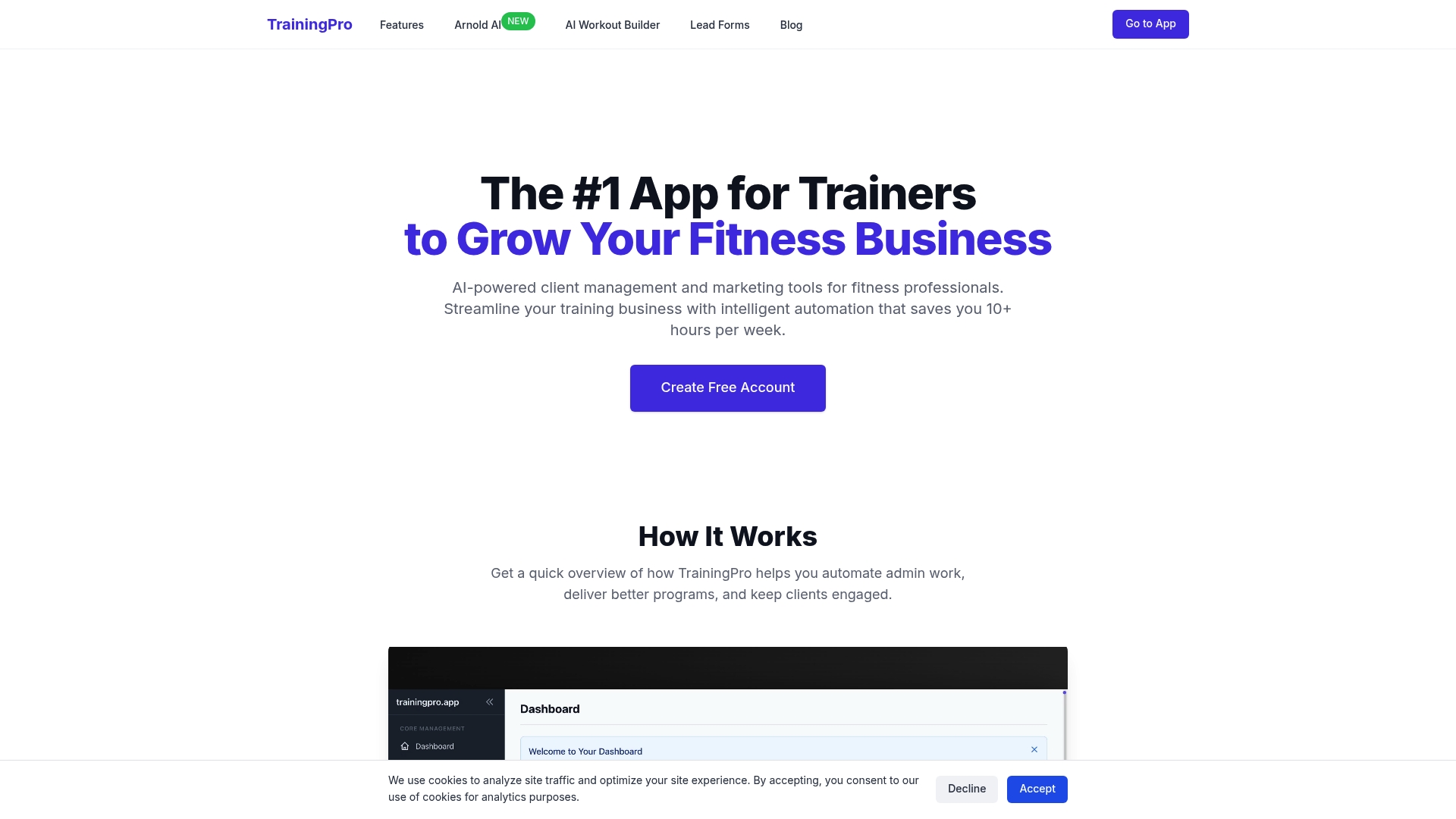
With the TrainingPro platform, you get tools to organize, tag, and deliver your content library directly to clients, with templates and automation that work from day one. Whether you're a solo trainer ready to stop reinventing the wheel or a gym owner looking to scale operations, TrainingPro gives you the structure to make it happen. Check out the AI-powered workout builder guide to see how automation and smart content delivery can transform your business today.
Ready to Transform Your Fitness Business?
Join thousands of trainers using TrainingPro to automate admin, grow their client base, and focus on what they love—coaching.
Start your 14-day free trial • Cancel anytime
Frequently asked questions
A fitness content library should have organized workouts, videos, and guides that can be searched and delivered to clients on demand, including nutrition resources and coaching FAQs.
A content library provides structured, reusable resources delivered directly to clients, while social media is primarily for marketing reach and broad engagement.
It dramatically reduces delivery time: centralized content hubs have driven 40% faster creative production for large fitness networks, and the same principle applies to individual trainers managing multiple clients.
Track retention, program usage, and engagement outcomes, not the number of stored resources. A smaller, well-used library consistently outperforms a large, disorganized one.
Always use clear tags and metadata so you and your clients can filter by goal, equipment, or client type and find the right resource instantly.


