
Engage your fitness clients: proven strategies for lasting retention
TL;DR:
- Most client relationships end within three to six months, but systemized engagement can improve retention.
- Onboarding, progress tracking, and automation are key to keeping clients motivated and committed long-term.
- Building scalable systems and using automation frees trainers to focus on personal, high-value interactions.
Fewer than 15% of personal training clients reach 50 sessions per year, and most relationships wrap up within three to six months. That churn is expensive, demoralizing, and largely preventable. The trainers pulling ahead in 2026 are not simply more charismatic or better coaches than you. They have built systems that keep clients informed, motivated, and accountable between every single session. In this article you will find practical, proven strategies for boosting client engagement, benchmarking your retention, and using automation to create a consistent client experience that works even when you are fully booked.
Table of Contents
- Set the stage: Why client engagement matters more than ever
- Start strong: Onboarding and expectation setting for lasting engagement
- Unlock motivation: Progress tracking and visible results with automation
- Consistent connection: Check-ins, feedback, and community at scale
- Adapt and personalize: Handling edge cases and maximizing retention
- Retention revisited: Why real results come from systemized engagement, not just charisma
- Streamline engagement: Tools to put these strategies into action
- Frequently asked questions
Key Takeaways
Set the stage: Why client engagement matters more than ever
Retention numbers across the fitness industry tell a clear story. 6-month retention sits at roughly 50%, and 12-month retention drops to between 20% and 30% for most trainers. The gym industry average annual retention rate is 66.4% according to the HFA 2025 report. Top performers, however, achieve 75% to 80% twelve-month retention by doing things differently. The gap between average and excellent is not talent. It is process.
The business case is equally hard to ignore. Acquiring a new client costs five to ten times more than keeping an existing one, and a 5% improvement in retention can boost profits by 25% to 95%. In practical terms, retaining two or three extra clients per month can outperform doubling your marketing budget.
So why do clients leave? The reasons are predictable and fixable:
- Lack of personal connection: Clients feel like a number, not a priority.
- Unclear expectations: They are not sure what success looks like or how long it takes.
- Repetitive programs: The same circuits every week kill motivation fast.
- No visible progress: Without data, effort feels invisible.
- No future planning: Once a goal is hit, there is no next chapter.
“Retention is an attention problem. The trainers who win long-term are the ones who build systems that deliver consistent attention at scale.”
The good news is that every item on that list is solvable. Strong client retention strategies combine smart communication, visible results, and automation to deliver the feeling of personal attention without burning you out.
Now that you have seen why client engagement is the make-or-break factor, let us break down the key drivers that retain and excite fitness clients.
Start strong: Onboarding and expectation setting for lasting engagement
First impressions stick. A well-designed onboarding experience tells a new client exactly what to expect, reduces anxiety, and ignites motivation before they have even broken a sweat. Lack of personal connection accounts for 50% of early client dropout, and most of that is rooted in unclear expectations set at the very beginning.
Structured onboarding with clear expectations is consistently rated as one of the highest-impact retention strategies available to trainers. Here is how to build it:
- Send a welcome message within 24 hours. Use an automated trigger so it goes out instantly, but personalize it with the client’s name and their stated goal.
- Schedule a goal-setting call or form. Define success together. What does progress look like in 30, 60, and 90 days? Write it down.
- Set communication expectations upfront. Tell clients how often they will hear from you, via which channel, and what response time to expect.
- Deliver the first program before the first session. Show them you are prepared and invested from day one.
- Automate a three-day and seven-day check-in. Ask how they are feeling, whether the program feels manageable, and if they have questions. These early touchpoints prevent silent dropout.
Automation handles the timing and consistency, but the content should feel personal. Use the client’s name, reference their goal, and keep the tone warm. Read more about these personal training onboarding tips to refine your own process.
Pro Tip
Record a short 60-second welcome video and include it in your automated onboarding message. Clients report that a personal video from their trainer dramatically increases early trust and excitement.
Once your clients are on board with clear expectations, maintaining engagement requires a system for regular, visible progress.
Unlock motivation: Progress tracking and visible results with automation
Motivation fades when progress feels invisible. That is the single biggest mid-program retention killer, and it is 100% preventable with the right tools. When clients can see their data improving, they stay engaged. When they cannot, they drift.
Tracking multiple dimensions of progress makes results feel real and multidimensional. Focus on:
- Body metrics: Weight, measurements, body fat percentage.
- Performance data: Strength gains, endurance improvements, movement quality.
- Habit completion rates: Sleep, hydration, daily step goals.
- Nutrition adherence: Logged meals, macro targets hit.
The evidence for this is striking. In one case study, a gym chain that deployed a wellness and nutrition tracking app saw retention climb from 52% to 78% while membership grew from 2,100 to 3,200. Members who used the nutrition tracker specifically showed 89% retention, the highest of any feature tested.
Automated fitness progress tracking removes friction for both you and your clients. They log data easily, you see it instantly, and progress becomes a visual story rather than a memory. Explore how integrating client tracking into your workflow creates measurable retention gains, and look at the workout tracking features that keep clients coming back session after session.

Pro Tip
Add habit and nutrition tracking to your offer even as a simple checklist. Clients who track habits daily are significantly more likely to stay enrolled past the six-month mark.
With visible progress fueling motivation, next-level engagement means adding consistency and a sense of community.
Consistent connection: Check-ins, feedback, and community at scale
Every trainer knows that one client who responds to every message and attends every session. You also know the other kind: the ghost who cancels twice and then disappears. The difference is rarely motivation. It is usually connection and accountability.
Consistent check-ins two to three times per week signal to clients that someone notices and cares. Automation makes this scalable. You do not need to personally type every message. You need a system that sends the right message at the right time.
Community and gamification features such as group challenges and leaderboards boost engagement by 30% to 60% compared to solo training, because accountability multiplies when others are watching.
Real methods that work at scale:
- Inactivity alerts: Trigger a check-in message when a client skips two or more consecutive sessions.
- Automated weekly feedback prompts: Ask clients to rate their energy, soreness, and program enjoyment on a simple 1-5 scale.
- Group challenges: Run a 21-day streak challenge or step competition. They generate buzz, referrals, and re-engagement.
- FAQ chatbots: Handle scheduling, billing, and program questions 24/7 without touching your inbox.
The results from automation-driven engagement are real. A three-location gym that used proactive automation including onboarding sequences, usage-triggered retention messages, and FAQ chatbots cut churn by 38% and recovered 22% of at-risk members who had gone quiet.
Strong client management strategies use technology to replace the tasks that drain your time and free you to focus on the human interactions that only you can deliver.
Even with best practices, unique situations require flexible engagement solutions.
Adapt and personalize: Handling edge cases and maximizing retention
Not every retention challenge fits a standard playbook. Knowing how to handle edge cases separates good trainers from great ones.
After a client hits their goal, the relationship is most at risk. 60% of clients leave shortly after achieving their primary goal according to the PTDC. The fix is simple: set the next goal before they reach the first one. Frame goal achievement as a milestone, not a finish line.
Here is a framework for managing common edge cases:
- Post-goal clients: Introduce a maintenance or performance phase immediately. Have the conversation two to three weeks before goal completion.
- Life disruptions (illness, travel, schedule changes): Offer a flexible hybrid option. Hybrid models combining in-person and app-based training dominate in 2026 and consistently produce top retention rates.
- Online-only clients: Add extra touchpoints with short video check-ins. Text messages alone feel impersonal for remote clients who never see you in person.
- Financial questions: Address cost proactively and without discounting. Explain your value and offer payment plan options before a client feels trapped by price.
Pursuing these hybrid training strategies builds a resilient client base that stays through life’s interruptions. And maintaining online coaching standards ensures your remote clients get the same quality experience as in-person ones.
Pro Tip
Every 8 to 10 weeks, offer clients a brief “reset” consultation. Review progress, refresh goals, and update their program. This simple gesture signals long-term investment in their success and dramatically reduces quiet dropout.
With innovative strategies in place, what actually drives long-term success, and what common advice should you rethink?
Retention revisited: Why real results come from systemized engagement, not just charisma
There is a persistent belief in fitness that retention is a personality game. If you are likeable, energetic, and inspiring, clients will never leave. That belief is costing trainers real money.
Charisma matters. Rapport matters. But neither scales. You can only personally follow up with so many people per day before the quality drops and the gaps widen. This is where automated consistency becomes your strongest retention tool, not a replacement for your personality, but an amplifier of it.
Here is the contrarian truth: templated automations and systemized check-ins actually free you to be more personal, not less. When your platform handles the routine touchpoints, your mental energy goes to the moments that matter most: the tough conversation with a plateau-stuck client, the creative program redesign, the celebratory message that lands perfectly because you had the bandwidth to write it.
The common challenges personal trainers face around time and client overload are not solved by working harder. They are solved by building smarter systems. Make the tech human. Use it to listen, respond, and celebrate. The automation keeps the engine running. You bring the soul.
Streamline engagement: Tools to put these strategies into action
Everything covered in this article, from structured onboarding to automated check-ins and progress dashboards, is exactly what TrainingPro was built to support. You should not have to stitch together five different tools to run a consistent, engaging client experience.
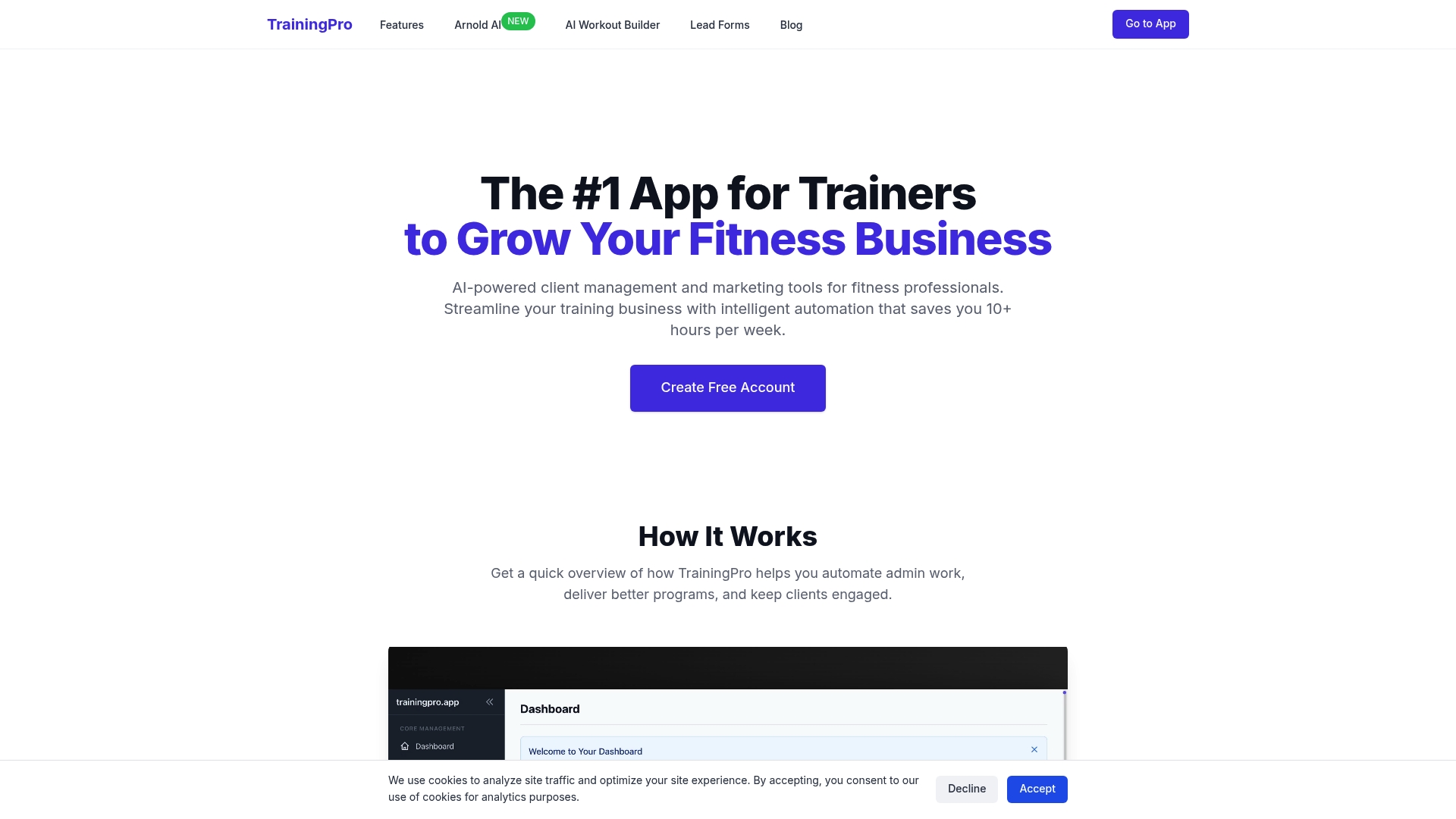
With TrainingPro, you can automate your check-in sequences, build branded progress dashboards, run group challenges, and track every metric your clients care about, all inside one platform. Arnold AI, the built-in AI assistant, handles personalized program creation so you spend less time designing and more time coaching. If you want to see how AI-powered personalization works in practice, the AI Workout Builder Guide walks you through the full workflow. Build the system once. Keep clients for the long term.
Frequently asked questions
Structured onboarding, consistent progress tracking, and ongoing community-driven challenges are the most effective engagement methods for sustained retention across all client types.
Automation tools increase retention by streamlining check-ins, tracking progress, sending inactivity alerts, and managing group challenges without adding hours to your schedule.
The main reasons are lack of personal connection (50% of cases), repetitive programs, no visible progress, and unclear expectations set at the start of the relationship.
A 5% improvement in retention can increase profits by 25% to 95% while reducing the marketing cost of constantly replacing lost clients.
Recommended
- Boost client retention in personal training: 2026 strategies | TrainingPro
- Client management for fitness pros: boost retention & engagement | TrainingPro
- How to track client progress: boost retention and results | TrainingPro
- Why track fitness progress: boost client engagement | TrainingPro
- Récupération musculaire : guide complet pour sportifs amateurs
Ready to Transform Your Fitness Business?
Join thousands of trainers using TrainingPro to automate admin, grow their client base, and focus on what they love—coaching.
Start your 14-day free trial • Cancel anytime


