
Top personal training tips that deliver real results
Every trainer has felt it: a flood of new methods, trending protocols, and conflicting advice that makes it hard to know what actually moves the needle for clients. The truth is, the biggest gains rarely come from the most complex programs. A large-scale ACSM review covering over 30,000 participants confirms that the shift from inconsistency to consistency produces the most dramatic improvements across all fitness goals. This article breaks down the highest-impact personal training tips, each grounded in current science and real-world practice, so you can boost client outcomes, improve retention, and build a coaching business that lasts.
Table of Contents
- Prioritize consistency for lasting results
- Tailor programs to client goals
- Avoid common programming errors
- Use SMART-ER goals for behavior change
- Assess clients thoroughly for individualization
- Apply motivational interviewing and behavior change techniques
- Build rapport for client retention
- Summary comparison of top training tips
- Enhance your results with smart training tools
- Frequently asked questions
Key Takeaways
| Point | Details |
|---|---|
| Consistency is key | Regular training schedules yield the biggest results and should always be prioritized. |
| Individualize programs | Tailored programming based on assessments and goals maximizes progress and reduces risk. |
| Focus on behavior change | SMART-ER goals and motivational interviewing greatly increase client motivation and retention. |
| Build strong rapport | Empathy and active listening translate directly to better client retention and referrals. |
| Leverage technology | AI-powered tools streamline programming, freeing trainers for more effective coaching. |
Prioritize consistency for lasting results
Before you add another advanced technique to your toolkit, consider this: consistency over complex programs delivers the largest gains for most clients. The jump from zero training to regular training is where the real transformation happens. Advanced periodization and specialty protocols matter, but they are secondary to showing up.
For most clients, training each major muscle group twice per week is the sweet spot. It is enough stimulus to drive adaptation without overwhelming recovery. When you build predictable routines, clients know what to expect, and that structure itself improves adherence. Think of tracking fitness progress as the accountability layer that keeps consistency visible and motivating.
Key habits that support consistency:
- Schedule sessions at the same time each week to build automatic behavior
- Keep early-stage programs simple so clients feel competent, not overwhelmed
- Use a streamlined training checklist to reduce session prep friction
- Celebrate attendance milestones, not just performance milestones
- Reduce barriers: shorter sessions beat skipped sessions every time
Statistic callout
An ACSM review of 30,000+ participants found that the transition from sedentary to consistently active produced the single largest improvement in strength and health outcomes, outpacing any programming variable.
Pro Tip
Resist the urge to overhaul a client’s program every few weeks. Repetition builds skill and confidence. Change variables gradually, not all at once.
After understanding the foundation of consistency, let’s move to programming the specifics that drive individual goals.
Tailor programs to client goals
Not every client wants the same outcome, and your programming should reflect that. Protocols differ significantly depending on the target: strength training calls for loads around 80% of one-rep max, hypertrophy benefits from roughly 10 sets per muscle group per week, and power development uses lighter loads between 30 and 70% of one-rep max with explosive intent.
Periodization with macrocycles, mesocycles, and microcycles combined with progressive overload is the most reliable way to prevent plateaus and protect against overtraining. A macrocycle covers an annual plan, a mesocycle spans a few weeks to a month, and a microcycle is your weekly structure.

| Goal | Load | Volume | Key focus |
|---|---|---|---|
| Strength | 80%+ 1RM | 3-5 sets, 1-5 reps | Neural adaptation |
| Hypertrophy | 65-80% 1RM | ~10 sets/muscle/week | Metabolic stress |
| Power | 30-70% 1RM | 3-5 sets, 3-5 reps | Speed of movement |
| Aging/functional | Moderate | 2-3 sets, 8-15 reps | Balance, bone health |
For programs designed for aging clients, prioritize functional strength, balance work, and bone-loading exercises. This population responds well to consistent moderate loads and benefits enormously from structured periodization.
How to build a periodized plan in four steps:
- Define the client’s primary goal and timeline
- Map out a macrocycle with clear phases (foundation, build, peak, recovery)
- Break each phase into mesocycles with specific volume and intensity targets
- Adjust weekly microcycles based on performance and recovery feedback
Pro Tip
Keep periodization simple for beginners. A basic linear progression, adding small weight each week, works extremely well for the first 6 to 12 months. Save complex undulating models for advanced clients who have plateaued. You can find solid workout examples for trainers to use as starting templates.
With individual goals clarified, trainers must also avoid the programming mistakes that quietly undermine results.
Avoid common programming errors
Even experienced trainers fall into predictable traps. Common mistakes include inadequate anatomy knowledge, ignoring all planes of motion, and failing to individualize programs. These errors do not just limit results; they increase injury risk and erode client trust.
Common errors and how to fix them:
- Training clients like yourself: Your preferences are not your client’s needs. Assess first, program second.
- Skipping the transverse and frontal planes: Most trainers default to sagittal plane movements. Add rotational and lateral work for balanced results.
- No modifications ready: Every session should have a regression and a progression for each exercise.
- Ignoring anatomy differences: Hip structure, shoulder mobility, and limb length all affect exercise mechanics. Adjust accordingly.
- Copying programs without context: A program that worked for one client may be wrong for another with different limitations.
"Train all planes for balanced results." Rotational and lateral movements are not optional extras; they are essential for functional fitness and injury prevention.
Reviewing common corrective training mistakes in competitive contexts can sharpen your eye for these issues in everyday programming too. And if you are navigating broader PT business challenges, fixing programming errors is one of the fastest ways to improve client satisfaction.
Avoiding errors lays the groundwork for more effective goal-setting and client engagement.
Use SMART-ER goals for behavior change
SMART-ER goals boost training adherence and behavior outcomes by adding two critical elements to the traditional SMART framework: Evaluated and Rewarded. Most trainers set goals but skip the follow-through that makes them stick.
SMART-ER stands for: Specific, Measurable, Achievable, Relevant, Time-bound, Evaluated, Rewarded.
Step-by-step goal setting with SMART-ER:
- Specific: Define the exact outcome. "Lose weight" becomes "reduce body fat by 5% in 12 weeks."
- Measurable: Identify the metric. Use body composition scans, strength benchmarks, or performance tests.
- Achievable: Set a realistic target based on the client’s current fitness level and lifestyle.
- Relevant: Connect the goal to what the client actually cares about, not what you think they should want.
- Time-bound: Set a clear deadline to create urgency and focus.
- Evaluated: Schedule regular check-ins to review progress and adjust the plan.
- Rewarded: Acknowledge milestones. Recognition fuels motivation more than most trainers realize.
Pro Tip
Revisit goals every four weeks. Life changes, and so do priorities. A goal that felt urgent in January may need reshaping by March. Use client progress tracking tools to make these reviews fast and data-driven. Your training session checklist is a great place to build this review habit in.
Effective goals work best when paired with thorough assessments that inform every programming decision.
Assess clients thoroughly for individualization
Initial assessments covering health history, fitness testing, and behavioral readiness are the foundation of individualized programming. Skipping this step is one of the most common reasons programs fail to deliver.
Core assessment areas to cover:
- Medical history and current medications
- Movement screening (overhead squat, single-leg balance, hip hinge)
- Cardiovascular fitness baseline (resting heart rate, step test, or VO2 estimate)
- Behavioral readiness: stage of change, motivation level, past exercise history
- Lifestyle factors: sleep, stress, nutrition habits
| Assessment tool | What it measures | Application |
|---|---|---|
| PAR-Q+ | Health risk screening | Clearance for exercise |
| FMS (Functional Movement Screen) | Movement quality | Identify compensations |
| 1RM or estimated 1RM | Strength baseline | Load prescription |
| Transtheoretical model questionnaire | Readiness to change | Coaching approach |
| Body composition analysis | Fat vs. lean mass | Goal tracking |
Use your workout program examples as a reference point after assessments to match the right template to each client’s profile. A solid training session checklist ensures you never skip a critical assessment step.
Once you assess and set goals, focus on the behavioral methods that drive real adherence.
Apply motivational interviewing and behavior change techniques
Directive-only coaching leads to 80% client drop-off, while motivational interviewing (MI) consistently improves adherence. MI is a client-centered communication style that guides people toward their own reasons for change rather than telling them what to do.
The COM-B model (Capability, Opportunity, Motivation, Behavior) pairs well with MI. It helps you identify exactly where a client is stuck and address the right barrier.
Practical MI and COM-B actions for trainers:
- Ask open-ended questions: "What would feel different if you hit this goal?"
- Reflect back what clients say to show you are listening
- Explore ambivalence without judgment: "What makes this hard for you right now?"
- Identify capability gaps (skill or knowledge) and fill them with education
- Create opportunity by removing scheduling or access barriers
- Reinforce intrinsic motivation by connecting workouts to personal values
Using motivational interviewing techniques takes practice, but even small shifts in how you communicate can dramatically improve how long clients stay engaged. Pair this with strong client retention strategies to build a stable, growing client base.
Behavioral methods are most effective when built on a foundation of genuine rapport.
Build rapport for client retention
Active listening, empathy, and personalized programs boost retention by up to 30%. Clients do not just hire you for your programming knowledge. They stay because they feel seen, supported, and understood.
Rapport-building techniques that work:
- Remember personal details: birthdays, job stress, family milestones
- Follow up between sessions with a quick check-in message
- Celebrate non-scale victories like improved energy or better sleep
- Be consistent in your own behavior so clients know what to expect from you
- Personalize warm-ups and cool-downs to reflect what the client enjoys
"Empathy and active listening are not soft skills. They are the core of a sustainable training business."
Strong relationships also generate referrals. A client who trusts you will recommend you without being asked. Explore retention strategies for 2026 and consider whether specializing in a niche could deepen those relationships further. You can also review personal trainer retention tips for more actionable ideas.
Summary comparison of top training tips
Here is a quick reference to help you prioritize which strategies to implement first, based on your current client mix and business stage.
| Tip | Why it matters | Best for | Impact level |
|---|---|---|---|
| Consistency | Largest single driver of progress | All clients | Very high |
| Goal-tailored programming | Matches stimulus to outcome | Intermediate+ clients | High |
| Avoiding programming errors | Prevents injury and plateaus | All clients | High |
| SMART-ER goals | Improves adherence and motivation | New and returning clients | High |
| Thorough assessments | Enables true individualization | All clients | Very high |
| Motivational interviewing | Reduces drop-off, builds engagement | Struggling clients | High |
| Rapport building | Drives retention and referrals | All clients | Very high |
Consistency, individualization, behavioral techniques, and rapport-building offer compounding benefits. Each strategy reinforces the others. For new clients, start with assessments, SMART-ER goals, and consistency. For established clients, layer in periodization, MI techniques, and deeper rapport work to sustain long-term progress.
Enhance your results with smart training tools
You now have a clear picture of what drives real client progress. The next step is making these strategies easier to execute at scale. That is where technology becomes your advantage.
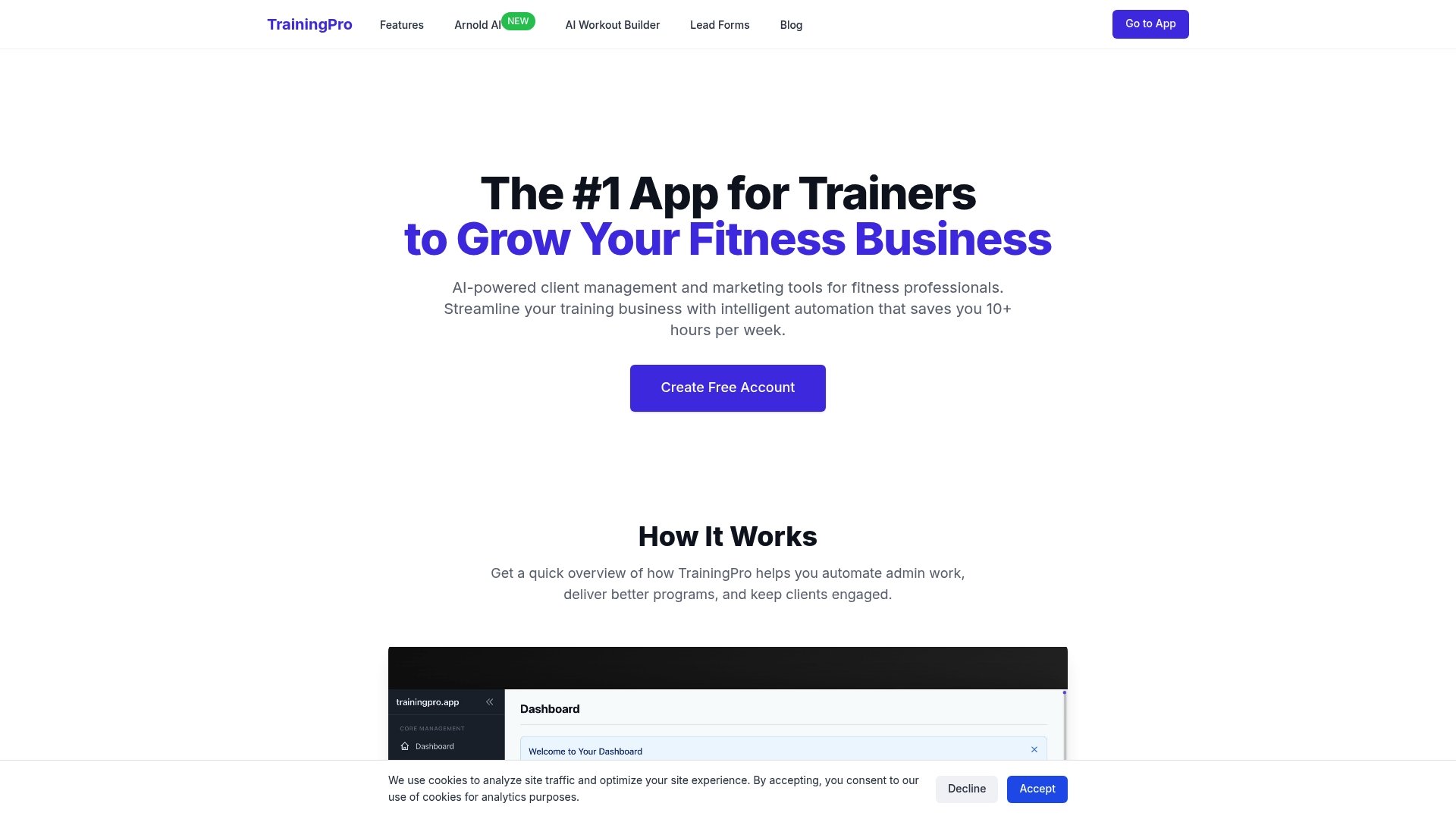
TrainingPro’s AI workout builder automates program design based on each client’s goals, assessment results, and training history, so you spend less time building spreadsheets and more time coaching. Arnold AI can generate instant program modifications, flag recovery concerns, and help you apply periodization principles without starting from scratch every cycle. TrainingPro saves trainers over 10 hours weekly, giving you the bandwidth to focus on rapport, communication, and the human side of coaching that no tool can replace. Start applying these tips with the right system behind you.
Ready to Transform Your Fitness Business?
Join thousands of trainers using TrainingPro to automate admin, grow their client base, and focus on what they love—coaching.
Start your 14-day free trial • Cancel anytime
Frequently asked questions
Consistency delivers the largest gains across all fitness goals. Building a reliable training routine is more impactful than any advanced programming technique.
Emphasize functional strength, balance, and periodized training to prevent muscle loss and support bone health. Periodization prevents sarcopenia and aids bone density in older exercisers.
SMART-ER goals are Specific, Measurable, Achievable, Relevant, Time-bound, Evaluated, and Rewarded. SMART-ER goals improve adherence and support lasting behavior change in clients.
Build rapport through empathy and personalized programs. Strong relationships increase retention by up to 30% and generate more referrals organically.
Motivational interviewing guides clients to find their own reasons for change, which leads to higher adherence. Directive coaching leads to 80% drop-off compared to client-centered approaches.


