
How to track client progress: boost retention and results

TL;DR:
- Systematic progress tracking improves client retention and strengthens trainer-client relationships.
- Combining objective metrics with subjective feedback offers a complete view of client progress.
- Effective data use enables program adjustments that boost motivation and long-term success.
Client drop-off is rarely about the workout. It happens when progress feels invisible. When a client can’t see how far they’ve come, motivation fades, sessions get skipped, and eventually they cancel. The good news? Systematic progress tracking changes that equation entirely. Trainers who build structured tracking into their practice don’t just retain more clients. They build stronger relationships, deliver better results, and grow more sustainable businesses. This guide walks you through exactly what to track, how to set up your system, how to fix common problems, and how to use data to keep clients engaged and coming back.
Table of Contents
- Gathering your tools: What you need to track fitness progress effectively
- Step-by-step: Setting up your client progress tracking system
- Troubleshooting: How to overcome common progress tracking pitfalls
- Verification and next steps: Using data to adjust programs and enhance retention
- Why holistic tracking, not just numbers, keeps clients coming back
- Streamline your coaching with TrainingPro
- Frequently asked questions
Key Takeaways
Gathering your tools: What you need to track fitness progress effectively
Once you understand the power of visible progress, equip yourself with the right tools and metrics. Before you build a tracking system, you need to know what you’re measuring and why. Not every metric matters for every client. A 55-year-old returning to exercise after an injury needs different benchmarks than a 28-year-old training for a powerlifting competition.
According to ACE Fitness, effective progress tracking spans multiple categories: body measurements, strength performance like one-rep max (1RM) and reps completed, body composition including weight and body fat percentage, endurance tests, habit compliance, workout completion rates, and subjective biofeedback such as energy levels, sleep quality, and mood. That last category is often underestimated.
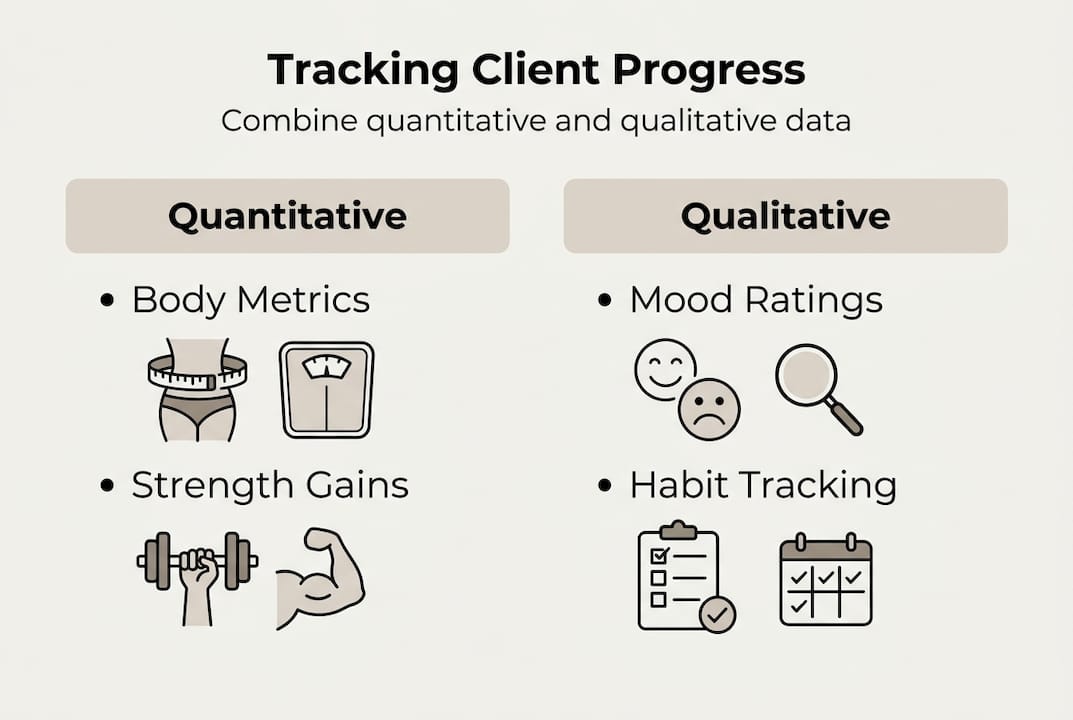
Here’s a breakdown of the core metric types to consider:
For tools, you have several options:
- Apps and platforms: Purpose-built software handles data storage, check-ins, and reporting automatically. Good client tracking for engagement tools keep everything in one place.
- Wearables: Devices like fitness trackers capture heart rate, steps, and sleep data passively. Useful for tracking metabolic metrics without extra effort from the client.
- Spreadsheets: Flexible and free, but require manual input and consistent maintenance.
- Paper logs: Simple and low-tech. Some clients genuinely prefer them, especially older demographics.
The importance of tracking fitness progress goes beyond data collection. It creates a feedback loop that keeps both you and your client accountable.
Pro Tip
Combine at least one objective metric (like weight lifted or body measurements) with one subjective metric (like a weekly mood or energy rating). This gives you a complete picture of how a client is actually responding to training, not just what the numbers say.
Start by selecting three to five metrics per client based on their goals, then build your tools around those choices. Overcomplicating it early leads to data you never use.
Step-by-step: Setting up your client progress tracking system
Now that you’re prepared, it’s time to put your system into action. Here’s how to launch it step by step.

A well-built tracking system doesn’t need to be complex. It needs to be consistent. Client retention data shows that clients who track progress are two to three times more likely to succeed, and that a 5% increase in retention can boost profits by 25 to 95%. The system you build directly affects those numbers.
Here’s a comparison of your main setup options:
Follow these steps to set up your system:
- Onboard with intention. During your first session, explain why tracking matters. Clients who understand the value are far more likely to engage. Try framing it as: “This data is how we make sure your program is actually working for you.”
- Establish a baseline. Record initial measurements, performance benchmarks, and a short subjective questionnaire. This is your starting point for everything. Use personal trainer goal strategies to structure this phase effectively.
- Schedule routine check-ins. Weekly habit check-ins and monthly performance reviews work well for most clients. Build these into your calendar so they don’t slip.
- Centralize your data. Whether you use an app or a spreadsheet, all client data should live in one place. Scattered notes across texts, emails, and paper create gaps.
- Review and communicate. After each review period, share findings with the client. Show them what improved, what stayed the same, and what the next focus is.
Refer to client management best practices and top tracking features to sharpen how you structure this process. The more seamless the system, the more consistent the data, and the stronger your results.
Troubleshooting: How to overcome common progress tracking pitfalls
Even systematized tracking encounters real-world obstacles. Here’s how to navigate and resolve them.
Tracking systems fail for predictable reasons. Knowing them in advance means you can fix problems before they cost you a client. Here are the most common pitfalls and how to address each one:
- Data gaps: Clients forget to log or skip check-ins. Solution: automate reminders and make logging as simple as possible. A one-question weekly check-in beats a 10-field form that never gets filled out.
- Technology aversion: Some clients won’t use apps. Solution: offer a paper alternative or a simple text-based check-in. Flexibility beats perfection.
- Motivation dips: Progress slows and clients disengage. Solution: shift the conversation to non-scale victories like improved sleep, better posture, or lifting a weight they couldn’t before.
- Plateau periods: The scale stalls or performance levels off. As noted in research on stalled progress, this is the time to adjust programming, introduce a deload week, or reassess volume and intensity.
- Inconsistent tracking: Sporadic data creates the illusion of no progress. Consistent tracking, even if imperfect, tells a much clearer story.
“Celebrate small wins and non-scale victories. A client who sleeps better, lifts more confidently, or shows up consistently is making real progress, even when the scale doesn’t move.”
For deeper guidance on retaining training clients through difficult phases, revisit your communication strategy. Sometimes the fix isn’t the program. It’s the conversation.
Pro Tip
If a client consistently misses check-ins or skips logging, don’t wait for a cancellation. Reach out proactively, reduce the tracking load temporarily, and reconnect them to their original goal. Refer to personal training tips for practical scripts that work in these moments.
Tracking resistance is usually a symptom of something deeper: unclear goals, low confidence, or feeling overwhelmed. Address the root cause, not just the missing data.
Verification and next steps: Using data to adjust programs and enhance retention
With tracking in place and pitfalls handled, the final step is closing the loop: putting your client data to work for retention and growth.
Data without action is just storage. The real value of tracking comes from what you do with it. Proactive adjustments based on data prevent churn, and monitoring adherence early is one of the strongest leading indicators of long-term retention.
Stat callout:
A 5% retention increase can boost profits by 25 to 95%. Your tracking system is a direct driver of that number.
Here’s how to close the loop effectively:
- Review data weekly. Look at workout completion rates first. Completion above 85% signals strong engagement. Below that, investigate why.
- Identify trends, not just snapshots. One bad week doesn’t mean the program is failing. Three consecutive weeks of declining performance or mood ratings does.
- Adjust programming based on evidence. Use combining process and outcome goals as a framework. If a client is hitting process goals (showing up, completing sessions) but not outcome goals (strength gains), the program variables need adjusting.
- Share progress visually. Show clients a graph of their strength over 12 weeks. Visual progress is far more motivating than a number on a page.
- Set new micro-goals. After each review, establish one or two new short-term targets. This keeps momentum going and gives clients something concrete to work toward.
- Reinforce the relationship. A quick message celebrating a milestone, whether it’s a new personal record or a streak of consistent attendance, goes a long way. Explore strategies for retention and growth strategies for trainers to build this into your regular workflow.
When clients see their data used to improve their experience, they feel invested. That investment is what keeps them renewing month after month.
Why holistic tracking, not just numbers, keeps clients coming back
Here’s what most tracking guides won’t tell you: numbers alone don’t retain clients. People do.
The fitness industry defaults to quantitative metrics because they’re easy to measure and easy to report. Weight down, reps up, body fat percentage lower. Clean, tidy, objective. But research comparing quantitative vs. qualitative tracking consistently shows that scale-only or mirror-only approaches miss the signals that actually predict whether a client stays or leaves.
A client who rates their energy a 4 out of 10 for three straight weeks is telling you something critical, even if their strength numbers are climbing. Mood, consistency, and self-reported effort are leading indicators. The numbers are lagging indicators. By the time the numbers drop, you’ve often already lost the client emotionally.
The most retained clients we see are the ones whose trainers blend structured metrics with regular self-reporting. It’s not either/or. It’s both. When you track engagement insights alongside performance data, you catch problems early and adjust before they become cancellations. That’s the real competitive edge in client retention.
Streamline your coaching with TrainingPro
Ready to implement a smarter system? TrainingPro brings your entire tracking workflow into one place, so you spend less time managing spreadsheets and more time coaching.
With TrainingPro, you can automate check-in reminders, log client progress, and generate reports without the manual overhead. The platform’s AI assistant, Arnold AI, helps you adjust programs based on real client data, while built-in lead generation forms keep your pipeline full. Whether you’re onboarding your first client or scaling to 50, TrainingPro gives you the infrastructure to track, retain, and grow. Download our free AI workout builder guide to see how automation can save you over 10 hours a week.
Frequently asked questions
Key metrics include body composition, strength performance, workout completion rates, habit adherence, and subjective feedback on energy or mood. Combining objective and subjective data gives you the fullest picture of client progress.
Track habits and workout completion weekly, and review body composition and strength metrics at least monthly. Clients who track consistently are two to three times more likely to reach their goals.
Shift focus to non-scale victories, reassess program variables like volume and intensity, and increase communication. Plateaus often resolve with a deload week or a programming adjustment, not by pushing harder.
Visible progress increases accountability and emotional investment. A 5% retention boost can increase profits by 25 to 95%, making your tracking system one of the highest-leverage tools in your business.
Recommended
- Why track fitness progress: boost client engagement | TrainingPro
- Client Tracking in Fitness: Boost Engagement and Drive Results | TrainingPro
- Boost client retention in personal training: 2026 strategies | TrainingPro
- 5 Ways to Retain Personal Training Clients | TrainingPro
Ready to Transform Your Fitness Business?
Join thousands of trainers using TrainingPro to automate admin, grow their client base, and focus on what they love—coaching.
Start your 14-day free trial • Cancel anytime


