
Training session planning guide: Steps for fitness pros
Session planning is the foundation of every client result you deliver. Yet many trainers find themselves cycling through the same routines, watching engagement drop and progress plateau. The problem isn’t effort. It’s structure. When sessions lack a clear framework, from pre-session screening to progressive overload, outcomes become inconsistent and clients lose confidence. A proven, evidence-based approach to planning doesn’t just improve safety. It builds trust, drives retention, and produces the kind of measurable results that grow your business. This guide walks you through every stage of effective session planning, so you can show up prepared, deliver confidently, and keep clients coming back.
Key Takeaways
Essentials: Pre-session assessment and goal setting
Before you write a single exercise, you need a clear picture of who you’re training. Skipping this step is the most common reason sessions underdeliver. Start with a PAR-Q+ screening, a health history intake, and a basic risk stratification. These aren’t formalities. They protect your client and shape every decision you make afterward.
The ACSM-CPT domains place initial consultation at 25% of session planning competency, with exercise programming at 43% and leadership at 22%. That weighting reflects how critical early assessment is before any program design begins. Similarly, the NSCA-CPT framework dedicates 23% to client consultation and assessment, with 29% to program planning and 36% to execution. Both frameworks agree: you can’t skip the foundation.
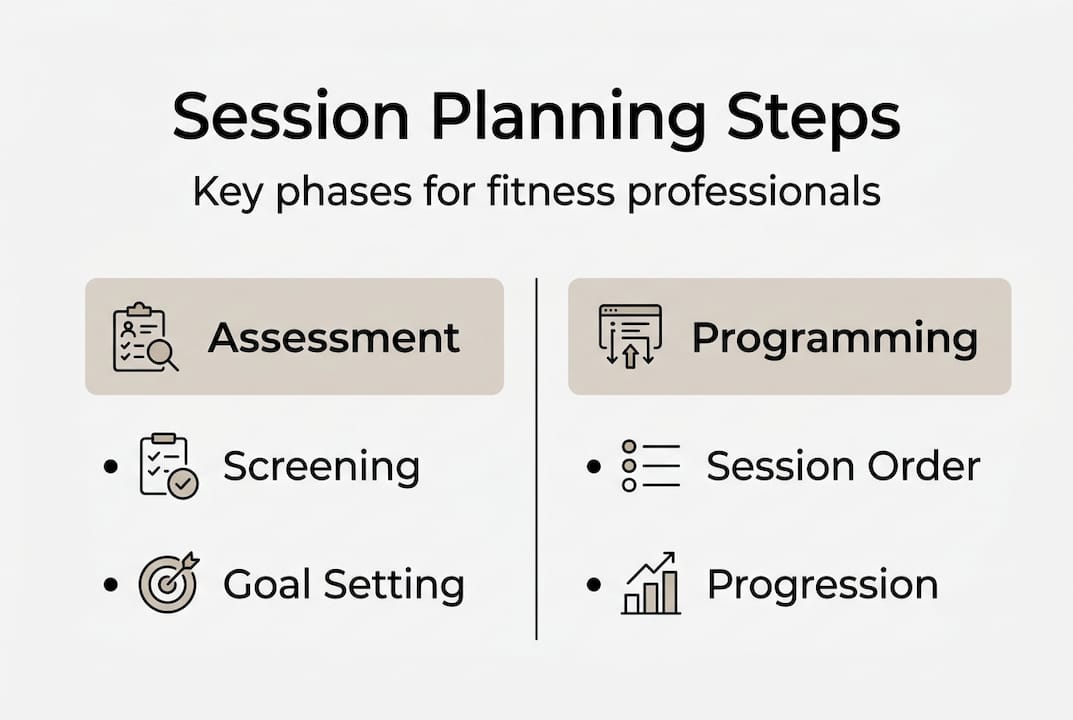
Once screening is done, move into a needs analysis. What does this client actually need to achieve their goal? A 58-year-old returning to exercise after a knee replacement has very different needs than a 30-year-old training for their first powerlifting meet. Use consultation workflow tips to streamline this process and avoid missing key details.
From there, set SMART goals: Specific, Measurable, Achievable, Relevant, and Time-bound. Goals give your programming direction and give clients a reason to stay engaged. Research on holistic behavioral strategies shows that combining goal-setting with behavioral support significantly improves adherence compared to exercise prescription alone.
Here’s a quick checklist you can use before every new client intake:
Use a structured pre-session checklist and digital client screening forms to keep this process consistent across every client.
Pro Tip
For clients with chronic conditions or recent injuries, always request written medical clearance before designing any program. It protects both of you and builds immediate trust.
Structuring the session: Order, methodology, and exercise selection
With your assessment complete and goals defined, it’s time to build the session itself. Structure matters more than most trainers realize. The order in which exercises appear directly affects performance, safety, and the training stimulus your client receives.
Follow this sequence for most clients:
- Warm-up (5-10 minutes): Dynamic mobility, activation drills, and low-intensity cardio to prepare the nervous system.
- Compound/power movements: Squats, deadlifts, presses, and pulls come first when the client is fresh. These demand the most neurological output.
- Assistance and hypertrophy work: Isolation exercises, accessory lifts, and targeted muscle work follow the main lifts.
- Cool-down (5-10 minutes): Static stretching, breathing work, and light movement to aid recovery.
As well-rounded workout planning confirms, prioritizing neurological demand at the start of a session ensures your client performs the most technically complex movements when their focus and energy are highest. This is especially important for beginners who are still building motor patterns.
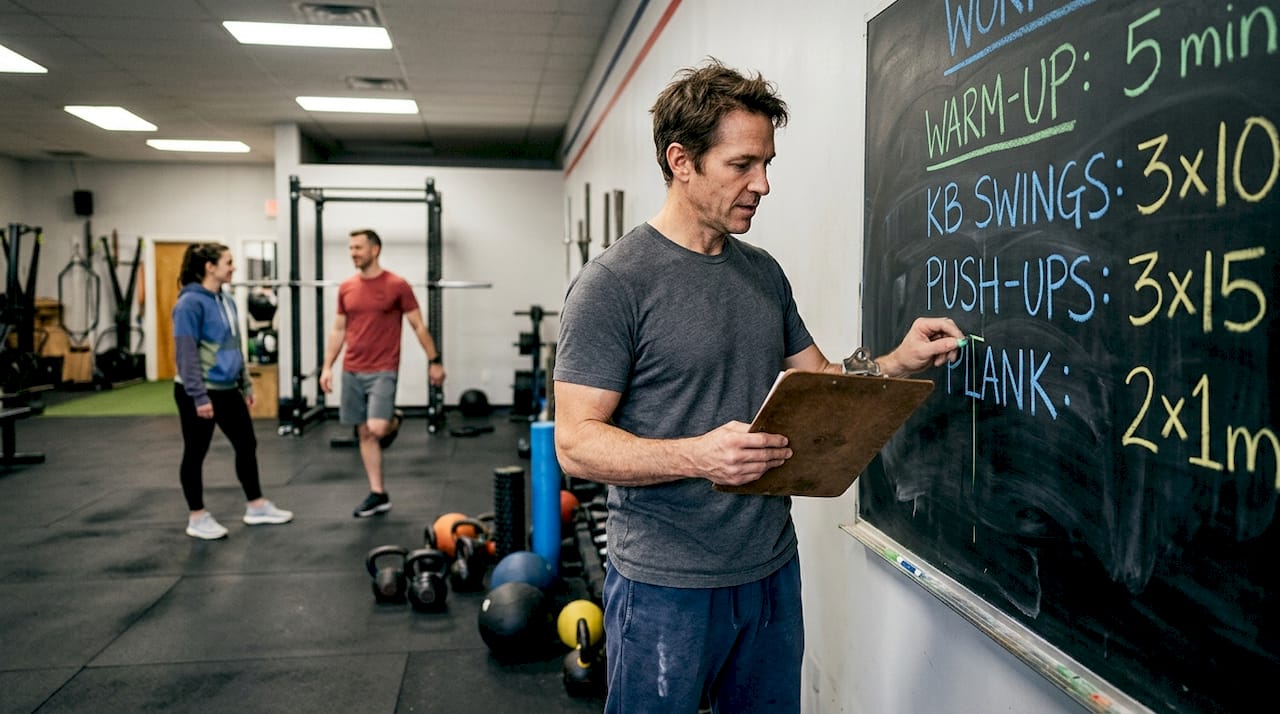
Balance your exercise selection across four fundamental movement patterns: push, pull, squat, and hinge. Neglecting any one pattern over time creates muscular imbalances and raises injury risk. For example, a client who only presses but never rows will likely develop shoulder issues within months.
For exercise prescription, apply the FITT-VP model: Frequency, Intensity, Time, Type, Volume, and Progression. This framework ensures every variable is intentional, not guesswork.
“The best session structure isn’t the most complex one. It’s the one your client can execute safely, consistently, and with purpose.”
When adapting session order for sport-specific clients, you may need to shift priorities. A Hyrox athlete, for example, needs conditioning work integrated differently than a bodybuilder. Use your exercise library to build a bank of vetted alternatives for each movement pattern.
Pro Tip
Always have a backup exercise ready for each main lift. Equipment availability and client energy levels vary. Flexibility in your plan prevents wasted session time.
Programming principles: Periodization, progression, and safety
A great single session means nothing without a smart long-term plan behind it. Periodization is how you organize training over weeks and months to drive consistent progress and prevent burnout.
There are three main models to know:
- Linear periodization: Volume decreases while intensity increases week over week. Best for beginners and peaking phases.
- Undulating periodization: Daily or weekly variation in volume and intensity. Works well for intermediate clients who adapt quickly.
- Block periodization: Training is organized into focused phases (accumulation, intensification, realization). Ideal for advanced athletes.
Periodized programs produce 31% greater strength gains compared to non-periodized training, based on 2025 data. That’s not a marginal difference. It’s the gap between a client who hits a plateau in month two and one who keeps progressing for a year.
Progressive overload is the engine inside any periodization model. Track it using RPE (Rate of Perceived Exertion) or reps-in-reserve (RIR), which tells you how many reps a client had left in the tank. Both methods give you real-time data without requiring a max effort test every session.
Safety is non-negotiable. The ACSM pre-participation guidelines require screening before any program begins, with medical clearance for higher-risk individuals. For older adults or clients with injuries, modify intensity, range of motion, and load accordingly. See modifying for injuries for practical strategies.
Build in a deload every 4-6 weeks. A deload is a planned reduction in volume or intensity that allows the body to recover and adapt. Skipping deloads is one of the most common reasons clients hit walls or get injured. The latest resistance guidelines reinforce this as a standard practice for all training populations.
Pro Tip
When a client reports feeling unusually fatigued or sore heading into a session, treat that as a signal to deload early. Listening to that feedback prevents injuries before they happen.
Session verification and troubleshooting: Tracking, feedback, and adaptation
Planning and executing a session is only half the job. Verifying that it’s working and adjusting when it isn’t is what separates good trainers from great ones. Ongoing tracking closes the loop between what you planned and what actually happened.
Here’s a simple process to verify session effectiveness:
- Log session data: Record sets, reps, load, and RPE after every session. Use apps or digital logs to keep this organized.
- Check in with the client: Ask how they felt during and after the session. Energy, soreness, and motivation are all useful data points.
- Review progress every 4-6 weeks: Compare current performance to baseline assessments. Are they moving toward their SMART goals?
- Identify patterns: If a client consistently underperforms on a specific exercise or day, investigate why. Sleep, nutrition, and stress all affect output.
- Adjust the plan: Update load, volume, or exercise selection based on what the data tells you.
Periodized programs show 23-31% better strength and hypertrophy outcomes when tracking is consistent. That number only holds if you’re actually reviewing and acting on the data. Tracking for its own sake adds no value.
“Feedback isn’t just nice to have. It’s the mechanism that turns a good program into a great one.”
When a client gets injured or experiences a sudden life change, your plan needs to flex. Don’t wait for the next formal review. Adjust immediately. Use workout program examples to quickly swap in appropriate alternatives without losing programming momentum.
Common troubleshooting scenarios:
- Client not progressing: Check adherence, sleep, and nutrition before changing the program.
- Client losing motivation: Revisit their goals. Have they shifted? Reconnect to their original reason for training.
- Persistent soreness: Reduce volume temporarily and check recovery habits.
Use workout tracking features to automate data collection and keep your focus on coaching, not admin.
Pro Tip
Send a brief check-in message 24-48 hours after a tough session. It shows you care, gives you recovery data, and keeps clients engaged between sessions.
What most trainers miss about session planning
Here’s the uncomfortable truth: most trainers spend 90% of their planning energy on sets, reps, and exercise selection, and almost none on the psychosocial side of training. That’s a significant blind spot.
Research confirms that combining behavioral strategies with physical programming produces better adherence outcomes than technical program design alone. Clients don’t drop out because your periodization model was wrong. They drop out because they didn’t feel seen, supported, or connected to the process.
The trainers with the highest retention aren’t always the ones with the most sophisticated programs. They’re the ones who build real trust, ask better questions, and adapt to the whole person, not just the fitness goal. A cookie-cutter template applied to a client going through a stressful life event will always underperform a simpler, more responsive plan.
Shift some of your planning energy toward personalized program strategies that account for motivation, lifestyle, and behavioral patterns. That’s where the real results live.
Tools to streamline training session planning
If you’re spending hours each week building programs from scratch, there’s a better way. TrainingPro gives fitness professionals a complete toolkit to plan, deliver, and track sessions without the manual overhead.
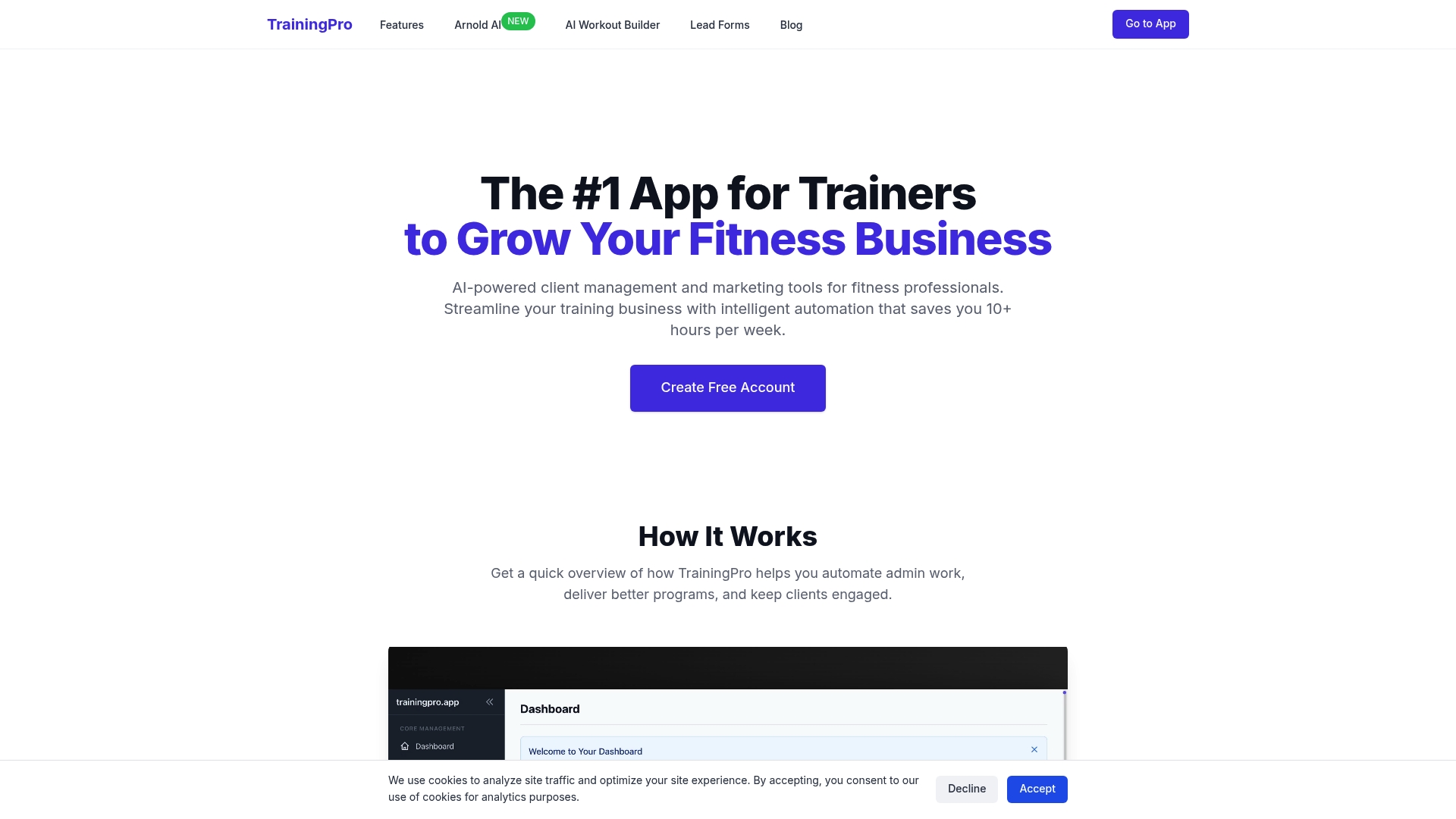
The AI workout builder generates personalized programs based on client goals, fitness level, and any injury considerations, saving you significant time on every new client. Arnold AI goes further, acting as your intelligent planning assistant to adapt programs in real time and keep sessions fresh. And if you want to go deeper on AI-driven programming, the AI-powered guide walks you through exactly how to integrate these tools into your workflow. Plan smarter, coach better, and reclaim the hours you’ve been losing to admin.
Frequently asked questions
Start with health screening, risk assessment, and SMART goal setting, then design a session that balances compound and assistance work, ending with a cool-down. The ACSM-CPT domains confirm that client screening and health history must come before any program design.
Most guidelines recommend reassessing every 4-6 weeks and adjusting based on progress, injuries, or feedback for continual improvement. The ACSM guidelines also recommend building in deloads within that same window to support recovery.
FITT-VP stands for Frequency, Intensity, Time, Type, Volume, and Progression, guiding trainers to tailor exercise prescription for safety and effectiveness. The FITT-VP model is a standard tool for structuring resistance and cardio programming across all client levels.
Linear periodization, which gradually increases intensity and reduces volume, is most effective for beginners, with undulating models working better for intermediates. Linear and undulating models both outperform non-periodized training by up to 31% in strength gains.
Always complete pre-participation screening and adapt routines using lower intensity, alternative exercises, and consult medical guidelines for special populations. The ACSM pre-participation standards require medical clearance for higher-risk clients before any program begins.
Recommended
- Training program creation: personalized approach guide | TrainingPro
- Personal training checklist 2026: streamline success | TrainingPro
- Optimize your fitness consultation workflow in 2026 | TrainingPro
- How to Create Your First Group Training Program (Step-by-Step) | TrainingPro
Ready to Transform Your Fitness Business?
Join thousands of trainers using TrainingPro to automate admin, grow their client base, and focus on what they love—coaching.
Start your 14-day free trial • Cancel anytime


