
Unlock Growth: Why Digital Transformation Matters for Trainers

TL;DR:
- Digital transformation increases gym membership and revenue by automating client management and engagement.
- Implementing phased automation improves retention, accountability, and personalized client experiences.
- Overcoming cost, tech complexity, and preserving personal touch are key to successful digital adoption.
One gym chain made a bold decision to digitize their trainer portal and add nutrition tracking. The result? Members grew 52% from 2,100 to 3,200, retention jumped from 52% to 78%, and they added $420k in annual revenue. That’s not a fluke. It’s what happens when fitness businesses stop patching together manual processes and commit to real digital transformation. If you’re a personal trainer or coach looking to grow your client base, improve retention, and free up your time, this guide breaks down exactly how to make it happen, step by step.
Table of Contents
- Understanding digital transformation in fitness training
- How digital tools empower trainers and clients
- Common roadblocks and how to overcome them
- From strategy to impact: A digital transformation framework
- Maximizing retention and revenue: Applying digital best practices
- What most trainers miss about digital transformation
- Transform your training business with TrainingPro
- Frequently asked questions
Key Takeaways
Understanding digital transformation in fitness training
Digital transformation gets thrown around a lot. But for personal trainers, it doesn’t just mean downloading a new app. It means fundamentally rethinking how your business runs, from how you attract clients to how you deliver programs, track progress, and keep people coming back.
The key distinction here is between digitization and digital transformation. Digitization is converting something analog to digital, like saving a paper workout plan as a PDF. Digital transformation goes further. It’s rebuilding your entire client experience around technology so every touchpoint is more efficient, personalized, and connected.
For trainers, the major areas of transformation include:
- Client management: Automating intake forms, contracts, and scheduling so onboarding is frictionless
- Program delivery: Sending workouts directly to clients through apps, with built-in video demos and progress logs
- Progress tracking: Using data dashboards to monitor client results and adjust programs in real time
- Client engagement: Automating check-in messages, feedback requests, and motivational touchpoints between sessions
The most effective way to start is by mapping your client’s journey from first contact to long-term retention. Where do things slow down? Where do clients fall off? Once you identify those weak spots, you can apply automation strategically.
“Map client journey, automate onboarding, program delivery, check-ins, and billing, then integrate AI for personalization.”
Platforms built for this purpose help you connect those dots without building your own system from scratch. You can also explore our AI workout builder guide or dive into growth strategies for trainers to see where transformation can deliver the biggest lift for your business.
How digital tools empower trainers and clients
Once you understand what digital transformation is, the next question is: what does it actually do for you day to day? The benefits show up on both sides of the trainer-client relationship.
Here’s how the gains stack up in practice:
- Automated onboarding saves hours. Instead of manually sending intake forms, contracts, and program introductions, automated workflows handle it all the moment a client signs up. You spend less time on admin and more time coaching.
- Nutrition and workout tracking drives accountability. When clients log meals and workouts in an app connected to their trainer, they stay on track more consistently. The visibility keeps them motivated and gives you the data to make smart adjustments.
- AI personalization raises client satisfaction. Automated meal and workout plan generators let you deliver tailored programs at scale, without building every plan from scratch. Clients feel like they’re getting personalized attention even between sessions.
- Engagement automations fill the gap between sessions. Scheduled check-in messages, progress nudges, and milestone celebrations keep clients engaged when they’re not in front of you.
The results from real-world adoption back this up. One wellness platform implementation saw retention climb to 78% and membership grow by over 1,000 members after adding a trainer portal and nutrition tracking.

Pro Tip
Set up a simple automated message that fires three days after a client completes their first week of training. A short “How did week one feel?” goes a long way toward building loyalty and catching dropout risk early.
For more on keeping clients engaged through data, check out client tracking for engagement and see how AI for fitness professionals can take your service to another level.
Common roadblocks and how to overcome them
Knowing the advantages is one thing. Actually making the shift is where most trainers hit friction. The good news is these roadblocks are predictable, and solvable.
Here are the most common barriers trainers face:
- Cost concerns: Many trainers assume digital platforms are out of reach financially. Most modern tools offer tiered pricing, and the time savings alone often offset the investment within the first month.
- Learning curve: New software can feel overwhelming, especially if you’re not naturally tech-forward. The fix is to start with one feature, not the whole platform.
- Fear of losing the personal touch: This is the biggest psychological barrier. Trainers worry that automating communication makes them feel robotic. But done right, automation actually frees you up for more meaningful, high-value interactions.
- Data privacy concerns: Clients trust you with sensitive health information. Choose platforms that are HIPAA-aware and clearly communicate their data practices to clients.
The fastest path through these roadblocks is an integrated platform that handles multiple functions in one place. Juggling five separate tools creates more confusion, not less.
Start with the single automation that saves the most time. Automating check-ins and onboarding is often the highest-impact first step.
Pro Tip
Your first automation should be check-in reminders. It takes under 30 minutes to set up and immediately removes a repetitive task from your week. Once that’s running smoothly, layer in the next system.
To explore how automation fits into a scalable business model, visit our guide on fitness business automation and review proven client management strategies that reduce churn.
From strategy to impact: A digital transformation framework
With a clear picture of the roadblocks, let’s walk through a practical framework you can follow to put digital transformation into motion.
The five-stage process:
- Assess your current operations. Map every step of your client journey. Note where you’re doing manual work that could be automated.
- Map your client journey end to end. From lead capture through long-term retention, identify every touchpoint and where clients commonly drop off.
- Choose your platforms. Select tools that cover client management, program delivery, and progress tracking in an integrated way.
- Implement in phases. Start with onboarding automation, then program delivery, then engagement sequences. Don’t try to automate everything at once.
- Optimize continuously. Use your tracking data to identify what’s working and where clients still disengage, then adjust.
Here’s a snapshot of what this framework delivers in practice:
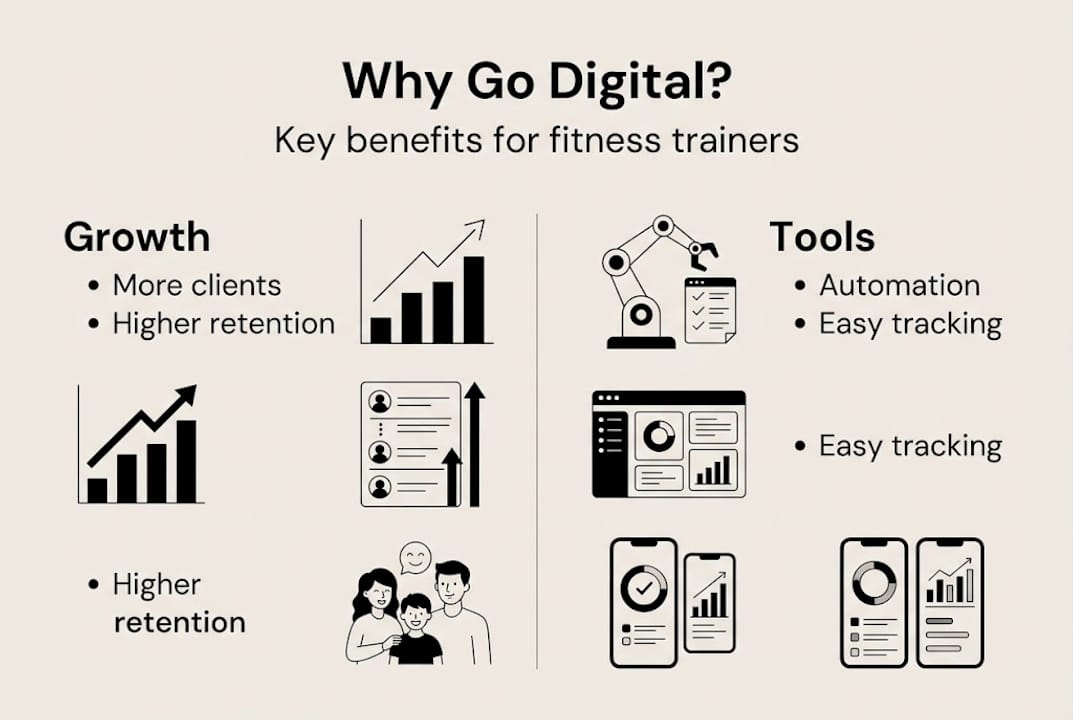
Those numbers come directly from a real-world case study of a gym chain that followed this kind of structured rollout. The 52% membership jump and $420k revenue increase weren’t accidental. They followed from deliberate, phased digital adoption.
You can also apply this framework to improve client retention strategies and leverage built-in workout tracking features to keep clients accountable and motivated throughout.
Maximizing retention and revenue: Applying digital best practices
The framework gets you started. But keeping the momentum going requires applying digital best practices consistently over time.
The connection between digital engagement and client loyalty is direct. Clients who receive consistent, personalized communication stay longer. Those who feel seen and supported between sessions are far less likely to quietly cancel.
Here are the best practices that drive ongoing retention and revenue:
- Automate weekly check-ins. A short message asking how training is going keeps the line of communication open without requiring you to remember to send it manually.
- Use feedback loops. After every program block, send clients a brief survey. Their answers tell you exactly how to improve their experience and your service.
- Make personalized adjustments visible. When you update a client’s program based on their data, tell them. “I noticed your squat numbers have improved, so I’ve progressed your lower body programming” reinforces the value of the relationship.
- Track leading indicators. Don’t wait for a client to cancel. Monitor login frequency, workout completion rates, and response times to your messages. These signals tell you who needs extra attention before it’s too late.
Here’s a sample data view showing post-transformation performance:
Platforms that automate client check-ins and billing make these practices sustainable at any client volume. You can dig deeper into fitness progress tracking and learn specific tactics to retain personal training clients over the long term.
What most trainers miss about digital transformation
Here’s the part most trainers get wrong: they treat digital transformation as a technology project. They compare software, trial platforms, and measure success by how many features they’re using. But that’s not what moves the needle.
The real opportunity is using technology to re-center your business around the client experience. Every automation, every tracking tool, every AI-generated program should exist to make your clients feel better supported, not to replace the relationship you’ve built with them.
The trainers who win long-term are the ones who use tools to eliminate low-value admin so they can double down on high-value coaching. Less time chasing invoices means more time giving genuine feedback. Less time building programs manually means more time refining the ones you have.
Technology is the infrastructure. Your coaching is still the product. When you get that balance right, business growth follows naturally because you’re delivering a better experience at every stage of the client journey.
Transform your training business with TrainingPro
Ready to put these strategies into action? TrainingPro gives you everything you need to digitally transform your fitness business in one place.
From AI-powered program creation with Arnold AI to automated client communication and progress tracking, TrainingPro is built specifically for trainers who want to grow without burning out. Use the AI workout builder to deliver personalized programs at scale, and download our free workout builder guide to see how AI can save you hours every week. The TrainingPro app requires no download and works right from your browser. Start your transformation today.
Ready to Transform Your Fitness Business?
Join thousands of trainers using TrainingPro to automate admin, grow their client base, and focus on what they love—coaching.
Start your 14-day free trial • Cancel anytime
Frequently asked questions
Digital transformation means using technology to streamline operations, enhance client engagement, and personalize fitness programs. This includes automating onboarding, program delivery, check-ins, and billing while integrating AI for tailored client experiences.
Most platforms offer scalable pricing that pays off quickly. One gym’s digital investment helped drive a 52% membership increase and $420k in additional annual revenue, showing strong return even at moderate pricing tiers.
Automated communication, progress tracking, and personalized programming keep clients accountable and motivated. Retention rose to 78% in one case study after a full digital platform was implemented.
Cost, complexity, and fear of losing the personal touch are common concerns. Starting with onboarding automation and choosing an integrated platform reduces friction and makes the transition manageable.
Yes. Evidence from real gym implementations shows members grew by 52% and retention improved by 26 percentage points after structured digital adoption, translating directly to significant revenue growth.
Recommended
- Business tools every trainer needs for growth in 2026 | TrainingPro
- Business growth strategies for trainers in 2026 | TrainingPro
- Master the role of technology in personal training | TrainingPro
- TrainingPro — #1 App for Trainers | Fitness Business Software
- Comment le digital transforme la formation vocale moderne


