
Unified fitness platforms: boost retention and automate coaching

TL;DR:
- Unified fitness platforms consolidate management, coaching, and marketing tools into one system for efficiency.
- They significantly improve client retention, increase revenue, and reduce admin time through seamless data use.
- Compared to gym management software, unified platforms focus on coaching, personalization, and scalable growth.
Running a fitness business often means you’re managing five tools before your first client session even starts. You’re checking one app for schedules, another for payments, a third for workout programs, and somehow squeezing in time for marketing. That’s not efficiency — that’s friction. Unified fitness platforms solve this by consolidating client management, programming, and marketing into a single system, and the results are measurable. Trainers who make the switch see better retention, stronger revenue, and more time to do what they actually love: coach.
Table of Contents
- What is a unified fitness platform?
- Key benefits: From retention to ROI
- Unified vs gym management tools: What’s the real difference?
- AI automation and seamless integrations: The new standard
- Evaluating unified platforms: How to choose for your business
- Why unified fitness platforms are redefining the industry standard
- Ready to transform your fitness business?
- Frequently asked questions
Key Takeaways
What is a unified fitness platform?
A unified fitness platform is exactly what it sounds like. It brings all the core tools of your fitness business together under one login. Client profiles, workout programming, progress tracking, automated marketing, payment processing, and scheduling all live in one connected system.
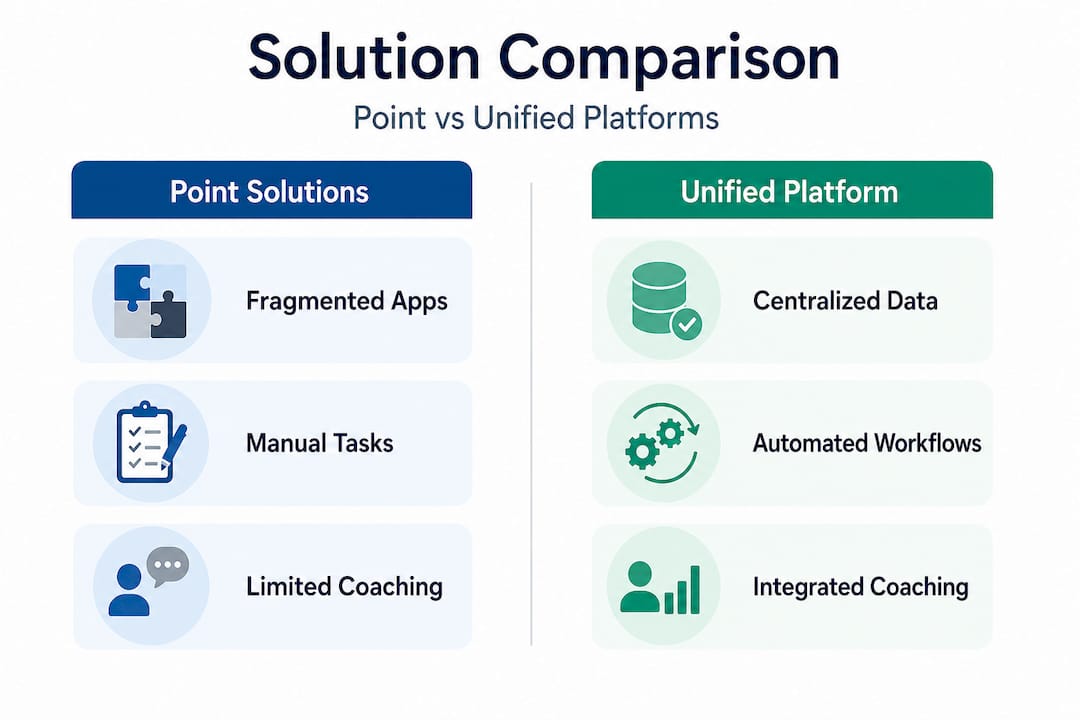
This is fundamentally different from the “point solution” approach most trainers start with. You might use one gym management software for billing, a separate app to deliver workouts, a spreadsheet to track progress, and an email tool for marketing. Each of these tools works fine on its own. But none of them talk to each other, and that’s where the problems start.
When your data is fragmented, your decisions are too. You can’t see at a glance which clients are at risk of dropping off, which programs are producing results, or where your marketing is converting. The benefits of training software go well beyond convenience. They create the foundation for data-driven coaching and scalable business growth.
Core features you’ll find in a true unified platform:
- Client profiles with full training history and health notes
- AI-assisted program creation and auto-scheduling
- In-app messaging and automated check-in reminders
- Integrated payment processing and invoicing
- Lead capture forms and marketing automation
- Progress analytics and performance reporting
To see how this plays out in practice, consider what well-designed fitness mat advantages illustrate in a product sense — the best tools are designed to work seamlessly within a broader setup, not in isolation. The same logic applies to your software stack.
The business case for unification is strong. According to a Nirmitee.io case study, custom wellness management systems helped one platform grow membership from 2,100 to 3,200 members, increase retention from 52% to 78%, and generate an additional $420K in revenue. Unified programs also delivered a 3x ROI alongside a 21% reduction in healthcare costs for member organizations.
Key benefits: From retention to ROI
Once you understand what unified platforms do, the next question is: what do they actually deliver for your business? The short answer is a lot, and the numbers back that up.
Retention is the clearest win. When your clients experience a consistent, connected journey — personalized programs, timely check-ins, and progress they can actually see — they stay longer. The same wellness platform data shows retention rates climbing from 52% to 78% when operators moved to unified systems. That’s not a marginal improvement; it’s a complete transformation of client lifecycle value.
Revenue growth follows retention naturally. More retained clients mean more monthly recurring revenue with no additional acquisition cost. Combined with client retention strategies that are easier to execute inside a unified platform, you’re compounding your results over time.
Key business outcomes trainers report after switching:
- Reduced time spent on admin by 10+ hours per week
- Higher average client lifetime value
- Improved client satisfaction scores and referral rates
- Faster onboarding for new clients
- More consistent programming quality across the board
The use of data analytics is another major factor. When your data lives in one place, you can spot patterns that fragmented tools hide. Which clients are skipping sessions? Which programs generate the best adherence? Which lead sources convert best? A unified platform answers all of these with a single dashboard.
Stat highlight
Unified wellness programs deliver a 3x ROI and a 21% reduction in healthcare costs for member organizations — clear proof that the investment pays off fast.
Pro Tip
Set up weekly automated check-ins inside your platform to stay connected with every client, not just the ones who message you first. Consistent touchpoints are one of the highest-leverage retention moves you can make, and automation makes them effortless.
Unified vs gym management tools: What’s the real difference?
This is a question that comes up constantly, and it matters. Not all platforms are built for the same job. Understanding the difference saves you from investing in the wrong tool.
Gym management software like ZenPlanner does one thing very well: operations. Billing, membership contracts, access control, and class scheduling are its core focus. If you run a large facility, this kind of software is valuable. But it was never designed to help you write better programs, automate client communication, or grow your marketing pipeline.
Trainer-first platforms, by contrast, are built around coaching and client engagement. Tools in this category prioritize programming, progress tracking, AI-generated workouts, and seamless communication. As the Wellhub blog on wellness programs points out, corporate HR platforms like Wellhub focus on employee wellness unification across on-site and digital channels, while trainer platforms like Trainerize emphasize coaching scalability and AI automation. Gym management tools prioritize billing and operations over programming.
Learning to navigate operations vs programming tools is critical for any trainer building a sustainable business.
Use case breakdown by user type:
- Independent personal trainer: Needs client management, AI-assisted programming, automated marketing, and payment tools in one system. Gym management software is overkill and under-delivers on coaching.
- Boutique studio owner: Needs class scheduling and billing, but also needs client engagement and retention tools that go beyond basic admin functions.
- Corporate wellness provider: Needs reporting, compliance tracking, and multi-user management across a distributed workforce, with coaching content layered in.
If you’re a trainer looking for the right fit, reviewing top trainer software options gives you a clear side-by-side view of what’s available and what’s built for your specific workflow.
“The most effective platforms are those that align with the actual job of a fitness professional — not just managing memberships, but transforming how coaches deliver results at scale.”
The takeaway here is simple. If your primary goal is billing efficiency, a gym management tool might suffice. If your goal is to grow a client-centered coaching business, you need a platform built specifically for that purpose.
AI automation and seamless integrations: The new standard
Every serious platform now offers some form of AI. But not all AI features are created equal, and the way you use them matters as much as the features themselves.
True AI automation in a unified platform handles three big categories: programming, scheduling, and marketing. AI can generate workout plans tailored to a client’s fitness level, injury history, and goals in seconds. It can recommend session timing based on client availability patterns. It can draft and send follow-up messages to leads who haven’t converted yet.

Integrations are equally important. A unified platform that connects with wearables like Garmin or Apple Watch can pull in real-time performance data and adjust programming accordingly. Payment integrations remove friction at the purchase point. CRM integrations keep your lead pipeline organized without manual data entry.
As Technogym’s open platform research demonstrates, success in connected fitness hinges on seamless integrations with wearables and payment systems, alongside data-driven insights. It also warns clearly that over-reliance on AI risks producing generic advice, and that hybrid human-AI models consistently outperform pure automation.
What effective AI automation looks like in practice:
- Auto-generated program templates adjusted for individual client history
- Smart scheduling that adapts to cancellations and rescheduled sessions
- Triggered marketing emails based on client engagement signals
- Progress reports delivered automatically at set intervals
- Lead follow-up sequences that run without manual input
Check out some of the latest fitness tech innovations shaping how equipment and software are converging in 2026. The integration between physical tools and digital platforms is accelerating fast.
For deeper guidance on putting this into practice, exploring AI workflow tips and program customization strategies will give you a concrete starting point.
Pro Tip
Always review AI-generated programs before sending them to clients. The AI handles the structure and volume calculations, but your professional eye catches the nuance: how a client moved last week, what they mentioned about their shoulder, and whether they’re emotionally ready to push harder this cycle.
“The trainers who win with AI are the ones who use it to amplify their expertise, not replace it.”
Evaluating unified platforms: How to choose for your business
With so many options available, choosing the right unified platform comes down to a clear evaluation framework. Don’t get distracted by feature lists. Focus on what your business actually needs today and what it will need in 12 months.
Platforms like the custom wellness systems studied by Nirmitee.io show that the right unified system dramatically accelerates growth, but only when it’s matched to the operator’s specific context and scale. And as Technogym’s research reinforces, the platforms that produce the best outcomes are those built on solid integrations and smart data use.
Must-have features to look for:
- Client management with complete profile history
- AI-powered program creation and customization tools
- Automated marketing with lead capture and follow-up
- Wearable and payment integrations
- Progress tracking with visual reporting
- Scalable pricing that grows with your client base
Steps to migrate from legacy tools to a unified system:
- Audit your current stack. List every tool you use, what it costs, and what it actually does. Identify redundancies and gaps.
- Export your client data. Most platforms allow CSV exports. Gather all client profiles, program history, and payment records before switching.
- Choose your platform and run a pilot. Test with 5 to 10 clients for 30 days. Measure onboarding friction and client response.
- Set up automations before you go live. Build your check-in sequences, marketing funnels, and program templates first so the system works from day one.
- Transition remaining clients in batches. Move groups of clients over weekly so you can troubleshoot without disrupting your entire book of business.
- Review data at 60 and 90 days. Track retention, engagement, and revenue against your pre-platform baseline.
Understanding why custom training programs are central to long-term client results also guides your platform selection. If the tool can’t support true personalization at scale, it’s not the right fit.
Why unified fitness platforms are redefining the industry standard
Here’s an honest take that most articles won’t give you: the fitness industry has a tool addiction problem. Every year, new apps promise to fix one specific problem, and trainers add them to an already overcrowded stack. The result is more complexity, not more capability.
The shift to unified platforms isn’t just a tech trend. It’s a correction. The trainers and studios that are growing fastest right now are the ones who stripped back their tools and rebuilt around a single, connected system. They’re not spending time on data exports and manual syncing. They’re spending time coaching.
What makes this even more interesting is the human factor. Every instinct says more automation equals less personal connection. But the data says the opposite. When you free yourself from 10 hours of admin work per week, you have 10 more hours for the relationship-building that actually drives deeper client engagement and word-of-mouth referrals.
The Technogym platform research is clear on this point. Hybrid human-AI models outperform pure automation every time. The technology handles the structure. You provide the judgment, the empathy, and the accountability that no algorithm can replicate.
The future of fitness business isn’t more apps. It’s fewer, better-connected systems that put the trainer-client relationship at the center of every workflow.
Ready to transform your fitness business?
If you’ve been stitching together too many tools and watching time disappear into admin work, there’s a better path forward. TrainingPro is built specifically for fitness professionals who want a unified system that handles the business side while they focus on coaching.
With TrainingPro, you get an AI assistant for trainers that builds personalized programs in seconds, an AI workout builder that adapts to each client’s unique needs and history, and a complete fitness software platform that combines client management, marketing, and progress tracking. No app downloads required. No fragmented stack to manage. Just one connected system that grows with your business and keeps your clients engaged from day one.
Ready to Transform Your Fitness Business?
Join thousands of trainers using TrainingPro to automate admin, grow their client base, and focus on what they love—coaching.
Start your 14-day free trial • Cancel anytime
Frequently asked questions
Unified platforms enable more consistent and personalized client engagement, which has been shown to boost retention rates from as low as 52% up to 78% in real-world implementations.
Unified fitness platforms combine coaching tools, AI programming, marketing automation, and analytics in one system, while gym management tools like ZenPlanner prioritize billing and operations over coaching functions.
Yes. Modern unified platforms support seamless wearable and payment integrations, pulling real-time client data into your dashboard while streamlining the financial side of your business automatically.
Not if you use it correctly. Hybrid human-AI models consistently outperform pure automation, so your expertise and relationship skills remain the most valuable part of the coaching experience.
Recommended
- Engage your fitness clients: proven strategies for lasting retention | TrainingPro
- How to grow gym clientele: proven strategies to boost retention | TrainingPro
- Why track fitness progress: boost client engagement | TrainingPro
- Digital fitness workflows: AI automation saves 10+ hours | TrainingPro
- 7 Winning Paid Media Campaign Examples for CrossFit Gyms


